Français (France)
  Nederlands (nl-NL)
 00:00 • intro | 00:47 • in the streets of the modern city | 01:54 • some religious buildings | 05:00 • Leh Palace | 05:52 • in the alleys of the old town | 08:03 • some shops in the old town | 12:13 • some street vendors | 16:18 • Gompa Tsemo Maitreya
Personal creation from visual material collected during my trip Unknown India • Ladakh, Karnataka, Telangana (2022)
Map of places or practices in Leh on this site
• Use the markers to explore the content •
Leh: Urban Structure and Cultural Crossroads in Ladakh
A high-altitude capital between history and modernity
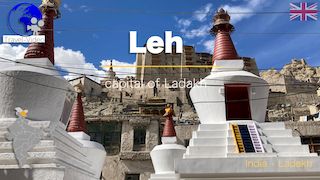
Situated in the Indus Valley at over 3,500 meters above sea level, Leh stands as the main urban center of Ladakh. Once the capital of a Himalayan kingdom, the city continues to play a central role in the region’s administrative, economic, and cultural life. Its location reflects a long-standing balance between environmental constraints and human adaptation, where urban forms reveal both historical continuity and recent transformations.
The video offers an immersive exploration of this multifaceted city, where modern streets, historical quarters, religious buildings, and everyday activities coexist. By linking these elements, it presents Leh not as a static place, but as a dynamic urban environment shaped by multiple influences.
Urban spaces, religious diversity, and daily life
The modern streets of Leh illustrate the city’s ongoing evolution. Recent constructions, commercial activity, and infrastructure reflect increased connectivity and economic change, while still adapting to the realities of high-altitude living. The urban fabric expands outward, yet retains traces of older spatial organization.
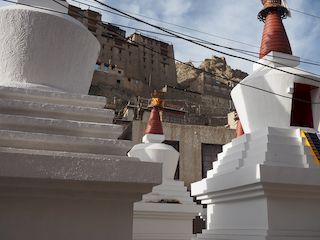
Religious buildings form an essential component of the cityscape. The Jama Masjid Mosque Leh reflects the historical presence of Islam, while the Gurdwara Sri Datun Sahib is associated with Sikh traditions linked to the journeys of Guru Nanak. These sites, integrated into the city, illustrate a coexistence of religious practices that has shaped Leh’s identity over time.
Overlooking the city, the Leh Palace remains a dominant architectural landmark. Built in the seventeenth century and inspired by Tibetan models, it embodies the former seat of royal power and offers insight into the city’s historical organization. Nearby, the Tsemo Gompa Maitreya occupies a strategic position on higher ground, reinforcing the spiritual dimension of the landscape.
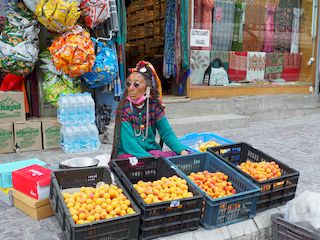
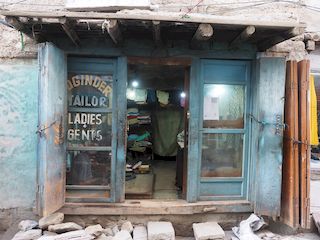
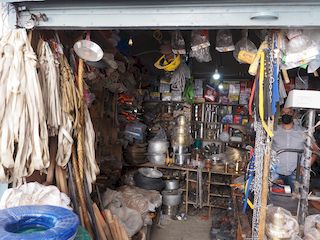
In contrast, the narrow lanes of the old town preserve a more traditional urban atmosphere. Dense construction, limited space, and locally adapted building techniques define this area, where small-scale commerce remains active. The presence of street vendors highlights a form of everyday economy rooted in proximity and continuity.
Historical development and urban organization
Leh developed over centuries as a hub of exchange between Central Asia, Tibet, and the Indian subcontinent. Its position along trans-Himalayan trade routes contributed to the growth of a city structured around commerce, governance, and religious institutions. The royal palace, constructed during a period of political consolidation, reflects this historical role.
The city’s spatial organization continues to bear the imprint of these developments. Older neighborhoods are concentrated along the slopes, with buildings made from earth and stone, designed to withstand temperature variations and limited resources. More recent expansions spread across flatter areas, reflecting demographic growth and economic change.
Culturally, Leh is defined by its diversity. Buddhism, Islam, and Sikhism coexist within a relatively compact urban space, shaping both the architectural landscape and daily life. This diversity is not only visible in monuments, but also in social practices and urban interactions.
A visual approach that reveals spatial complexity
The videos on this site provide a structured way to understand such an environment. Built largely from carefully selected and animated photographs, they allow for a detailed observation of architectural features, urban textures, and spatial relationships. This approach slows down the viewing process and encourages a more precise reading of the city.
The progression of images guides the viewer from modern streets to older quarters and then toward elevated viewpoints. This sequence clarifies how different parts of the city relate to one another, how circulation is organized, and how the urban fabric connects to the surrounding landscape. The result is a clearer perception of Leh as a layered and coherent whole.
A city shaped by continuity and transformation
Leh emerges as a place where historical legacy, religious diversity, and contemporary change intersect. Its urban landscape reflects both enduring traditions and ongoing adaptation, forming a complex yet balanced environment.
Further exploration through the detailed pages dedicated to its monuments and traditions provides deeper insight into the structures and practices that define this key city of Ladakh.
Links to related pages
• Main dynasties that ruled the region •


Audio Commentary Transcript
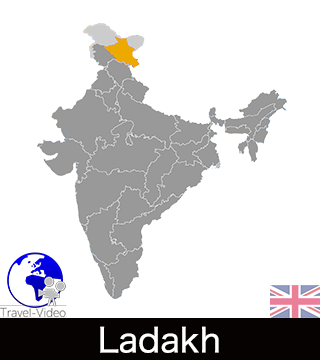
Formerly a stopover on one of the silk roads in the Indus Valley, at an altitude of 3500 meters, Leh was the capital of the ancient kingdom of Ladakh and is today a city with a rich cultural past. It is nonetheless a very small city on an Indian scale, with some 30,000 inhabitants, which does not prevent it from being the most important city in Ladakh, which became a Union Territory in 2019, whereas until then was part of the state of Jammu and Kashmir.
Like all historic cities, Leh has a modern district with shopping streets where locals, but especially tourists, like to stroll.
In Leh, there are also many religious buildings. Since Ladakh is predominantly Buddhist, it is not surprising that there are many stupas (called "chorten" in the region) and a few Buddhist temples. The city also has several mosques as well as a Gurdwara.
On the other hand, there are no Hindu temples, even if in recent years a large Indian military contingent has been based at the gates of the city. It is likely that the Hindu temples found in Leh are more discreet than those of other religions.
Wherever one is in Leh, the Old Royal Palace (known as Leh Palace, or "Lhachen Palkhar"), built in the early 17th century, and in ruins today, is ubiquitous. The location of this palace was not chosen at random. Its dominant position, perched on top of a steep hill, gave it a panoramic view of the city, which offered defensive advantages.
But the old town of Leh is not only made of narrow and deserted alleys. The city has kept the memory of the trade of yesteryear, when it was an important stop on the Silk Road.
During the harvest season, the farmers of the region come to offer their products in town. It is mostly women who sell their fruits and vegetables in the busy streets of the modern city, sitting on the sidewalk and telling each other the latest gossip between two customers.
On one of the hills surrounding Leh, near the old Royal Palace is a monastery dating from the same period as the palace, in the 15th century, the Gompa Tsemo Maitreya. In the Buddhist religion, we speak of Maitreya to designate the future Buddha. If Siddhartha Gautama is known as the current Buddha, Buddhism teaches that the world will know many Buddhas. Maitreya is therefore the Buddha "on standby" in the world of the gods, in case men forget the teaching of universal truth, called Dharma in Buddhism.

Music:
- - YouTube video library - AchillesIn Memory of Jean Talon - The Mini Vandals, (© Alchemists Tower - Strings by Kevin MacLeod is licensed under a Creative Commons Attribution 4.0 license. https://creativecommons.org/licenses/by/4.0/
- Source: http://incompetech.com/music/royalty-free/index.html?isrc=USUAN1100632
- Artist: http://incompetech.com/)
- - YouTube video library - Alone
- - YouTube video library - Carol of the Bells
- - YouTube video library - Dissappointment, (© Dissappointment by Kevin MacLeod is licensed under a Creative Commons Attribution 4.0 license. https://creativecommons.org/licenses/by/4.0/
- Source: http://incompetech.com/music/royalty-free/index.html?isrc=USUAN1100481
- Artist: http://incompetech.com/)
- - YouTube video library - Heavy Interlude, (© Heavy Interlude by Kevin MacLeod is licensed under a Creative Commons Attribution 4.0 license. https://creativecommons.org/licenses/by/4.0/
- Source: http://incompetech.com/music/royalty-free/index.html?isrc=USUAN1100515
- Artist: http://incompetech.com/)
- (Live Music) - - Live_Hemis gompa
- - YouTube video library - Murder Mystery
- - YouTube video library - People Watching
Disclaimer: Despite its appropriateness, copyright issues prevent the use of indian traditional music in "Leh, the capital of Ladakh • India", hence the use of royalty-free music. Despite our careful selection, some might regret this decision, which is necessary to avoid potential lawsuits. Although difficult, this decision is the only viable solution.