Français (France)
  Nederlands (nl-NL)
 Street vendors in Leh, located in the Ladakh region of northern India, represent a form of urban commerce connected to the daily movement of residents, travelers, and traders within the Himalayan town. Positioned along streets, public squares, and busy pathways, these vendors offer a wide range of goods including food, drinks, handicrafts, and everyday items. Their activity reflects a flexible local economy based on direct transactions and small-scale trade. Street vendors contribute to the liveliness of public spaces and provide convenient access to goods for both local inhabitants and visitors, complementing the services offered by permanent shops and markets.
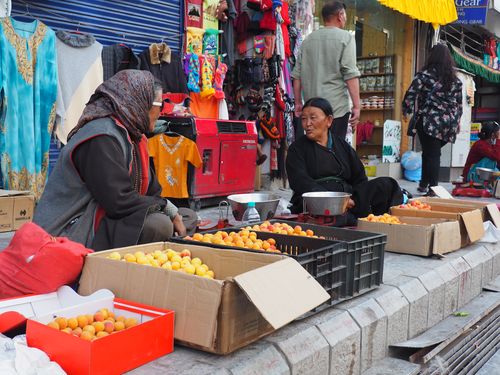
Leh • Street vendors
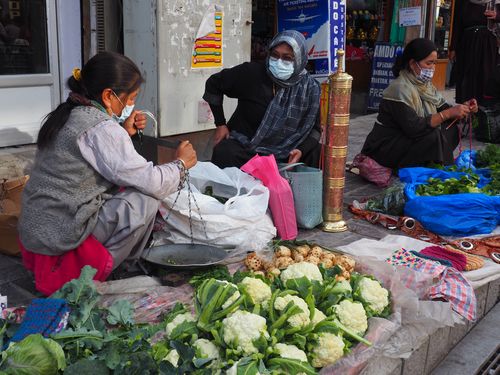
Leh • Street vendors
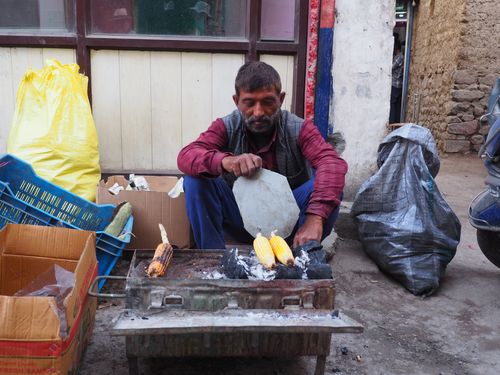
Leh • Street vendors
Tradition profile
Street vendors
Tradition category: Local market
Tradition family: Traditional markets and fairs
Tradition genre: Trade and Local Creativity
Geographic location: Leh • Ladakh •
• Links to •
• List of videos about Leh on this site •
Leh, the capital of Ladakh • India
The Tradition of Street Vendors in Leh – History of a Living Economic Culture in Ladakh
The tradition of street vending in Leh, capital of the Ladakh region in northern India, has deep historical roots linked to the area’s geographical position and cultural exchanges. Situated along ancient trans-Himalayan trade routes connecting India, Tibet, and Central Asia, Leh developed as a natural trading hub. Its open-air markets and street vendors emerged not as marginal activities but as essential components of a regional economy based on barter, seasonal exchange, and human interaction.
Political and Social Context of Emergence
The origins of street vending in Leh date back several centuries, when the city was a vital stop on the caravan routes linking Kashmir and Tibet. Political stability under the Namgyal dynasty (16th–17th centuries) encouraged trade by providing safe passage to merchants and establishing taxation systems adapted to the mobility of caravans. These rulers recognized the importance of commerce not only as a source of revenue but also as a symbol of Ladakh’s openness to surrounding cultures.
The early markets were held in open spaces near monasteries or crossroads where merchants could display local products such as barley, yak butter, wool, and salt, and exchange them for goods from distant lands—tea, spices, silk, and turquoise. This informal yet organized system relied on mutual trust rather than written contracts. Socially, the activity involved both men and women, with women frequently handling local produce while men engaged in long-distance trade.
Religious factors also played a role in the formation of this tradition. The Buddhist monastic economy, centered on donations and redistribution, fostered periodic gatherings where trade naturally developed. These market days became social as well as economic events, reinforcing solidarity among valley inhabitants.
Major Historical Events Shaping the Tradition
The decline of the caravan routes during the 19th century, following British expansion in the Indian subcontinent, reshaped local commerce. The annexation of Ladakh by the Dogra rulers of Jammu and Kashmir in 1834 brought new administrative regulations and taxes, but also restricted cross-border trade with Tibet. Many merchants who had relied on long-distance exchanges turned toward local markets, reinforcing the role of street vending as a survival mechanism.
After India’s independence in 1947, and especially following the 1962 Sino-Indian war, the closing of northern routes ended centuries of trans-Himalayan trade. Leh’s economy had to reinvent itself. Street vendors, who once catered to caravans, began to serve the needs of the local population and the Indian army stationed in the region.
In the 1970s, the opening of Ladakh to tourism initiated another transformation. Western travelers, seeking authenticity and mountain culture, began frequenting Leh’s bazaars. Vendors adapted quickly, diversifying their goods: alongside vegetables and dairy products appeared handcrafted jewelry, thangkas, woolen scarves, and Tibetan-inspired artifacts. This adaptation illustrates the resilience and creativity of the local population, capable of transforming a traditional practice into a modern livelihood.
Global Context and Comparative Perspectives
The phenomenon of street vending in Leh fits into a global pattern of informal economies in mountainous or marginal regions. Similar markets exist in Nepal, Peru, or Morocco, where geography limits infrastructure and formal trade systems. These spaces provide access to essential goods, create community interaction, and preserve traditional knowledge.
Leh’s case, however, stands out for its fusion of Buddhist ethics, self-sufficiency, and openness to the outside world. While global capitalism often marginalizes informal vendors, in Ladakh this system persists as a marker of cultural identity. The mixture of barter traditions and modern monetary exchange illustrates a balance rarely achieved elsewhere.
Transformations and External Influences
Over the last decades, urban growth, tourism, and modernization have changed the appearance and organization of street vending. Once temporary and mobile, vendors now occupy semi-permanent stalls along Leh’s main bazaar and near religious or tourist sites. Wooden carts and plastic tarps have replaced traditional baskets and yak-hair tents, while the range of products has expanded to include souvenirs, electronics, and imported goods.
These changes reflect both economic necessity and the impact of globalization. The influence of traders from the Kashmir Valley introduced new business techniques and products. At the same time, environmental and municipal regulations have begun to limit informal trade in some areas. Yet, despite these pressures, the essence of the tradition endures: direct human contact, oral negotiation, and adaptability.
Women continue to play a prominent role, especially in selling vegetables, dairy, and textiles. Their participation reflects broader social changes, giving them visibility and economic autonomy in a society where gender roles were traditionally distinct. Street vending also serves as an entry point for rural migrants seeking livelihoods in Leh’s growing economy.
Social Organization and Community Impact
The structure of Leh’s street markets mirrors the city’s ethnic and religious diversity. Ladakhis, Baltis, Tibetans, and Kashmiri migrants coexist and trade side by side, creating a dynamic social mosaic. The bazaar acts as a neutral meeting ground, where commerce bridges differences of language, religion, and origin.
Within the community of vendors, solidarity networks are strong. Families often share spaces, and experienced traders mentor newcomers. The market is also an intergenerational institution: children help parents, learn arithmetic and communication skills, and absorb values of patience and cooperation. In this sense, street vending functions as an informal educational system embedded in daily life.
Beyond the economic sphere, these markets have symbolic importance. They embody the Ladakhi ethos of self-reliance (drokpa) and communal harmony. The act of exchange reinforces social bonds and preserves the rhythm of traditional life amid modernization.
Statistics, Anecdotes, and Local Narratives
No official census exists, but estimates suggest several hundred vendors operate seasonally in Leh, mainly between May and October. Their numbers fluctuate with tourism and agricultural cycles. Many families depend entirely on this activity during the summer months.
Oral histories mention how, before the closure of the border with Tibet, traders from across the plateau would meet in Leh’s bazaar, transforming it into a microcosm of Central Asian commerce. Older inhabitants recall markets so dense that one could cross the main street walking over the edges of the stalls. Such memories persist as symbols of prosperity and exchange.
Contemporary Role and Cultural Importance
Today, street vending remains a vital part of Leh’s urban and cultural landscape. It sustains local livelihoods, shapes the city’s atmosphere, and attracts visitors seeking an authentic experience of Himalayan life. The practice reflects a coexistence between traditional self-sufficiency and the pressures of modern commerce.
For many Ladakhis, the street market represents more than an economic activity—it is a living space of interaction, where news circulates, friendships form, and cultural continuity is maintained. The persistence of this practice illustrates the community’s ability to adapt without losing its identity.
Current Preservation and Future Challenges
Urbanization, tourism infrastructure, and changing consumption patterns threaten the survival of traditional street vending. Younger generations, drawn to formal employment or digital commerce, show less interest in continuing the family trade. Climate change also affects agricultural production, indirectly impacting the supply of local goods.
Nevertheless, local authorities and NGOs have begun promoting sustainable markets that respect both tradition and hygiene standards. Some initiatives aim to register street vending as part of Ladakh’s intangible cultural heritage, while others organize weekly markets dedicated to local producers.
Though not yet recognized by UNESCO, the tradition of street vendors in Leh stands as a living example of human adaptability, resilience, and social cooperation. It preserves the values of exchange, trust, and mutual support that have long defined life in the Himalayas, linking past and present in the rhythm of everyday commerce.
The Tradition of Street Vendors in Leh – Structure, Practice, and Cultural Meaning
The tradition of street vending in Leh, the main urban center of Ladakh in northern India, represents far more than a simple economic activity. It is a form of social interaction and cultural continuity that has evolved over centuries, shaped by geography, religion, and community life. The practice reflects Ladakh’s identity as a crossroads of Himalayan civilizations, where mobility, resilience, and cooperation remain central to everyday existence.
Origin and Context of Emergence
Street vending in Leh developed within a setting defined by isolation and interdependence. The harsh environment of the high Himalayas, where agricultural production is limited and transport difficult, encouraged systems of local trade based on exchange and mutual trust. Historically, Leh stood at the intersection of caravan routes linking Tibet, Central Asia, and the Indian plains. Markets emerged naturally wherever people gathered—near monasteries, trade routes, and seasonal festivals—providing essential goods and fostering social cohesion.
Politically, during the Namgyal dynasty (16th–17th centuries), Leh flourished as a regional trading capital. The state encouraged commerce through moderate taxation and protection of traders. Street vendors, often small-scale farmers or artisans, complemented long-distance trade by providing daily supplies to residents and travelers. Over time, this activity became integrated into local social organization, forming a bridge between rural producers and urban consumers.
Religiously, the Buddhist worldview of Ladakh shaped the moral dimension of commerce. Exchange was not seen merely as profit-seeking but as a form of interdependence (pratītyasamutpāda)—a reflection of human solidarity. This spiritual underpinning explains why street vending, even when informal, has long been viewed as a legitimate and respected part of life.
Constituent Elements and Practices
Street vending in Leh is characterized by simplicity, adaptability, and a close relationship between people and place. Vendors set up temporary stalls along the main bazaar, near temples, bus stands, and tourist areas. Their setups are modest: woven mats, wooden tables, or small carts displaying vegetables, dairy products, spices, fabrics, or handmade jewelry. The act of arranging, calling out prices, and negotiating forms a choreography repeated daily—a skill learned by observation and practice rather than formal instruction.
Women play a significant role, especially in selling local produce such as barley, peas, apricots, and butter. Men are often more involved in itinerant trade, offering goods that require travel, like wool, carpets, or imported handicrafts. Seasonal variation is also crucial: the markets thrive in summer when roads are open and agricultural surpluses can be sold, but contract sharply during the long winter months.
The gestures and sounds of the market—scales balancing, hands measuring grain, voices bargaining—constitute an oral and visual culture in themselves. These interactions transmit both economic and ethical knowledge: how to price fairly, how to maintain relationships, and how to read a customer’s needs.
Symbolism and Social Meaning
The tradition carries multiple symbolic dimensions. It reflects values of moderation, reciprocity, and resilience that are deeply rooted in Ladakhi life. The market is a space of equality where hierarchies blur—monks, farmers, and tourists may all stand side by side to buy and sell. This egalitarian quality reinforces the Buddhist ideal of community interdependence and the idea that economic activity can also be a moral act.
Colors and materials used in the market have symbolic resonance. The earthy tones of wool and grains, the saffron of apricots, and the red of chili peppers echo the natural palette of Ladakh’s landscape and its monastic art. Sound, too, carries meaning: the market’s steady murmur represents vitality and continuity, while silence in the off-season signals the cyclical rhythm of Himalayan life.
Evolution and External Influences
Over time, street vending in Leh has adapted to changing political and economic realities. The closure of the Tibetan border after 1962 ended centuries of caravan trade, forcing communities to reorient their economies inward. During the 1970s, with the arrival of tourism and road access from the Indian plains, the character of the markets began to shift. Vendors started catering to visitors as well as locals, selling woolen hats, silver ornaments, and Buddhist souvenirs.
This transition introduced new materials, currencies, and techniques. Plastic replaced handmade baskets; bargaining became multilingual; and the once purely subsistence economy acquired a commercial dimension. Yet, despite these transformations, the practice maintained its human scale and face-to-face intimacy.
Comparatively, Leh’s street markets resemble those of Nepal’s Kathmandu or Bhutan’s Thimphu, where similar balances between local life and tourism exist. The distinctiveness of Leh lies in its blend of Buddhist ethics and frontier adaptability—values that have allowed this tradition to persist through political upheavals and cultural change.
Social Organization and Community Impact
Street vending in Leh is not only an individual occupation but a social system. Vendors often work in extended family units, passing down stalls or trading spots from one generation to another. Informal associations exist among sellers, helping them share information, protect prices, and resolve conflicts without formal intervention.
The market also functions as a cultural meeting point. Ladakhis, Kashmiris, and Tibetans trade side by side, illustrating the plural character of the region. Religious diversity is visible, yet peaceful coexistence prevails: Muslim traders from Kargil may sell spices next to Buddhist women from nearby villages offering vegetables or butter. Such interactions strengthen social cohesion and mutual understanding in a multi-ethnic environment.
Economically, street vending supports hundreds of households in Leh, particularly those without access to formal employment. For women, it offers financial independence; for rural families, a way to maintain contact with the city; for youth, a stepping stone toward entrepreneurship.
Statistics, Anecdotes, and Oral Memory
Reliable statistics are rare, but estimates suggest that during the tourist season, up to 500 vendors operate in Leh’s main market and surrounding streets. Many are part-time traders combining agriculture with seasonal commerce. Elderly residents still recall earlier times when caravans from Yarkand or Lhasa converged at Leh’s bazaar, bringing silk and turquoise. These memories are preserved in family stories and local songs that celebrate trade as both livelihood and adventure.
A well-known anecdote recounts how, in the early 20th century, the Ladakhi royal family would walk through the bazaar each year during Losar, the New Year festival, purchasing symbolic goods from local vendors as a gesture of prosperity and goodwill. This ritual emphasized the unity between rulers and people, linking governance and trade through mutual respect.
Recognition and Preservation Challenges
While not officially recognized by UNESCO or national heritage registers, the tradition of street vending in Leh is widely acknowledged as a cornerstone of local identity. It embodies the adaptability of Himalayan societies to modern change while preserving their communal ethos.
However, challenges are mounting. Urban expansion, stricter municipal regulations, and the growing dominance of permanent shops threaten to marginalize street vendors. Younger generations are increasingly drawn to education and salaried employment, leaving fewer successors to continue this informal trade.
Local authorities have begun to respond with designated vending zones and weekend markets designed to preserve both tradition and urban order. Non-governmental initiatives also encourage tourists to buy from small vendors to sustain local livelihoods. Discussions on intangible heritage preservation have emerged, emphasizing the need to document this practice before it fades.
In a rapidly modernizing region, the street vendors of Leh continue to represent an enduring form of cultural resilience. Their presence in the city’s streets not only sustains economic life but also keeps alive a collective memory of exchange, coexistence, and simplicity—values that have defined Ladakh for centuries.
 Links to the main sections of the site