Français (France)
  Nederlands (nl-NL)
 The ceremony at Likir Monastery, located in the Indian state of Ladakh, represents a living expression of Tibetan Buddhism as practiced in this Himalayan region. It gathers monks and devotees in structured rituals composed of prayers, chants, and symbolic gestures, following a well-established liturgical calendar. These gatherings foster spiritual harmony, the transmission of teachings, and communal unity. The sound of traditional instruments, the scent of incense, and the display of thangkas and ritual offerings create a solemn yet vibrant atmosphere. The ceremony highlights the monastery’s role as a religious, educational, and social hub, emphasizing the Buddhist ideals of compassion and wisdom. For both locals and visitors, it embodies the enduring presence of spiritual traditions that shape the cultural fabric of Ladakh.
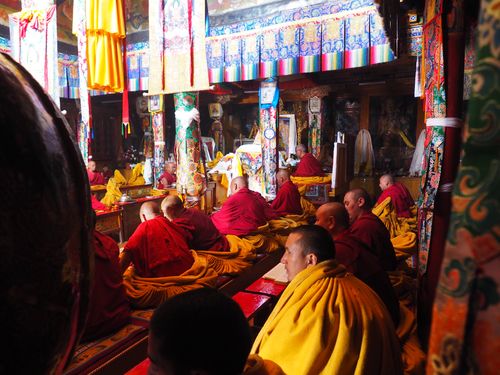
Likir • Ceremony at the monastery
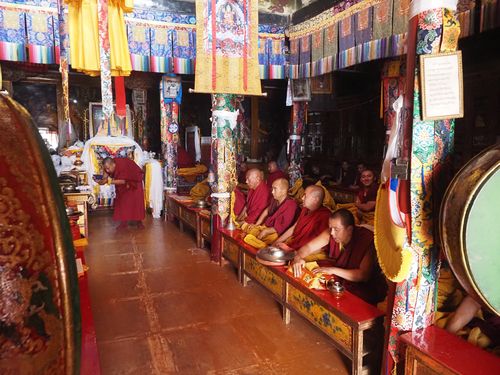
Likir • Ceremony at the monastery
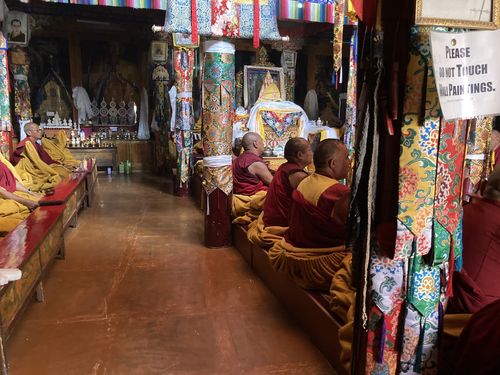
Likir • Ceremony at the monastery
Tradition profile
Ceremony at the monastery
Tradition category: Buddhist celebrations
Tradition family: Religious traditions
Tradition genre: Religious Festivals and Celebrations
Cultural heritage: Buddhist
Geographic location: Likir • Ladakh • India
• Links to •
• List of videos about Likir on this site •
Likir Gompa • Ceremony, monks and Buddhist paintings
The Monastic Ceremony of Likir — History, Evolution, and Cultural Continuity in the Ladakh Himalayas
The monastic ceremony practiced at Likir Monastery, one of the oldest religious institutions in Ladakh, represents more than a devotional act: it embodies centuries of political balance, social cohesion, and spiritual resilience within the high-altitude Buddhist world of the western Himalayas. Rooted in the Gelugpa tradition of Tibetan Buddhism, this ritual practice reflects both local adaptation and trans-Himalayan continuity. Through the centuries, the ceremony has remained a means of spiritual purification, community affirmation, and cultural preservation in a region shaped by isolation and exchange alike.
Political and Social Context of Emergence
The tradition of monastic ceremonies at Likir emerged during the re-establishment of Buddhism in Ladakh around the 11th century, a period of renewed religious vitality following earlier centuries of decline. This revival was linked to the “Second Diffusion” of Buddhism from Tibet, which saw scholars, translators, and monks spreading tantric doctrines and monastic discipline throughout the Himalayan world.
Likir Monastery, traditionally attributed to the reign of King Lhachen Gyalpo (circa 1065), was founded under royal patronage as part of a broader political strategy. The rulers of Ladakh sought to consolidate their authority by aligning themselves with the powerful spiritual lineages of Tibetan Buddhism, particularly the Gelug school, which emphasized monastic discipline, philosophical study, and moral order. The ceremonial life of Likir thus served a dual function: the spiritual regeneration of the faithful and the symbolic reinforcement of political legitimacy through religion.
Socially, these rituals unified a dispersed population across harsh mountain terrain. The monastic ceremony, performed at fixed times of the year, offered a shared reference point for village communities, traders, and pilgrims. Participation in these events—whether through offerings, service, or prayer—was seen as an act of merit, reaffirming both individual piety and collective belonging.
Historical Milestones and Transformations
Over its long history, the monastic ceremony of Likir has been influenced by successive political and cultural transformations. During the Namgyal dynasty (16th–19th centuries), Ladakh experienced a period of artistic, religious, and economic flourishing. The rulers actively promoted monastic education and ritual practice, viewing them as instruments of governance and diplomacy. The major festivals of Likir, featuring masked dances (cham), symbolic exorcisms, and communal prayers, were codified during this time to coincide with agricultural and calendrical cycles.
The 19th century brought new challenges. The Dogra conquest of Ladakh (1834–1842) and subsequent integration into the princely state of Jammu and Kashmir disrupted traditional patronage networks. Yet, despite these upheavals, the monastic system remained resilient. The ceremonies, no longer dependent solely on royal support, came to rely increasingly on local communities for material and spiritual sustenance.
The 20th century introduced another phase of adaptation. British influence and the later incorporation of Ladakh into independent India (1947) exposed the region to administrative modernization and changing cultural dynamics. During the Indo-China conflict of 1962 and the isolation that followed, Likir and other monasteries became key custodians of cultural memory. Rituals, once confined to monastic walls, began to acquire new meanings as symbols of identity and continuity for Ladakh’s Buddhist population.
Global Context and Cultural Parallels
When the ceremony of Likir first took form, similar developments were unfolding across Asia. In medieval Japan, Zen monasteries institutionalized ritual discipline; in Southeast Asia, Theravāda monastic orders shaped civic life through calendrical festivals. The Ladakhi ceremony fits within this broader pattern of Buddhist ritualism, where liturgy, performance, and doctrine are fused into a comprehensive moral and cosmic order.
Like European monastic processions of the same era, the ceremonies at Likir combined pageantry with pedagogy: their purpose was not merely to display devotion but to teach moral principles through spectacle, sound, and rhythm. The presence of musicians, dancers, and reciters turned the ritual into a form of sacred theater, one that conveyed complex philosophical ideas—impermanence, compassion, and the victory of wisdom over ignorance—through accessible, sensory expression.
Evolution of Practices and Ritual Forms
Over time, the ceremonial practice of Likir evolved to reflect both continuity and change. The core ritual structure—a sequence of prayers, offerings, visualizations, and chants—has remained stable for centuries. However, the materials and audiences have changed. Earlier, the rituals were performed exclusively for the local faithful; today, they also attract lay visitors and international observers seeking cultural immersion.
Certain ritual elements have adapted to modern realities. The introduction of printed scriptures replaced hand-copied manuscripts, ensuring textual fidelity and accessibility. Musical ensembles now include standardized instruments, but the melodies and rhythms remain faithful to traditional Tibetan notation. The choreography of the cham dance, transmitted orally, continues to be rehearsed under the supervision of senior monks, who emphasize precision in gesture and symbolism.
Despite modernization, the ceremony retains its esoteric dimension. Each element—the color of the robes, the arrangement of butter lamps, the circular motion of dancers—corresponds to an intricate cosmology derived from Vajrayana Buddhism. The performers are not entertainers but mediators of divine forces, believed to purify the monastery and the surrounding world.
Social Organization and Communal Function
Within Ladakh’s social fabric, the ceremony at Likir plays a vital integrative role. It is both a religious obligation and a social gathering that reinforces intergenerational ties. Monks of different ranks—abbot, senior lamas, novices—perform distinct duties, reflecting the hierarchical yet collective ethos of monastic life. Villagers contribute food, textiles, and monetary offerings, reaffirming the reciprocal bond between the monastery and the laity.
For local families, participation brings spiritual merit and social recognition. Many volunteer during preparations, helping with decorations, meals, and the arrangement of ritual objects. The ceremony thus functions as a communal endeavor, balancing sacred intention with everyday cooperation.
Beyond its religious meaning, the event also serves as an educational experience. Through observation and participation, younger generations internalize both the ethical principles and practical skills necessary for preserving Ladakh’s cultural heritage.
Contemporary Role and Cultural Significance
In modern Ladakh, the ceremony of Likir stands as a marker of identity and resilience. It embodies the enduring coexistence of religion, art, and community in a society undergoing rapid transformation. The event continues to be performed annually according to the Tibetan lunar calendar, drawing hundreds of devotees and visitors.
For many Ladakhis, it represents a moment of reconnection with ancestral values amid growing globalization. The ritual reaffirms Buddhist ideals of compassion and interdependence while offering a sense of stability in an environment where modernization and tourism reshape traditional lifestyles.
International recognition has added new dimensions to this heritage. Likir’s ceremonies are now considered integral to the “living traditions” of Himalayan Buddhism, attracting scholarly and institutional attention. Yet this visibility also poses challenges: balancing authenticity with accessibility, and devotion with performance.
Preservation Efforts and Modern Challenges
The preservation of the monastic ceremony faces multiple challenges—urbanization, declining monastic vocations, and the shifting priorities of younger generations. The expansion of tourism, while economically beneficial, risks transforming spiritual rituals into cultural spectacles. Moreover, environmental changes affecting agriculture and water resources indirectly impact the rhythm of rural life that sustains the monastery.
Nevertheless, significant efforts are underway to ensure continuity. Monastic schools train novices in liturgy, music, and ritual choreography, while digital archives record chants and performances for educational purposes. The Indian government and UNESCO have expressed interest in safeguarding the intangible heritage of Ladakh’s monasteries, recognizing their role in maintaining intercultural dialogue and ecological awareness.
Through these initiatives, the ceremony of Likir continues to thrive as a living institution—an evolving yet faithful expression of Buddhist devotion and Himalayan identity. It bridges the past and the present, reminding participants that the act of ritual is also an act of remembrance, community, and renewal.
The Monastic Ceremony of Likir — Structure, Symbolism, and Cultural Function in the Himalayan Buddhist Tradition
The monastic ceremony practiced at Likir Monastery in Ladakh is one of the most vivid expressions of Himalayan Buddhism, combining devotion, artistry, and social order into a single spiritual framework. Rooted in centuries of ritual discipline, this tradition exemplifies how religion, community, and culture intersect in a region where isolation has preserved ancient practices while encouraging adaptation to modern realities.
Origin and Context of Emergence
The monastic ceremony at Likir finds its origins in the 11th century, a period of religious consolidation in Ladakh when Tibetan Buddhism was reintroduced after earlier periods of decline. This revival coincided with the region’s strategic importance along the trade routes linking Tibet, Kashmir, and Central Asia. Monasteries like Likir, established under royal patronage, became both spiritual and administrative centers. Their rituals reflected the need to unify faith and governance in a society where the king’s legitimacy was closely tied to his relationship with the Buddhist clergy.
Within this political framework, the ceremony served as a public reaffirmation of cosmic order and social stability. It allowed the ruling elite to demonstrate piety, while villagers expressed devotion and loyalty through participation and offerings. The Gelugpa lineage, to which Likir belongs, emphasized intellectual rigor, ritual precision, and moral discipline. These values found their embodiment in collective ceremonies that combined philosophy, meditation, and performance. The setting of Ladakh—isolated yet open to Tibetan influence—created the conditions for a tradition that was both local in its social meaning and trans-Himalayan in its religious structure.
Constituent Elements and Practices
The ceremony follows a meticulously defined structure that blends liturgy, movement, and sensory symbolism. It begins with purification rituals in which monks prepare the sacred space by lighting butter lamps and offering incense. Chanting of mantras such as Om Mani Padme Hum resonates through the monastery’s assembly hall, accompanied by deep horns (dungchen), drums, cymbals, and conch shells that invoke the cosmic vibration of the universe.
The participants occupy precise roles: senior lamas lead the recitations and meditations, while younger monks handle the ritual objects—bells, vajras, and tormas (colored butter sculptures). The sequence alternates between meditative stillness and dynamic gestures. During certain festivals, the ritual culminates in the cham, or sacred dance, performed by masked monks embodying divine and mythological figures. Each gesture and step follows ancient choreography, transforming the courtyard into a cosmic stage representing the triumph of wisdom over ignorance.
The knowledge underlying these rituals is transmitted orally within the monastic community. Learning begins at an early age through observation, memorization, and apprenticeship under a spiritual teacher. This continuity of practice ensures the ceremony’s survival as a living tradition rather than a reconstructed performance.
Symbolism and Meanings
The monastic ceremony at Likir functions simultaneously on spiritual, educational, and aesthetic levels. Every sound, color, and object carries layered meaning rooted in the tantric interpretation of reality. The yellow and maroon robes of the monks signify renunciation and spiritual authority; the rhythmic beats of drums mirror the cyclical nature of existence, while the burning of incense symbolizes the purification of thoughts.
The visual dimension is equally significant. Mandalas and thangkas displayed during the ceremony depict the structure of the universe, with the central deity representing enlightenment surrounded by the forces of protection and transformation. These images are not mere decoration—they serve as meditative diagrams guiding the participants toward an understanding of interdependence and impermanence.
The ceremony also encodes social messages: discipline, harmony, and cooperation are portrayed as reflections of cosmic balance. By performing their roles with precision, the monks illustrate the Buddhist idea that enlightenment is achieved through mindfulness in every action.
Evolution and External Influences
Though deeply rooted in the past, the monastic ceremony at Likir has continually evolved. Initially focused on local worship and royal patronage, it gradually expanded to incorporate wider religious functions, including prayers for peace, health, and prosperity. The decline of royal power in the 19th century led to greater reliance on community support. Villagers became the principal sponsors of annual rituals, transforming the event into a participatory expression of collective faith.
The 20th century brought new forms of adaptation. After the political integration of Ladakh into India, the monastery preserved its autonomy by emphasizing education and heritage. Ritual manuals were standardized, while younger monks received both traditional and modern training. The influx of Tibetan refugees after 1959 further strengthened Likir’s connection with the broader Tibetan Buddhist diaspora.
Comparatively, the Likir ceremony parallels ritual forms in other Buddhist regions. In Bhutan and Nepal, similar masked dances function as public teachings through art. Like the processional liturgies of medieval Europe, these ceremonies translate complex theology into collective experience, making spirituality visible through rhythm, color, and sound.
Social Organization and Community Impact
The ceremony plays a central role in structuring social life in the surrounding villages. It brings together monks, laypeople, and artisans in a collaborative endeavor that transcends caste or class. Families contribute offerings of grain, butter, or textiles, while local musicians accompany the ritual sequences. This cooperative dynamic reinforces the monastery’s role as the spiritual and moral axis of community life.
For the monks, participation strengthens discipline and collective identity. For lay devotees, it provides a tangible link to the sacred. The ritual calendar of the monastery—punctuated by annual festivals such as the Likir Cham in winter—marks the rhythm of the agricultural and spiritual year. These events reaffirm community ties, resolve social tensions, and renew the moral order according to Buddhist cosmology.
Narratives, Anecdotes, and Frequency
The ceremony is held regularly throughout the year, with certain highlights attracting large gatherings. The most prominent, the Likir Festival, combines prayers, recitations, and masked dances performed over two days. Hundreds of participants gather to witness performances that reenact the destruction of negative forces by enlightened beings.
Local oral traditions recount episodes where the ceremony was believed to protect the valley from natural disasters or illness. Legends attribute its continuity to the blessings of protective deities whose images reside within the monastery. These stories strengthen communal faith in the ritual’s efficacy, blending history and myth into a unified cultural memory.
Recognition and Preservation
Today, the ceremony at Likir is recognized as part of Ladakh’s living heritage. It attracts pilgrims, scholars, and travelers who view it as an authentic manifestation of Himalayan spirituality. While this visibility has brought economic benefits and cultural pride, it has also raised concerns about commodification. Monastic leaders emphasize that the ritual’s primary purpose remains spiritual, not performative.
Efforts to preserve the ceremony focus on training new generations of monks and documenting the chants, dances, and instruments for archival purposes. Partnerships between Ladakhi monasteries, cultural organizations, and academic institutions support workshops on ritual arts and music. Although the ceremony is not yet listed as UNESCO intangible heritage, its inclusion has been discussed as part of a broader initiative to protect Himalayan Buddhist traditions.
Challenges persist: modernization, declining monastic recruitment, and the pressures of tourism threaten the ceremony’s authenticity. Nonetheless, its endurance demonstrates the resilience of a culture that continues to balance faith with adaptation.
Conclusion
The monastic ceremony of Likir represents a synthesis of devotion, art, and communal ethics—a ritual that embodies the philosophical depth and social vitality of Himalayan Buddhism. Through centuries of change, it has preserved its essential character as a living dialogue between the spiritual and the worldly. Its continuity depends not only on monks and monasteries but on the collective will of the community that sustains it.
As a ritual expression of order and compassion, the ceremony remains both a symbol of Ladakh’s heritage and a reminder that tradition, when rooted in meaning, can endure beyond time and transformation.
 Links to the main sections of the site