

 Français (France)
  Nederlands (nl-NL)
 00:00 • intro | 01:50 • Ceremony at the monastery | 04:51 • In the courtyard of the monastery | 06:24 • The treasures of the monastery | 07:53 • Some masks for Chham dance | 08:49 • Around the monastery
Personal creation from visual material collected during my trip Unknown India • Ladakh, Karnataka, Telangana (2022)
Map of places or practices in Likir on this site
• Use the markers to explore the content •
Likir Gompa, Monastic Life and Buddhist Art in Ladakh
A Living Monastery in the Mountains of Northern India
Likir Gompa, located in the Ladakh region of northern India, is one of the important Buddhist monasteries of the western Himalayas. Built on an elevated ridge overlooking the valley, it combines religious life, monastic architecture, and a striking mountain setting. This video introduces a place where spiritual practice remains closely linked to historic buildings, ritual objects, and the daily rhythm of the monastic community.
The site is notable not only for its position in the landscape, but also for the richness of its interior spaces. Courtyards, prayer halls, murals, statues, ceremonial objects, and scenes of ordinary monastic activity all contribute to its identity. Likir is therefore more than a preserved monument. It remains an active religious center where tradition, learning, and heritage continue to meet.
Main Themes Shown in the Video
The ceremony shown at the monastery is one of the most meaningful aspects of the film. It reveals the living dimension of the site through the presence of monks, ritual gestures, chanting, and the use of liturgical instruments. Such scenes help viewers understand that Himalayan gompas are not simply historic remains, but institutions still functioning today.
Images taken in the courtyard highlight the spatial organization of the complex. Courtyards often serve as central spaces for movement, communal gatherings, and certain religious festivals. They also form transitions between residential buildings and sacred halls.
The treasures of the monastery present another essential theme: the preservation of religious art. Murals, thangkas, statues, manuscripts, and ritual objects illustrate the role of monasteries as guardians of cultural and spiritual memory in Ladakh.
The masks displayed for Cham dance introduce the ceremonial and symbolic dimension of Himalayan Buddhism. These ritual dances, often performed during annual festivals, combine religious teaching, dramatic representation, and communal participation.
Historical, Religious, and Architectural Context
Likir Gompa was founded in the eleventh century, during an important phase in the revival of Tibetan Buddhism across the western Himalayas. Like other monasteries in Ladakh, it benefited from local patronage and underwent expansions over time. Today it belongs to the Gelug school, one of the principal traditions of Tibetan Buddhism.
Its location on a hilltop reflects several practical and symbolic considerations. The elevated setting gives visual prominence to the monastery, offers a degree of seclusion for religious life, and maintains a close relationship with nearby villages and cultivated land. Historically, monasteries in Ladakh often played spiritual, educational, and sometimes economic roles within mountain communities.
The architecture uses materials suited to the environment: stone, earth, timber, and protective plaster finishes. Thick walls reduce the impact of winter cold and daily temperature variations. Flat roofs and terraces suit the dry climate. The complex developed through successive additions, creating an irregular yet functional composition closely adapted to the terrain.
What the Videos on This Site Make Especially Clear
The videos on travel-video.info are often created from carefully selected photographs animated through smooth transitions and measured pacing. This method is particularly effective for a place such as Likir Gompa. It allows viewers to move gradually from broad views to details, making a complex monastic site easier to understand.
The arrangement of buildings around the courtyard, the relationship between architecture and mountain slopes, and the hierarchy between public and sacred spaces become more legible through progressive framing. Changes of angle help reveal circulation paths, terraces, and multiple levels within the monastery.
This visual approach is equally valuable for observing artworks and ritual objects. Painted surfaces, carved details, masks, fabrics, and ceremonial expressions gain clarity through a slower rhythm than a rapid moving sequence would provide. The result is both informative and visually engaging.
A Meaningful View of Ladakh’s Buddhist Heritage
Discovering Likir Gompa through this video means approaching a monastery where heritage, religious practice, and Himalayan landscape remain closely connected. For those wishing to continue the journey, the detailed pages linked to the monument and its traditions offer deeper insight into the history and culture of this important Ladakhi site.
Links to related pages

Audio Commentary Transcript
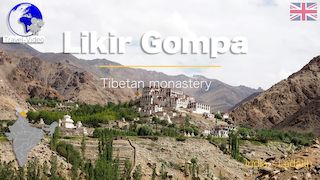
About fifty kilometers west of Leh, the capital of Ladakh, is one of the oldest Buddhist monasteries in the region, Likir Gompa. Likir Gompa, or Likir Monastery, was founded in the 11th century according to tradition, although most of the current buildings date from the 18th.
This monastery nestled on the mountainside is a fine example of Ladakh architecture, with its white walls contrasting with the surrounding arid mountains.
What strikes the visitor on approach is also the imposing golden statue, representing the Buddha Maitreya, 23 meters high. Buddhism is not fixed, and some communities are waiting for the future Buddha, named Maitraya Buddha, who is waiting to return to earth when the teachings of the Buddhist faith are in decline.
Likir Monastery is not just a place of meditation and prayer, but is also an important training center for local children. In Buddhist tradition, it is common for at least one child per family to enter the monastery. In addition to religious training, novices receive a general education, ranging from reading and writing to history and geography to mathematics.
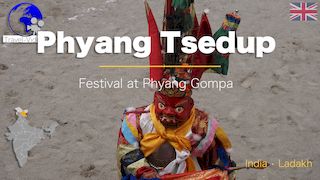
In Ladakh, all major monasteries hold festivals during which monks perform dances symbolizing the victory of good over evil. These dances are generally called "Chham" dances. During these festivals, the monks wear colorful costumes and very expressive masks to emphasize their role in the choreography.

Music:
- - - Live_Likir_Gompa


