

 Français (France)
  Nederlands (nl-NL)
 00:00 • intro | 00:28 • the port and the city | 00:58 • San Bartolomeo Co-Cathedral Basilica | 04:29 • the Benedictine cloister | 05:58 • the sarcophagi of Liapari
Personal creation from visual material collected during my trip Italy: Seductive Sicily (2022)
Map of places or practices in Lipari on this site
• Use the markers to explore the content •
Lipari, Heritage Between the Ancient World and Christianity
An Island Town Shaped by Sea Routes and Memory
Lipari, the principal island of the Aeolian archipelago, has long occupied an important position within Mediterranean navigation routes. Its natural harbor, strategic setting, and local resources encouraged the growth of a town where Greek, Roman, medieval, and modern layers remain visible. This video explores an urban center where religious history and the ancient past continue to coexist within a relatively compact space.
Visitors encounter an active port, streets marked by island life, major ecclesiastical monuments, and funerary remains from antiquity. Lipari is especially interesting because of this continuity: different periods did not erase one another completely, but accumulated over time, creating a town where historical transitions can still be read.
Main Sites and Themes Shown in the Video
The harbor and surrounding town first highlight Lipari’s enduring relationship with the sea. For centuries, the port has structured trade, movement, communication, and supply. It remains a lively area where everyday local activity meets the arrival of travelers. The urban fabric around it preserves the character of a Mediterranean island center shaped by maritime life and volcanic terrain.
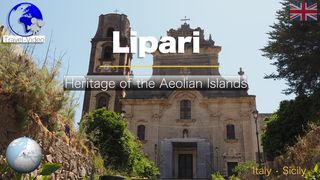
The Co-Cathedral Basilica of San Bartolomeo is one of Lipari’s major landmarks. Dedicated to the patron saint of the island, it reflects the long importance of Christianity in local religious life. Its position on elevated ground also recalls the symbolic and defensive value of this commanding part of the town.
The nearby Benedictine cloister reveals another dimension of Lipari’s heritage: monastic presence and the historical role of religious communities in education, administration, and spiritual life. Cloisters traditionally combine circulation spaces with quiet internal courts designed for reflection and ordered daily routines.
The sarcophagi of Lipari point to a much earlier chapter of history. These funerary monuments recall the significance of the island during antiquity and the archaeological richness of the site. They create a direct link between the present town and its ancient inhabitants.
Historical, Cultural, and Urban Context
Lipari was occupied from prehistoric times and later integrated into Greek maritime networks before passing under Roman control. Owing to its location between Sicily, southern Italy, and the Tyrrhenian Sea, it participated in long-lasting commercial exchanges. Its history was also shaped by earthquakes, volcanic activity, and maritime attacks, all of which influenced urban planning and defensive choices.
The elevated zone now occupied by the cathedral has held strategic importance for centuries. Successive communities built, rebuilt, and transformed this area according to changing political and religious needs. The combination of sacred, residential, and protective functions in one commanding sector is one of Lipari’s defining urban characteristics.
Modern Lipari still reflects its island condition. The scale of the town remains moderate, links with the harbor remain constant, and historic monuments continue to exist beside ordinary daily life. Rather than a preserved stage set, Lipari is a living town where the past remains integrated into present use.
What the Videos on This Site Make Especially Clear
The videos on travel-video.info are often created from carefully selected photographs animated through smooth transitions and progressive framing. This approach is particularly effective for a place such as Lipari. It allows viewers to move gradually from general harbor views to architectural details, making the urban structure easier to understand.
The relationship between the lower town and the monumental heights becomes clearer, as do the links between religious buildings, inhabited streets, and the surrounding coast. Changes of angle and measured zooms help reveal volumes, perspectives, and connections between sites.
This visual method also favors close observation of materials and carved details: stone arcades of the cloister, church façades, funerary sculpture, and the atmosphere of streets shaped by maritime life. The slower rhythm gives viewers time to absorb elements that rapid moving footage might only suggest.
A Mediterranean Town of Lasting Continuity
Discovering Lipari through this video means exploring a town where the ancient world, Christian traditions, and contemporary island life remain closely connected. For those wishing to continue the journey, the detailed pages dedicated to its principal monuments offer deeper insight into each of these historical layers.
Links to related pages


Audio Commentary Transcript
Off the northeastern coast of Sicily, Lipari is the largest of the Aeolian Islands. Since prehistoric times it has thrived on volcanic resources and its strategic position on Mediterranean sea routes. Greeks, Romans, Byzantines, Arabs and Normans have shaped its identity, turning the island into a crossroads where ancient heritage meets enduring Christian traditions.
The Co-Cathedral Basilica of Saint Bartholomew
Built by the Normans in the late 11th century, the Basilica of San Bartolomeo was rebuilt in the 16th after Ottoman raids and earthquakes that shook the island. Blending medieval and Baroque elements, it houses the reliquary statue of Saint Bartholomew, patron of the Aeolian Islands.
The reliquary statue of Saint Bartholomew preserves the memory of the apostle, one of the twelve disciples of Jesus. According to tradition, he preached the Gospel in the East before being martyred in the 1st century. His relics were moved several times to protect them, eventually finding refuge in Lipari, where he became the island’s patron. This silver statue contains bone fragments of the saint, venerated by the island’s inhabitants since the Middle Ages.
The cathedral’s vault unfolds a sweeping narrative from the Old Testament: the golden calf, Abraham and Isaac, Judith, and other biblical episodes. These frescoes were painted around 1700 in a late Baroque style and were partially restored or reworked in the 19th century, which explains the differences in color and execution visible today.
The Benedictine cloister
The Benedictine cloister, built in the 11th century, is one of Lipari’s most notable medieval remains. Its paired arcades and carved capitals reflect the monastic presence that shaped the cathedral’s history.
The sarcophagi of Lipari
The sarcophagi preserved in Lipari come from the island’s ancient necropolises, used from the Greek era through the Roman period. They bear witness to the prosperity of the ancient city of Aeolus and its continuous occupation into Late Antiquity.

Music:
- - YouTube video library - Invisible Beauty
- - YouTube video library - Lone Harvest - Kevin MacLeod, (© Lone Harvest by Kevin MacLeod is licensed under a Creative Commons Attribution 4.0 license. https://creativecommons.org/licenses/by/4.0/
- Source: http://incompetech.com/music/royalty-free/index.html?isrc=USUAN1100409
- Artist: http://incompetech.com/
- )
Disclaimer: Despite its appropriateness, copyright issues prevent the use of italian traditional music in "Lipari • Aeolian Heritage from Antiquity to Christianity", hence the use of royalty-free music. Despite our careful selection, some might regret this decision, which is necessary to avoid potential lawsuits. Although difficult, this decision is the only viable solution.


