Français (France)
  Nederlands (nl-NL)
 00:00 • intro | 00:05 • Modica, the city with two cathedrals | 00:57 • San Giorgio cathedral | 04:50 • San Pietro cathedfral
Personal creation from visual material collected during my trip Italy: Seductive Sicily (2022)
Map of places or practices in Modica on this site
• Use the markers to explore the content •
Modica, Baroque Architecture and the Hills of Southeastern Sicily
A Historic Sicilian Town Shaped by Topography
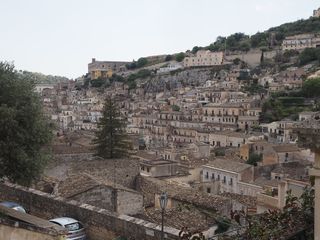
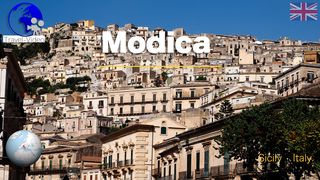
Located in southeastern Sicily, Modica is known for its distinctive urban landscape, where historic districts extend along narrow valleys and steep hillsides. The town preserves one of the most characteristic examples of Sicilian Baroque architecture, largely rebuilt after the devastating earthquake of 1693 that transformed many cities across eastern Sicily. The video explores this complex urban environment through its monumental stairways, layered streets, church façades, and panoramic viewpoints overlooking the surrounding valleys.
Modica’s historical center combines religious buildings, palaces, and densely organized residential quarters integrated directly into the relief of the landscape. The relationship between architecture and topography plays a central role in the identity of the city. Churches and civic buildings are not isolated monuments but parts of a tightly interconnected urban fabric shaped by elevation changes and narrow circulation routes.
The video highlights how the city developed around several historical districts, creating a succession of perspectives where domes, bell towers, staircases, and stone façades appear at different levels along the slopes. This organization gives Modica a visual rhythm that distinguishes it from flatter urban centers elsewhere in Sicily.
The Cathedrals of San Giorgio and San Pietro
The main focus of the video is the pair of cathedrals that dominate Modica’s historic landscape: San Giorgio and San Pietro. These churches reflect the historical division of the city into separate urban sectors and explain why Modica is often described as the “city of two cathedrals.”
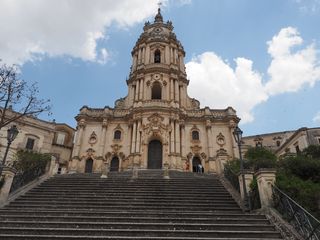
The Cathedral of San Giorgio is one of the most important examples of Sicilian Baroque architecture. Built above a monumental staircase, the church occupies a commanding position on the hillside. Its curved façade, vertical composition, and elevated setting create a carefully staged visual effect that becomes especially apparent when viewed from lower sections of the city. The building demonstrates the importance of perspective and theatrical composition in eighteenth-century Sicilian architecture.
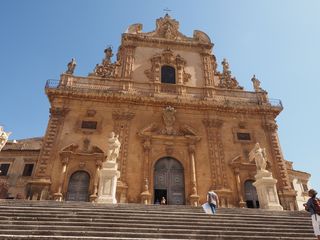
San Pietro Cathedral presents a different relationship with the surrounding urban fabric. Located in a lower district, it is integrated more directly into the street network and neighboring buildings. Its richly decorated façade and the statues lining the staircase emphasize the role of the church within the daily life of the town. The contrast between the two cathedrals illustrates the architectural diversity that emerged during the reconstruction of Modica after the earthquake.
Through these monuments, the video also reveals how religious architecture shaped the organization of public space in the city. Stairways, squares, and street alignments were designed not only for circulation, but also to reinforce the visual presence of the churches within the urban landscape.
Reconstruction After the Earthquake of 1693
The present appearance of Modica is closely linked to the rebuilding campaigns that followed the earthquake of 1693. During this period, Sicily formed part of the Spanish Empire, and several towns in the region underwent extensive reconstruction. In Modica, however, the rebuilding process preserved much of the earlier medieval street pattern, resulting in a dense and irregular urban layout adapted to the natural terrain.
The Baroque architecture visible throughout the city is characterized by monumental staircases, dynamic façades, sculpted balconies, and strong visual integration between buildings and the surrounding hillsides. Local stone played an important role in defining the appearance of the reconstructed city, especially through the warm tones visible on façades and decorative details.
Modica also retained its importance as the center of the County of Modica, one of the major feudal territories of Sicily. The economic and political influence associated with this status contributed to the financing of large religious and civic projects that continue to define the city today.
What the Videos on This Site Make Easier to Observe
The visual construction used in the videos on travel-video.info makes it possible to observe Modica progressively and in detail. Carefully animated photographs and slow transitions help clarify the relationship between the cathedrals, the staircases, and the steep urban landscape surrounding them.
This approach is particularly effective for understanding architectural proportions and spatial organization. The viewer can observe how façades interact with slopes, how stairways structure movement through the city, and how the churches dominate different sections of the urban environment. Close framings reveal decorative details, while wider perspectives place the monuments within the broader landscape of valleys and hills.
The use of still photography also encourages a slower reading of architectural forms and urban relationships that can easily be overlooked during a rapid visit.
A Distinctive Example of Sicilian Baroque Urbanism
Today, Modica remains one of the most representative urban ensembles of post-earthquake Baroque Sicily. The combination of dramatic topography, monumental religious architecture, and densely layered streets gives the city a particularly strong architectural identity. The detailed pages dedicated to the cathedrals provide further insight into the history and characteristics of these major monuments.
Links to related pages



Audio Commentary Transcript
Modica
Modica, in Sicily, has a rare peculiarity: two major cathedrals, San Giorgio and San Pietro. This duality is due to the city's historical division into two rival districts, each claiming its own religious landmark. Today, Modica is a UNESCO World Heritage site, recognized for its exceptional Baroque architecture. The city is also renowned for its chocolate, produced using a technique inherited from the Aztecs and introduced to Sicily by the Spanish in the 16th century.
San Giorgio
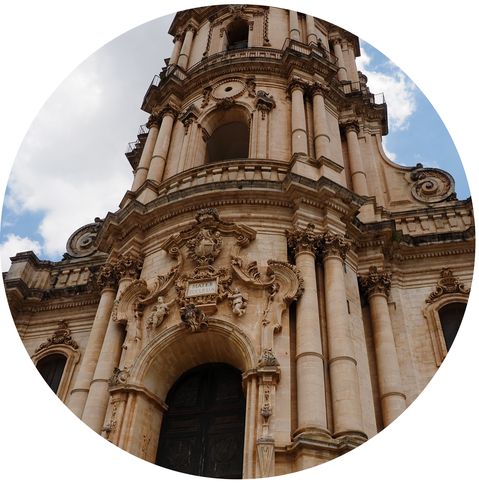
Located in the historical heart of Modica, the Cathedral of San Giorgio is a masterpiece of Sicilian Baroque architecture. Built after the devastating earthquake in 1693, it stands majestically on the city's heights, accessible via a grand staircase of 250 steps. The façade, characterized by rich sculptural decorations and Corinthian columns, embodies the exuberance and grandeur of the Baroque style. Dominating the urban landscape, the cathedral is topped with an imposing dome, visible from miles around, symbolizing the resilience and cultural rebirth of Modica post-earthquake.
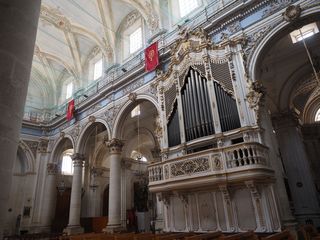
The interior of San Giorgio Cathedral in Modica, completed in 1738, showcases distinctive Baroque architecture with Corinthian columns supporting graceful arches. The tops of the columns feature intricate sculptural details that contrast with the relatively austere ceiling. Marble flooring and the main altar, made of polychrome marble, add to the grandeur of the space, while wall paintings and statues visually enrich the side aisles, reflecting the church's rich artistic tradition.
The cathedral's floor also includes a gnomon, a sophisticated astronomical device. This gnomon consists of precise markings engraved in the marble, enabling the tracking of the sun's path through strategic openings to mark specific astronomical moments, thus integrating a scientific dimension into this place of worship.
San Pietro
The Cathedral of San Pietro is located on Corso Umberto I, in the lower part of the city of Modica. This religious building, directly accessible from the main street, features a richly decorated baroque facade, characterized by statues of the twelve apostles that frame the main entrance.
The existence of two cathedrals in the city of Modica, San Pietro and San Giorgio, attests to the historical importance and status of Modica as an administrative and religious center. Historically, the division of the city into two large parishes corresponded to a social and geographical distribution, with each cathedral serving different segments of the population. This architectural and organizational peculiarity reflects the urban structure of Modica during periods of its greatest prosperity.
The interior of San Pietro Cathedral in Modica is a striking example of Sicilian Baroque, characterized by decorative opulence and dramatic use of light and space. Richly adorned vaults and imposing colonnades create a majestic yet welcoming atmosphere. The church also houses remarkable artworks, including frescoes and statues that enhance its many altars, reflecting the religious fervor and local artistic talent. Together, these elements form a cohesive ensemble that embodies the spirit of the Baroque in this historic region of Sicily.
Music:
- - YouTube video library - Shadoma - The Mini Vandals
- - YouTube video library - Vaquero Perdido - The Mini Vandals
Disclaimer: Despite its appropriateness, copyright issues prevent the use of italian traditional music in "Modica, two cathedrals, one unique heritage • Sicily", hence the use of royalty-free music. Despite our careful selection, some might regret this decision, which is necessary to avoid potential lawsuits. Although difficult, this decision is the only viable solution.