Français (France)
  Nederlands (nl-NL)
 00:00 • intro | 00:38 • Staircase of Santa Maria del Monte | 02:05 • Santa Maria del Monte church | 03:49 • the streets of the old town | 05:06 • The Cathedral-Basilica of San Giulianov | 07:19 • Walk around the cathedral
Personal creation from visual material collected during my trip Italy: Seductive Sicily (2022)
Map of places or practices in Caltagirone on this site
• Use the markers to explore the content •
Caltagirone, Sicily’s City of Ceramics and Monumental Streets
A Hill Town of Art and Historic Character
Located in the interior of eastern Sicily, Caltagirone is one of the island’s most distinctive historic towns. Internationally known for its ceramic production, it combines centuries-old craftsmanship with baroque urban planning and a strong Mediterranean identity. Built across steep slopes, the town presents a landscape of rising streets, terraces, church façades and changing viewpoints that connect monuments with everyday urban life.
The video highlights several of the city’s defining features: the famous Staircase of Santa Maria del Monte, the church above it, the streets of the old town and the Basilica-Cathedral of San Giuliano. Together, these places reveal a town where decorative art, architecture and topography form a remarkably coherent whole.
The Famous Staircase and the Historic Centre
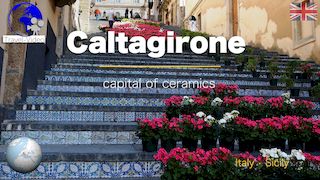
The most emblematic landmark of Caltagirone is the Staircase of Santa Maria del Monte. This long ceremonial stairway links two levels of the city and strongly shapes the urban experience. Its fame comes not only from its scale, but also from its decoration. The risers are covered with colourful ceramic tiles that reflect the town’s best-known artistic tradition.
The staircase is more than an ornamental monument. It functions as an urban axis, a route between neighbourhoods and a gathering place. Seen from below, it creates a dramatic perspective rising toward the church. Seen from above, it opens wide views across rooftops and streets.
At the summit stands the Church of Santa Maria del Monte, which completes the composition and gives the ascent a symbolic destination. Its elevated position reflects a long tradition in which religious architecture and public space are closely linked.
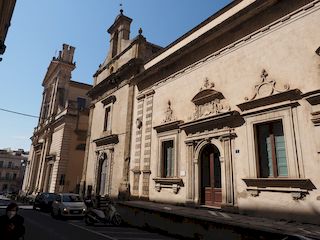
The streets of the old town reveal another side of Caltagirone. Secondary stairways, balconies, stone portals and small squares form a dense urban fabric adapted to the hillside terrain. The walk toward the Basilica-Cathedral of San Giuliano introduces a major religious landmark whose dome and scale dominate parts of the skyline.
A Town Shaped by Baroque Reconstruction
Although Caltagirone has older roots, much of its present appearance was shaped after the devastating earthquake of 1693, which affected a large part of eastern Sicily. Like several towns in the region, Caltagirone underwent reconstruction and renewal during the baroque period.
This helps explain the harmony of many streetscapes, the emphasis on façades and the careful staging of monuments within the urban landscape. The Staircase of Santa Maria del Monte, even if modified over time, belongs to this broader tradition of theatrical town planning adapted to a steep site.
At the same time, the ceramic tradition reaches back through many centuries of Mediterranean exchange. Greek, Arab, Norman and Spanish influences all contributed to techniques, motifs and decorative uses. In Caltagirone, ceramics are not simply a local craft industry. They are part of the town’s visual identity.
Architecture, Relief and Colour
Much of Caltagirone’s charm comes from the meeting of hillside geography and decorative culture. Rising streets, stepped routes and terraces create a vertical town where each movement changes the perspective. Domes, bell towers and façades appear and disappear as one turns through the streets.
Ceramics add an essential chromatic dimension. Blues, yellows, greens and whites animate stairways, signs, fountains and architectural details. This presence of colour distinguishes Caltagirone from many other monumental towns whose beauty depends mainly on stone.
What These Videos Make Especially Clear
Videos created from carefully selected and animated photographs are especially effective for a sloping town like Caltagirone. They allow viewers to follow visual axes gradually, climb the staircase step by step and then discover squares, churches and panoramic openings.
This format is also ideal for observing ceramic details that can be difficult to appreciate at a glance. Slower transitions help reveal how craftsmanship becomes part of architecture rather than a separate decorative layer.
Changes of scale between narrow streets and larger monuments also become clearer, giving viewers a structured understanding of the town.
A Sicilian Town of Art and Identity
Caltagirone brings together baroque heritage, ceramic craftsmanship and dramatic urban form. The video offers a balanced introduction through major landmarks and quieter streets alike. The related detailed pages provide further insight into a Sicilian town where architecture constantly interacts with colour, craftsmanship and light.
Links to related pages

Audio Commentary Transcript
Caltagirone, a town in southern Sicily, is famous for the quality of the ceramics produced by its artisans for many centuries. Its name comes from an Arabic expression meaning Castle of pottery. Like most towns in the region, Caltagirone was razed by the terrible earthquake of 1693 and rebuilt in the Baroque style at the beginning of the 18th century.

Music:
- - YouTube video library - Progressive Moments
- - YouTube video library - Pure Potentiality - Benjamin Martins
- - YouTube video library - Side Path
Disclaimer: Despite its appropriateness, copyright issues prevent the use of italian traditional music in "Caltagirone, capital of ceramics, Sicily • Italy", hence the use of royalty-free music. Despite our careful selection, some might regret this decision, which is necessary to avoid potential lawsuits. Although difficult, this decision is the only viable solution.