

 Français (France)
  Nederlands (nl-NL)
 00:00 • intro | 00:39 • alignment of buddhas in an undergrowth | 02:04 • big reclining buddha | 03:41 • alignments of buddhas in front of the pagoda
Personal creation from visual material collected during my trip Myanmar • Burma (2016)
Map of places or practices in Monywa on this site
• Use the markers to explore the content •
Monywa, Buddhist Landscapes and Monumental Statues in Myanmar
Religious Complexes Across the Plains of Central Myanmar
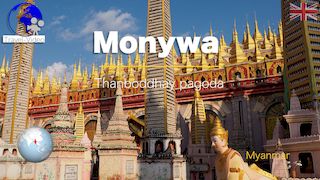
Located in the Sagaing Region of central Myanmar, Monywa is known for its large Buddhist sanctuaries and extensive fields of statues spread across the dry plains surrounding the city. The video explores several of these religious sites, where repeated representations of the Buddha create highly distinctive spiritual landscapes characteristic of contemporary Burmese Buddhism.
The scenes shown in the video alternate between wooded areas, open religious esplanades, monumental sculptures, and long alignments of identical statues. These sites illustrate a devotional tradition in which the multiplication of sacred images plays an important role in religious practice, merit-making, and the visual organization of ceremonial space. In Monywa, this repetition often reaches an impressive scale, especially through the endless rows of Buddhas and the gigantic reclining figure visible from afar.
The relatively open landscape of central Myanmar reinforces the visual impact of these sanctuaries. Religious structures appear isolated against the plains, emphasizing both the scale of the monuments and the geometric regularity of the alignments.
Forests of Buddhas and Monumental Religious Sculpture
One of the most striking locations featured in the video is the Aung Myae Oo Forest, where large numbers of Buddha statues are arranged beneath trees in carefully organized rows. The repetition of identical figures creates a strong visual rhythm reinforced by perspective effects and the contrast between the statues and the surrounding vegetation. The video highlights the way natural space and religious planning combine to form a structured spiritual environment.
The Maha Bodhi Ta Htaung complex is particularly famous for its enormous reclining Buddha and its monumental standing figures dominating the surrounding landscape. The scale of these statues reflects the importance of monumental religious imagery in many recent Burmese Buddhist sites. Their dimensions alter the perception of space itself, creating an architectural environment based primarily on volume, repetition, and visual impact.
The alignments of Buddha statues positioned before pagodas form another major theme of the video. These repeated sequences produce an almost continuous visual field, especially when observed through frontal perspectives or lateral viewpoints. Golden surfaces, elevated platforms, and surrounding religious structures contribute to the strong visual unity of the complexes.
The Aung Sakkya Pagoda adds another dimension through the presence of prayer halls and ceremonial spaces associated with the statues. Together, these elements demonstrate how architecture, sculpture, and landscape organization interact within contemporary Buddhist religious complexes in Myanmar.
Burmese Buddhism and the Multiplication of Sacred Images
The religious sites of Monywa reflect several important characteristics of modern Burmese Theravāda Buddhism. The construction of monumental statues and the repetition of Buddha images are closely linked to devotional practices and the accumulation of religious merit. Donations used to finance such monuments are traditionally considered acts of spiritual value within Buddhist culture.
The emphasis placed on scale and quantity also reveals a desire to create highly visible religious environments capable of dominating the landscape. Unlike older historical sites centered around a limited number of major monuments, several modern religious complexes in Monywa rely on accumulation and repetition as central visual principles.
Within these sites, architecture often plays a secondary role compared to sculpture. Buildings primarily serve to organize circulation, prayer areas, and access to the monumental statues that define the identity of the sanctuaries.
What the Videos on This Site Make Easier to Observe
The visual construction used in the videos on travel-video.info makes it possible to observe the effects of repetition and perspective created by the statue alignments with particular clarity. Carefully animated photographs and slow transitions help reveal the scale relationships between visitors, monumental Buddhas, and the open religious spaces surrounding them.
This approach is especially effective for observing details that can be difficult to perceive during a rapid visit, including the regularity of the alignments, the arrangement of platforms, and the spatial organization of the religious complexes. Wide perspectives place the sanctuaries within the plains of central Myanmar, while closer framings emphasize sculptural details, textures, and the interaction between vegetation and religious structures.
A Distinctive Religious Landscape of Contemporary Myanmar
The Buddhist complexes of Monywa illustrate the importance of monumental religious imagery in contemporary Myanmar. The combination of giant statues, repeated rows of Buddhas, and open devotional spaces creates a spiritual landscape that is highly characteristic of the region. The detailed pages dedicated to the individual monuments provide additional insight into the history, architecture, and religious significance of these major Buddhist sites.
Links to related pages












Audio Commentary Transcript
An undergrowth with hundreds of almost identical Buddhas sitting cross-legged waiting for their devotees under their parasols. Strange vision that these statues under crowned trees, pipals or fig trees of the pagodas (bodhi trees), the tree under which Buddha reached the nirvana in Bodghaya in India (see the film in this series).
But in Monywa, there are more than these Buddhas. There is a huge standing Buddha, the third largest in the world, there is the great reclining Buddha, and there are hundreds of Buddhas in the courtyard of a temple on the road to the great standing and reclining Buddhas.

Music:
- - YouTube video library - People Watching
Disclaimer: Despite its appropriateness, copyright issues prevent the use of burmese traditional music in "Monywa, Buddhas and more Buddhas • Myanmar ", hence the use of royalty-free music. Despite our careful selection, some might regret this decision, which is necessary to avoid potential lawsuits. Although difficult, this decision is the only viable solution.


