Français (France)
  Nederlands (nl-NL)
 00:00 • intro | 00:26 • outside the monastery | 01:30 • toilet of the Buddha statue | 03:28 • details of the monastery architecture
Personal creation from visual material collected during my trip Myanmar • Burma (2016)
Map of places or practices in Inwa on this site
• Use the markers to explore the content •
Maha Aung Mye Bonzan Monastery in the Ancient City of Inwa
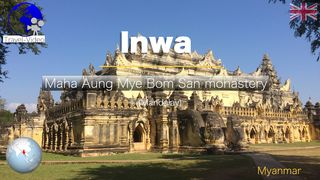
In the former royal city of Inwa, near Mandalay, the Maha Aung Mye Bonzan Monastery stands as one of the most remarkable Buddhist religious buildings of the Konbaung period in Myanmar. Often referred to as Me Nu Monastery, this imposing monastic complex is notable for its large masonry structure covered with stucco decoration, an unusual characteristic in a country where traditional monasteries were historically built mainly from wood. The video explores the monument through views of its exterior architecture, ritual activity around a Buddha image and detailed observations of its decorative elements, revealing both the historical importance of the site and its continuing religious role today.
The scenes show a monument located within the quieter rural landscape of Inwa, far removed from the density of modern urban centres. Once one of the principal royal capitals of Burma, Inwa preserves a landscape marked by ruined fortifications, monasteries and scattered remains linked to several Burmese dynasties. Within this historical environment, the Maha Aung Mye Bonzan Monastery remains one of the best preserved religious monuments dating from the early nineteenth century.
The sequences devoted to the washing ritual performed on a Buddha statue also highlight the fact that the monastery is not simply an archaeological or architectural site. As in many Buddhist religious places in Myanmar, devotional practices remain central to daily life. The ritual gestures performed before Buddha images reflect traditions associated with purification, merit-making and respect toward the teachings of Buddhism.
Architecture and Religious Spaces
The Maha Aung Mye Bonzan Monastery was constructed in 1818 during the reign of King Bagyidaw under the patronage of Queen Nanmadaw Me Nu, whose name later became closely associated with the monument. The building is particularly distinctive because of its use of brick and stucco intended to imitate the refined appearance of carved wooden monasteries.
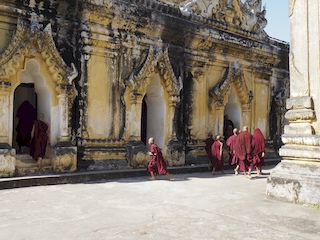
The exterior views shown in the video reveal the monument’s imposing proportions and rich decorative program. The façades are covered with arches, niches, mouldings and floral motifs characteristic of Burmese artistic traditions during the Konbaung dynasty. The layered terraces, multi-tiered roof structures and ornamental details reflect architectural influences associated with royal palaces and court-sponsored monasteries of the period.
Unlike some large Buddhist complexes composed of many separate structures, the monastery presents a relatively compact architectural organization. Its spaces originally accommodated religious instruction, monastic residence and devotional activities. Interior halls were used by monks for Buddhist studies, ceremonies and meditation.
The detailed architectural sequences allow close observation of the stucco ornamentation, one of the most remarkable aspects of the monument. Columns, decorative frames and sculpted surfaces demonstrate the effort to reproduce in masonry the elegance usually associated with traditional teakwood architecture.
The scenes showing the ritual cleansing of the Buddha image introduce another important dimension of the site. In Theravāda Buddhist traditions practiced in Myanmar, washing Buddha statues represents a symbolic act of purification and reverence. Such rituals reinforce the continuity between the monument’s historical significance and its present-day spiritual function.
Inwa and the Burmese Royal Dynasties
The history of the Maha Aung Mye Bonzan Monastery is closely linked to the history of Inwa, also known historically as Ava. Founded during the fourteenth century, the city served several times as the capital of Burmese kingdoms before gradually declining during the nineteenth century after wars and repeated earthquakes.
During the Konbaung dynasty, Inwa remained an important religious and political centre even after the royal court progressively shifted toward Amarapura and later Mandalay. Kings, queens and members of the royal family continued to sponsor the construction of monasteries, temples and religious institutions intended to reinforce both political prestige and Buddhist merit.
The Maha Aung Mye Bonzan Monastery illustrates this tradition of royal patronage. Queen Me Nu played a significant role in financing religious architecture, following long-established Burmese practices linking political authority with support for Buddhism and the monastic community.
The building also reflects broader architectural changes occurring during the period. Although most Burmese monasteries were traditionally constructed in wood, repeated destruction caused by fires and earthquakes encouraged the use of brick and stucco for certain important monuments. The monastery therefore represents both continuity and adaptation within Burmese architectural traditions.
Today, the wider landscape of Inwa remains filled with traces of former royal capitals. Monasteries, stupas, defensive towers and ruined religious structures continue to testify to the historical importance of the region in the formation of precolonial Burmese kingdoms.
A Detailed Reading of Architecture and Rituals
The videos presented on travel-video.info often combine animated photographs with carefully selected sequences allowing a slower and more progressive observation of historical sites. This approach is particularly suitable for a monument such as the Maha Aung Mye Bonzan Monastery, where decorative richness and architectural volumes require attentive visual reading.
Slow movements within the images help reveal the complexity of the stucco carvings, monumental openings and ornamental details inspired by traditional Burmese wooden architecture. The animated photographs also emphasize the perspectives created by the terraces and the overall composition of the building.
The sequences devoted to ritual activity around the Buddha statue add an additional cultural dimension to the presentation of the monument. The visual pacing makes it easier to observe gestures, ceremonial objects and the relationship between religious space and devotional practice.
This gradual visual construction also helps explain the connections between architecture, dynastic history and contemporary religious life within the former royal city of Inwa.
A Major Monument of Burmese Buddhism
The Maha Aung Mye Bonzan Monastery remains today one of the most important surviving religious monuments of historic Inwa. Combining royal patronage, Buddhist traditions and Konbaung-period architecture, the site illustrates several major aspects of Myanmar’s cultural history. The video offers a detailed exploration of its decorative forms, religious spaces and living traditions while providing a broader understanding of the historical and spiritual importance of this remarkable Burmese monastery.
Links to related pages
















Audio Commentary Transcript
Myanmar monasteries dating from the Konbaung period are often made of wood and are still remarkable. This monastery is built in brick but built in the same style as those in wood with very refined wooden ornaments reminiscent of the sculptures of more classical monasteries. Like many monuments, this monastery was partially destroyed by the earthquake of 1838. It was restored some forty years later.

Music :
- - YouTube video library - Vanity reprise
- - YouTube video library - Waiting - Andrew Langdon
Disclaimer: Despite its appropriateness, copyright issues prevent the use of burmese traditional music in "Inwa, Maha Aung Mye Bom San monastery • Myanmar", hence the use of royalty-free music. Despite our careful selection, some might regret this decision, which is necessary to avoid potential lawsuits. Although difficult, this decision is the only viable solution.