Français (France)
  Nederlands (nl-NL)
 00:00 • intro | 00:27 • picking palm fruit | 01:27 • crushing fruit | 01:46 • fermentation | 02:32 • distillatie
Personal creation from visual material collected during my trip Myanmar • Burma (2016)
Map of places or practices in Bagan on this site
• Use the markers to explore the content •
Bagan, a Palm Alcohol Distillery Between Rural Knowledge and Traditional Technique
Another Face of the Bagan Region
Bagan is internationally renowned for its temples, stupas and vast monumental plain that reflects the power of the Kingdom of Pagan. Yet the region is more than an archaeological landscape. It is also a living rural territory shaped by agriculture, local resources and practical knowledge transmitted through generations. This video focuses on one of those lesser-known aspects of regional life: the production of palm alcohol.
By following the successive stages of work, from harvesting palm fruit to crushing, fermentation and distillation, the viewer discovers a world of skilled gestures, empirical knowledge and family or village-scale production. Such activities remind us that famous historical regions are sustained not only by monuments, but also by everyday economies and communities able to transform what their environment provides.
Bagan therefore appears not only as a major heritage destination, but also as a place of labor, resourcefulness and continuing tradition.
The Palm Tree as a Valuable Resource
The harvesting of palm fruit introduces the process. In many tropical regions of Asia, different species of palm trees provide essential raw materials: fruit, fibers, timber, leaves, sugar or fermentable sap. In central Myanmar, palms are deeply integrated into rural landscapes and local economies.
The palm is especially valuable because many parts of the tree can be used. Its products may contribute to food preparation, domestic crafts or beverage production. Harvesting often requires agility, experience and knowledge of seasonal cycles, especially when fruit or sap must be collected at height.
Showing this first stage is important because traditional production begins long before the workshop or still. It depends on understanding the natural rhythm of trees, knowing the right moment for collection and maintaining access to productive groves.
Around Bagan, these practices connect rural communities directly to their environment and illustrate forms of sustainable local resource use developed over time.
Crushing and Fermentation
Once gathered, the raw material must be prepared. Crushing the fruit, or more broadly extracting fermentable matter, is a decisive step. The aim is to release sugars or juices that can later be transformed into alcohol.
This work is often carried out with simple but effective tools: wooden mortars, presses, knives, collection vessels or prepared working surfaces. Although modest in appearance, such equipment reflects generations of adaptation to local conditions. The quality of the final product depends partly on the care taken during this initial preparation.
Fermentation then becomes the central biological process. Natural yeasts convert sugars into alcohol over time. In traditional settings, this stage is usually controlled not through laboratory instruments but through observation and experience: smell, bubbling activity, texture, ambient temperature and timing.
This practical knowledge represents a genuine technical culture. It may not be expressed in scientific vocabulary, yet it is based on repeated experimentation, memory and careful adjustment. Such expertise is often transmitted orally within families or communities.
The video therefore reveals that artisanal production involves not only manual labor, but also accumulated understanding of natural processes.
Distillation and the Control of Heat
The distillation stage is often the most visually striking part of the sequence. Distillation consists of heating a fermented liquid so that alcoholic vapors rise, then condensing them into a stronger spirit.
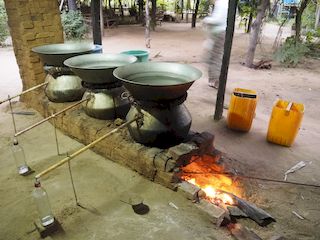
In rural contexts, the apparatus may remain relatively simple: metal pots or drums, connecting pipes, cooling containers and furnaces fueled by wood or other available materials. Despite this apparent simplicity, successful distillation requires real precision. Temperature, heating rhythm, condensation flow and separation of the first fractions all influence quality and safety.
Managing fire is especially important. Too much heat can damage flavor or waste material; too little heat slows production. Experience allows producers to interpret sound, steam behavior, smell and flow rate in order to maintain balance.
This part of the process demonstrates how sophisticated results can be achieved with limited equipment when practical skill is well developed. It also reflects the ingenuity of rural producers working within modest means.
Social and Economic Context
In many parts of Myanmar, palm-based products long provided supplementary income for farming households. Production could take place alongside agriculture, animal husbandry or small-scale trade. Around Bagan, local livelihoods were never based solely on monumental heritage.
For centuries, residents depended on cultivation, river exchange, transport, craftwork and food processing. Palm alcohol belongs to this wider economic diversity. It reflects the ability of rural communities to combine agriculture with value-added production using nearby resources.
Modern changes have altered some of these traditions. Tourism, regulation, new markets and shifting lifestyles have transformed production patterns. Some operations remain oriented toward local consumption, while others attract visitors interested in traditional techniques.
Yet their significance goes beyond curiosity. They preserve knowledge about materials, fermentation, heat management and small-scale production systems rooted in regional history.
What the Videos of This Site Make Especially Clear
The videos of travel-video.info, often created from carefully selected and animated photographs, are particularly effective for explaining traditional crafts. They allow viewers to pause on tools, textures, raw materials and the logical sequence of operations.
In the case of a palm alcohol distillery, this format makes it easier to understand the transition from harvest to preparation, from fermentation to distillation. Each gesture becomes more readable than during a rapid on-site visit.
Transitions between images also reconnect the workshop to its rural surroundings. The viewer understands that production is not simply a machine process or recipe, but part of an agricultural landscape, seasonal rhythm and local social structure.
This visual progression encourages a concrete understanding of skills that are often overlooked.
A Technical Tradition in Rural Myanmar
The Bagan region fascinates visitors through its temples, yet it also deserves attention for the activities that sustain local life. Palm alcohol distillation reveals a quieter heritage built on practical intelligence, disciplined gestures and adaptation to available resources. For those wishing to explore further, the detailed pages devoted to regional traditions offer a deeper look at the daily life and technical culture of rural Myanmar.
Links to related pages




















Audio Commentary Transcript
To make palm alcohol, you must first be a good climber. You have to climb to the top of the palm tree to make incisions and cut the tops of the flowers to collect the sap which is the basis of this alcohol.
Once the sap has been harvested, either by natural flow from the incisions made at the top of the palm tree or by crushing the flowers using the millstone powered by the ox, the liquid is left in the sun for a few hours to let the fermentation take place.
Fermentation is very fast, so that after two hours you can move on to distillation. To distill the fermented sap, it is poured into a kind of still. In fact, a pot in which a pipe is inserted for the flow of cooled alcohol vapors. We put fire under these pots and cover them with a basin of cold water, to facilitate the condensation of the vapors which will escape by the pipe to finish their course in the bottles placed at the foot of the still.
But palm sap isn't just for making alcohol. It is also made into sugar. Of course, for this you must not let the liquid ferment.
It is put to heat directly after the harvest, in basins placed directly on the fire.
And because in these countries nothing is wasted, the leaves become works of art.

Music:
- - YouTube video library - Clouds
Disclaimer: Despite its appropriateness, copyright issues prevent the use of burmese traditional music in "Bagan, a palm liquor distillery • Myanmar", hence the use of royalty-free music. Despite our careful selection, some might regret this decision, which is necessary to avoid potential lawsuits. Although difficult, this decision is the only viable solution.