Français (France)
  Nederlands (nl-NL)
 00:00 • intro | 00:43 • the Bagaya wooden monastery in Myanmar
Personal creation from visual material collected during my trip Myanmar • Burma (2016)
Map of places or practices in Amarapura on this site
• Use the markers to explore the content •
Amarapura and the Bagaya Monastery, a Wooden Masterpiece of Myanmar
A Rare Monument in a Former Royal Capital
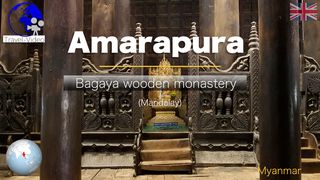
In central Myanmar, near Amarapura and close to Mandalay, the Bagaya Monastery is one of the most remarkable wooden religious buildings in the country. In a region famous for former royal capitals, pagodas and monastic foundations, this structure stands out for the quality of its carpentry, the elegance of its proportions and the richness of its carved decoration.
Amarapura served several times as a capital of the Burmese monarchy between the late eighteenth and nineteenth centuries. The city therefore preserves important traces of political and religious history. Bagaya Monastery belongs to that heritage and represents a central aspect of local culture: the importance of Buddhist monastic institutions in education, social life and urban identity.
This video offers an opportunity to discover a singular monument shaped almost entirely by timber craftsmanship. In a region where stone temples often attract the greatest attention, Bagaya demonstrates the artistic prestige of wood as an architectural material.
A Great Teak Monastery of Refined Design
Bagaya Monastery is especially famous for its use of teak, a hardwood long valued for strength, durability and resistance to climate. The building rests on numerous heavy pillars that raise the principal halls above ground level. This elevated arrangement helps protect the structure from moisture while also giving it an imposing presence.
The façades display a harmonious rhythm of columns, openings and covered galleries. Tiered roofs, characteristic of traditional Burmese architecture, create vertical emphasis and give the monastery a distinctive silhouette. Deep overhanging eaves also produce shifting patterns of shadow that enrich the visual effect of the building.
One of the monument’s greatest attractions lies in its carved wooden ornament. Gables, railings, lintels and decorative panels often feature floral, geometric or symbolic motifs. Such details reveal the skill of local craftsmen and the importance given to beautifying sacred spaces.
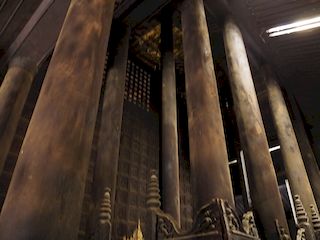
Inside, long alignments of pillars create remarkable depth and perspective. The halls feel more restrained than the exterior, where repeated structural forms and filtered light produce an atmosphere well suited to meditation, study and communal life.
Historical, Religious and Cultural Context
The present monastery dates mainly from the nineteenth century, when Amarapura still played an important role within the Burmese kingdom. The Konbaung dynasty strongly supported Buddhist institutions, which were closely linked to royal legitimacy, moral order and the transmission of learning.
In the Theravāda Buddhist tradition dominant in Myanmar, monasteries are more than places of worship. They often function as centres of education, scriptural study, manuscript preservation and community gathering. Bagaya Monastery formed part of this wider network of religious and intellectual life.
The choice of wood as the principal material reflects long-established regional building traditions. In tropical environments, locally available timber allowed flexible structures well adapted to climate conditions. Yet fire, insects and humidity caused many comparable buildings to disappear over time. The survival of a large wooden complex such as Bagaya therefore has particular heritage value.
Amarapura itself, now part of the greater Mandalay area, retains a strong historical identity. The nearby U Bein Bridge, also associated with teak construction, reminds visitors that woodcraft once played a major role in the architectural culture of the region.
What the Videos on This Site Make Especially Clear
The videos presented on this site are often created from carefully selected photographs arranged in a coherent visual sequence. This approach is especially effective for a monument such as Bagaya, where repetition of detail, texture and spatial rhythm deserves close attention.
Exterior views first make the overall balance of the building easier to understand. The raised platform, the forest of supporting pillars and the complexity of the layered roofs become clearer when seen progressively from different angles.
Closer images then reveal carvings, joinery, railings and ornamental surfaces that may be overlooked during a brief visit. The material quality of aged teak, with its tones and weathered texture, becomes more visible through attentive visual presentation.
Inside the monastery, sequences of images help explain the deep perspectives created by rows of columns. The eye follows structural axes, measures proportions and perceives the calm atmosphere shaped by subdued natural light.
Finally, the visual progression reminds viewers that monumental architecture does not always depend on stone or sheer mass. At Bagaya, grandeur emerges through craftsmanship, harmony of form and the warmth of natural material.
A Precious Witness to Traditional Burmese Architecture
Bagaya Monastery remains one of the finest surviving examples of wooden monastic architecture in Myanmar. It brings together technical skill, Buddhist spiritual culture and refined design within a historically significant setting.
The detailed page linked to this video offers the opportunity to explore the monument more closely, from structural design and decorative carving to its place within the royal and cultural heritage of Myanmar.
Links to related pages


















Audio Commentary Transcript
Bagaya is one of many wooden monasteries which is located in Inwa near Mandalay in Myanmar. This monastery is also known as Maha Waiyan Bontha Bagaya Monastery. This monastery is bigger and older than Pa Khan Gyi. It was built during the reign of Hsinbyushin between 1763 and 1776.

Music:
- - YouTube video library - Butterflies in Love
- - YouTube video library - Her Owl Ring
Disclaimer: Despite its appropriateness, copyright issues prevent the use of burmese traditional music in "Mandalay, Bagaya, wooden monastery • Myanmar", hence the use of royalty-free music. Despite our careful selection, some might regret this decision, which is necessary to avoid potential lawsuits. Although difficult, this decision is the only viable solution.