Français (France)
  Nederlands (nl-NL)
 00:00 • intro | 00:37 • ceremony with children | 01:58 • men sticking gold leaves on Buddha statue | 04:35 • the Mahamuni temple
Personal creation from visual material collected during my trip Myanmar • Burma (2016)
Map of places or practices in Mandalay on this site
• Use the markers to explore the content •
The Mahamuni Buddha Temple, a Major Buddhist Sanctuary in Mandalay
A religious centre at the heart of Burmese spiritual life
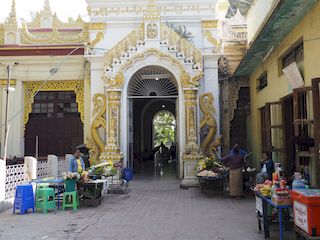
The Mahamuni Buddha Temple is one of the most important pilgrimage sites in Myanmar. Located in Mandalay, the country’s last royal capital, the complex attracts monks, worshippers and pilgrims who come to pray before one of the most revered Buddha images in Burmese Buddhism. The sanctuary combines ceremonial halls, covered galleries, shrines and gathering spaces within an environment where religious practice remains deeply connected to everyday life.
The video presents several aspects of this spiritual atmosphere. Scenes showing ceremonies involving children illustrate the role of Buddhism in the transmission of cultural and religious traditions within Burmese society. Other sequences focus on devotees applying gold leaf to the sacred Buddha statue, a ritual practice strongly associated with the Mahamuni Temple and with Buddhist devotional life in Myanmar.
Rituals, sacred spaces and temple activities
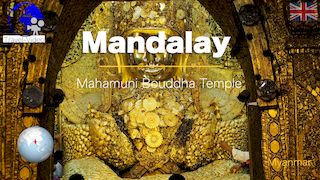
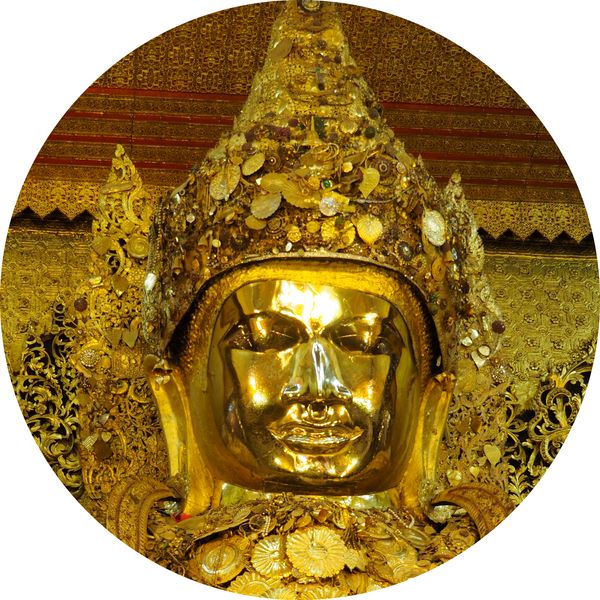
At the centre of the sanctuary stands the famous Mahamuni Buddha image, regarded as one of the holiest statues in the country. Over generations, male devotees have covered the statue with thin layers of gold leaf as an act of merit and devotion. This accumulation of gold has progressively altered the original surface of the sculpture, creating a thick and uneven texture that has become one of the temple’s most recognisable features.
The scenes showing men applying gold leaf reveal the importance of offering rituals in Burmese Buddhist practice. The gesture represents both a personal act of devotion and a collective contribution to the maintenance of the sacred image. These ceremonies also demonstrate the continuous activity of the sanctuary throughout the day.
The sequences involving children provide another perspective on the role of the temple in community life. Religious ceremonies connected to education, family traditions and social identity remain closely linked to Buddhist institutions in Myanmar. Clothing, gestures and ritual organisation visible in the video illustrate how temple spaces function not only as places of worship but also as centres of cultural continuity.
Architecturally, the Mahamuni complex combines large prayer halls, richly decorated roofs, gilded ornamentation and circulation spaces designed to accommodate large numbers of pilgrims. The organisation of the sanctuary reflects both ritual requirements and the importance of the site as a major religious destination.
Historical and cultural significance of Mahamuni
The Mahamuni Temple occupies a central position in the religious history of Myanmar. According to tradition, the main Buddha image originally came from the Arakan region and was transferred to Mandalay at the end of the eighteenth century following Burmese military campaigns in western Myanmar. After its relocation, the sanctuary became closely associated with royal authority and with the symbolic legitimacy of the Burmese kingdom.
Mandalay itself developed as an important political and spiritual centre during the final period of the Burmese monarchy before British colonisation. Even after the fall of the kingdom, the Mahamuni Temple retained its role as one of the country’s principal Buddhist sanctuaries.
The practices visible in the video reflect the continuity of Burmese Buddhist traditions into the present day. Ritual donations, collective ceremonies and the maintenance of sacred images remain strongly integrated into family life and religious observance. The temple therefore functions simultaneously as a pilgrimage centre, a ritual space and a symbol of cultural identity.
What the videos on this site make particularly clear
The videos on travel-video.info make it possible to observe ritual gestures, architectural details and devotional practices with considerable precision. The animated photographic sequences highlight the textures of the gold-covered surfaces, the organisation of ceremonial spaces and the interaction between pilgrims and sacred objects.
The gradual transitions between wider views and close framing also help clarify the spatial organisation of the sanctuary. Architectural volumes, circulation areas and ritual zones become easier to understand through this visual approach. Rather than presenting isolated documentary images, the video progressively reveals the relationship between religious practice, sacred space and temple architecture.
A major sanctuary of Burmese Buddhism
Through ceremonies, devotional rituals and sacred architecture, this video offers an insight into one of Myanmar’s most important Buddhist sanctuaries. The detailed pages dedicated to the Mahamuni Pagoda provide additional information about the history, symbolism and religious significance of this major temple complex in Mandalay.
Links to related pages












Audio Commentary Transcript
The Mahamuni Temple in Myanmar is an important place of pilgrimage. The temple owes its name to the Buddha statue it houses. The statue is made of bronze, is 4 meters high and weighs 6.5 tons. This statue would have been brought back by King Bodaupaya as war prize. As is the case with many statues in Myanmar, the statue is covered in gold leaf by devotees. During our visit, there was a ceremony and many little girls were present in their most beautiful dresses.
Music:
- - YouTube video library - Carol of the Bells
- - YouTube video library - Clouds
Disclaimer: Despite its appropriateness, copyright issues prevent the use of burmese traditional music in "Mandalay, Mahamuni Buddha temple • Myanmar ", hence the use of royalty-free music. Despite our careful selection, some might regret this decision, which is necessary to avoid potential lawsuits. Although difficult, this decision is the only viable solution.