

 Français (France)
  Nederlands (nl-NL)
 Aung Sakkya Pagoda is a Buddhist religious site located in Monywa, in the Sagaing Region of Myanmar. It forms part of a significant network of monasteries and pagodas that attract pilgrims and visitors from across the country and abroad. The pagoda is linked to Theravāda Buddhism, the predominant religious tradition in Myanmar. It serves as a place for prayer, meditation, and religious gatherings during major observances. Within the spiritual landscape of Monywa, Aung Sakkya Pagoda contributes to the local religious identity and reflects the enduring importance of Buddhist practice in central Myanmar.
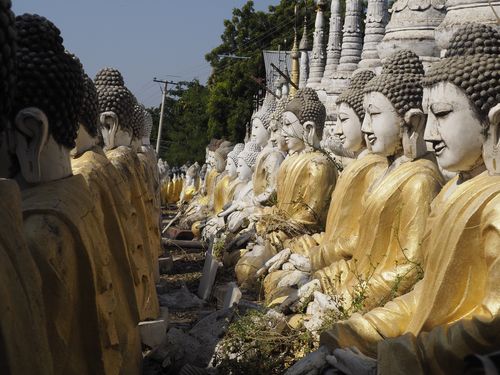
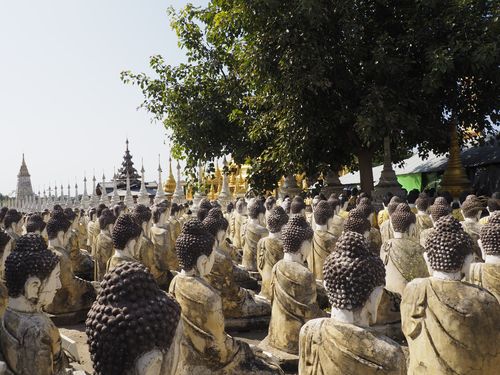
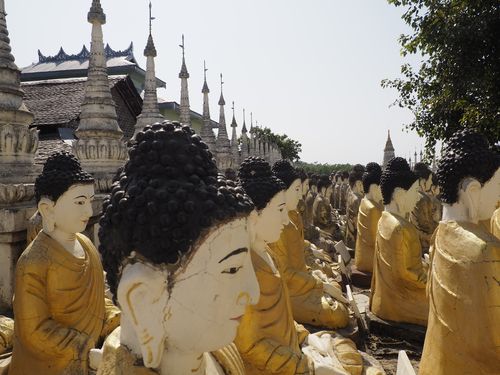
Monument profile
Aung Sakkya Pagoda
Monument category: Pagoda
Monument family: Pagoda or stupa
Monument genre: Religious
Cultural heritage: Buddhist
Geographic location: Monywa • Myanmar
Construction period: 20th century AD
• Links to •
• List of videos about Monywa on this site •
Monywa, Thanboddhay pagoda • Myanmar
Monywa, Buddhas and more Buddhas • Myanmar
History of Aung Sakkya Pagoda (Monywa, Myanmar)
Political and Social Context of Construction
Aung Sakkya Pagoda is located in Monywa, in the Sagaing Region of central Myanmar, an area long recognized as a major center of Theravāda Buddhist scholarship and monastic life. The foundation of the pagoda belongs to the modern period of Myanmar’s history, when religious construction became closely intertwined with questions of national identity, legitimacy, and social cohesion.
During the twentieth century, Myanmar experienced British colonial rule, independence in 1948, parliamentary government, and successive military administrations. In this context, the building of major Buddhist monuments frequently served both devotional and symbolic purposes. Religious patronage reinforced the moral authority of the state and reaffirmed Buddhism as the cultural foundation of Burmese society. Although Aung Sakkya Pagoda was not necessarily a royal foundation in the classical precolonial sense, its construction reflected the enduring alliance between the monastic community, lay donors, and state authorities.
Local elites, merchants, and devout laypersons contributed financially to the project, reflecting a deeply rooted tradition of merit-making. The ambition behind the construction was not merely architectural grandeur but the creation of a lasting spiritual landmark that would strengthen the religious identity of Monywa and the wider Sagaing Region. The project also formed part of a broader pattern of regional development in which cities sought to enhance their religious prestige through monumental structures.
While there is no evidence of overt rivalry comparable to medieval dynastic competition, symbolic emulation existed between religious centers. Monywa, already home to significant monastic complexes and large-scale Buddhist statuary, expanded its sacred landscape through projects such as Aung Sakkya Pagoda.
Historical Events and Institutional Continuity
Unlike ancient pagodas that endured cycles of invasion, destruction, and reconstruction, Aung Sakkya Pagoda belongs to a more recent era and has not been associated with documented episodes of warfare, siege, or plunder. Nevertheless, its history has unfolded within a region affected by political instability and shifting governance structures.
The broader Sagaing Region has experienced periods of tension, particularly during times of internal conflict in Myanmar. However, the pagoda itself has not been recorded as a direct target of violence. Its continuity reflects the resilience of religious institutions in Myanmar, which have often remained active even during political upheaval.
Following independence, changes in land administration and religious oversight influenced the management of religious sites. Aung Sakkya Pagoda adapted to new legal and administrative frameworks while maintaining its primary function as a devotional center. Over time, maintenance campaigns and incremental expansions were undertaken to accommodate increasing numbers of pilgrims and visitors.
No evidence suggests long-term abandonment. Instead, the monument has benefited from consistent community engagement and periodic restoration, ensuring its structural and functional continuity.
Global Context at the Time of Construction
The construction of Aung Sakkya Pagoda occurred within a broader twentieth-century revival of monumental religious architecture across Asia. In the decades following decolonization, newly independent states often emphasized cultural and religious heritage as foundational elements of national identity. In Myanmar, Buddhism functioned as both a spiritual system and a marker of cultural continuity.
Across Southeast Asia, countries such as Thailand and Sri Lanka engaged in similar projects, erecting monumental Buddha statues and expanding major temple complexes. These initiatives reinforced public religiosity and served as visual affirmations of continuity with ancient traditions.
Globally, the twentieth century also saw improvements in transportation and communication, facilitating religious tourism and pilgrimage. Monywa, though less internationally known than Bagan or Mandalay, developed into a regional pilgrimage destination. Aung Sakkya Pagoda thus formed part of a transnational movement of religious monumentalization that sought to inscribe faith visibly and durably within modern landscapes.
Transformations and Urban Evolution
At the time of its construction, the surroundings of Aung Sakkya Pagoda were less densely developed than today. Over subsequent decades, urban expansion and infrastructure improvements altered the physical environment of Monywa. Roads, commercial establishments, and residential zones gradually extended toward the pagoda.
Architectural modifications primarily involved the addition of access paths, stairways, platforms, and facilities for pilgrims. Electrical lighting, sound systems for ceremonies, and protective railings were introduced to meet contemporary needs. These interventions did not alter the monument’s religious function but improved its capacity to host large gatherings.
Temporary declines in visitor numbers during periods of political tension or economic hardship were followed by renewed activity. The site has not experienced sustained decay, and restoration efforts have focused on surface maintenance, repainting, and reinforcement of structural elements exposed to tropical weather.
Contemporary Role and Cultural Significance
Today, Aung Sakkya Pagoda functions as an active center of Theravāda Buddhist devotion. Lay worshippers visit the site to perform offerings, meditate, and participate in communal ceremonies. Major Buddhist festivals, especially those aligned with lunar observances, attract significant gatherings.
The pagoda contributes to the spiritual identity of Monywa and reinforces Sagaing Region’s reputation as a stronghold of monastic culture. For local communities, it represents both continuity and renewal, linking contemporary practice to centuries-old traditions.
At the national level, monuments such as Aung Sakkya Pagoda embody the enduring prominence of Buddhism in Myanmar’s cultural narrative. Even amid political uncertainty, religious monuments remain visible affirmations of collective faith.
The pagoda also plays a social role, hosting educational and charitable activities coordinated by monastic authorities. Its presence strengthens communal bonds and provides a venue for shared ritual experience.
Conservation and Modern Challenges
Aung Sakkya Pagoda does not hold individual UNESCO World Heritage status. Nevertheless, it forms part of Myanmar’s broader religious heritage landscape. Conservation challenges are primarily environmental. High humidity, intense rainfall during the monsoon season, and strong sunlight accelerate the deterioration of painted surfaces and gilded elements.
Air pollution associated with urban growth may also affect the longevity of external finishes. Regular maintenance, including repainting and repair of stucco ornamentation, is necessary to preserve the monument’s visual integrity.
Increasing visitor numbers generate wear on staircases, platforms, and flooring. Managing these flows while preserving the contemplative atmosphere of the site requires ongoing administrative coordination.
Urban development presents additional challenges. Ensuring that surrounding construction does not compromise the monument’s visual prominence or spiritual environment remains an important consideration for local authorities.
Conclusion
Aung Sakkya Pagoda in Monywa represents a modern expression of Myanmar’s enduring Buddhist tradition. Emerging from a twentieth-century context marked by political transformation and cultural reaffirmation, the monument reflects the close relationship between religion, community, and national identity. Its history is characterized not by cycles of destruction and reconstruction but by continuity, adaptation, and incremental development. As both a devotional center and a symbolic landmark, Aung Sakkya Pagoda occupies a significant place within the religious and cultural landscape of central Myanmar.
Architecture of Aung Sakkya Pagoda (Monywa, Myanmar)
General Layout and Site Organization
Aung Sakkya Pagoda is conceived according to the spatial principles that characterize modern Burmese Buddhist monumental complexes. The architectural composition is organized around a dominant central stupa rising from a series of concentric terraces. This axial and hierarchical arrangement reflects the cosmological symbolism embedded in Theravāda Buddhist architecture, in which vertical ascent signifies spiritual progression.
The complex is approached through a principal entrance aligned with the main stupa. Processional movement is fundamental to the design: pilgrims advance toward the core structure and subsequently perform circumambulation along paved platforms that encircle the monument. The layout accommodates both ritual circulation and collective gathering, integrating open courtyards with sheltered zones.
The pagoda’s placement within the urban landscape of Monywa ensures visual prominence. Its elevated terraces enhance visibility while protecting the structure from seasonal flooding during the monsoon period. Auxiliary structures, including prayer halls and smaller shrines, are distributed symmetrically around the central mass, reinforcing compositional balance.
Structural System and Technological Adaptation
Although visually rooted in traditional Burmese forms, the structural system of Aung Sakkya Pagoda relies on reinforced concrete technology. The central stupa consists of a concrete core designed to bear substantial vertical loads. This internal framework replaces the massive brick construction typical of earlier Burmese pagodas while achieving comparable volumetric solidity.
Foundations are engineered to stabilize the monument on the alluvial soils characteristic of central Myanmar. Reinforced footings distribute weight evenly and reduce the risk of differential settlement. Given the seismic sensitivity of the region, the concrete frame enhances resilience against moderate tectonic activity.
Drainage systems are integrated within terrace platforms and concealed channels. Sloped surfaces direct rainwater away from structural joints, minimizing erosion of plaster and gilded finishes. Roofed galleries and staircases incorporate load-bearing beams calculated to support high visitor density during major festivals.
Ventilation is achieved through open colonnades and high clerestory openings in adjacent prayer halls. The stupa itself, being largely solid, does not require internal climate control, but surrounding structures employ passive cooling strategies that mitigate heat accumulation.
Electrical lighting, sound systems, and security installations are embedded discreetly within structural cavities, allowing the monument to maintain its traditional aesthetic without visible technological intrusion.
Materials and Construction Techniques
Reinforced concrete forms the primary structural material, selected for durability and low maintenance requirements. External surfaces are coated with lime-based or cementitious plaster, subsequently painted or gilded. The gilding of the upper sections of the stupa is a defining visual feature, reflecting sunlight and emphasizing vertical ascent.
Decorative elements are crafted in molded stucco, fiberglass-reinforced composites, or cast concrete. These materials enable detailed ornamental articulation while reducing structural weight. The hti, or umbrella finial crowning the stupa, is typically fabricated from metal components assembled in segments and anchored to the central core.
Terrace pavements and staircases are surfaced with stone or ceramic tiles designed to withstand heavy foot traffic. Balustrades frequently incorporate sculpted nāga motifs, rendered in concrete and finished with paint or gold leaf.
The combination of industrial production methods and artisanal finishing reflects the evolution of Burmese religious architecture in the twentieth and twenty-first centuries, balancing efficiency with symbolic craftsmanship.
Stylistic Influences and Artistic Language
The architectural vocabulary of Aung Sakkya Pagoda draws directly from classical Burmese stupa typologies developed in regions such as Bagan and Mandalay. The bell-shaped or elongated dome rests upon a series of receding terraces, culminating in a slender spire topped by the hti.
Proportional relationships between base, dome, and spire follow established Theravāda conventions. The layered progression upward echoes cosmological representations of Mount Meru, the mythic center of the universe.
Ornamentation includes lotus motifs, geometric bands, and mythological guardians positioned at stair entrances. Gold surfaces symbolize purity and enlightenment, while white or pale tones at the base convey spiritual clarity.
Although firmly Burmese in inspiration, the construction incorporates contemporary finishing technologies that enhance durability and chromatic stability. Modern pigments and sealants protect decorative layers against humidity and ultraviolet exposure.
Spatial Organization and Notable Features
The central stupa is surrounded by circumambulatory paths arranged in ascending tiers. Staircases oriented toward cardinal directions provide access to higher platforms. Each directional approach may feature guardian figures or elaborately framed portals.
Prayer halls positioned near the stupa contain Buddha images aligned along central axes. These halls are typically rectangular, supported by reinforced concrete columns concealed within decorative cladding. Ceilings may feature painted motifs or gilded embellishments that echo the exterior aesthetic.
Unlike Islamic or Christian monumental architecture, the pagoda complex does not employ arches, vaults, or domes in the Western structural sense. Instead, volumetric mass and vertical tapering define the architectural character.
The hti at the summit incorporates multiple metal rings and ornamental tiers, often adorned with small bells. The acoustic effect of these bells in wind conditions contributes to the sensory experience of the site.
Dimensions and Construction Characteristics
The main stupa rises prominently above surrounding buildings, achieving a height sufficient to dominate the immediate skyline of Monywa. While precise measurements vary according to phase and extension, the monument’s scale supports large congregations during festival periods.
The tiered terraces create a progressive increase in elevation, reinforcing the perception of ascent. Engineering calculations ensure that each successive level distributes weight effectively onto the reinforced core.
Installation of the uppermost hti required specialized lifting equipment and coordinated structural anchoring. The assembly process demonstrates the integration of modern mechanical methods into traditional symbolic architecture.
Local narratives sometimes reference collective merit-making campaigns through which donors financed specific decorative elements. Commemorative inscriptions may acknowledge these contributions without altering the architectural coherence of the monument.
Conservation and Contemporary Challenges
Aung Sakkya Pagoda does not possess individual UNESCO World Heritage status. Nevertheless, its architecture contributes to the broader cultural heritage of Sagaing Region. Conservation priorities focus on surface maintenance and structural inspection.
Climatic factors present ongoing challenges. Intense sunlight, monsoon rainfall, and humidity accelerate deterioration of plaster and gilded surfaces. Periodic reapplication of gold leaf and repainting are necessary to preserve visual brilliance.
Urban expansion around Monywa increases exposure to pollution and mechanical vibration. Managing visitor circulation during peak religious observances requires infrastructural reinforcement to prevent structural strain on terraces and stairways.
Monastic authorities supervise restoration work, aiming to maintain stylistic continuity while applying contemporary conservation materials.
Architectural Significance
Architecturally, Aung Sakkya Pagoda embodies the continuity of Burmese stupa design within a modern technological framework. The adoption of reinforced concrete allows for structural stability without sacrificing traditional form. Passive climatic adaptation, efficient drainage systems, and durable materials reflect an awareness of environmental constraints specific to central Myanmar.
The monument stands as a visible synthesis of heritage and modernization. Its architectural language affirms adherence to Theravāda symbolism while employing contemporary construction techniques to ensure longevity. Within the religious landscape of Monywa, Aung Sakkya Pagoda remains a prominent and structurally coherent example of modern Burmese Buddhist monumental architecture.