Français (France)
  Nederlands (nl-NL)
 00:00 • intro | 00:59 • that morning at the market | 01:57 • Kya Khat Waing monastery | 03:43 • the market | 06:35 • Kyaig Pun pagoda | 07:16 • Shwe Tha Lyaung | 08:06 • Shwe Maw Daw Pagoda
Personal creation from visual material collected during my trip Myanmar • Burma (2016)
Map of places or practices in Bago on this site
• Use the markers to explore the content •
Bago (Pegu), Monks, Markets and Great Buddhas of Myanmar
A historic city where daily life meets the sacred
Bago, formerly known as Pegu, is one of the most important historic cities of Myanmar. Located northeast of Yangon, it served at different times as a political and religious capital, especially under Mon and later Burmese kingdoms. Today, Bago remains a major cultural centre where monumental Buddhist heritage coexists with active urban life, traditional markets and living monasteries.
This video offers a particularly revealing introduction to the city. It moves between scenes of morning commerce, monastic routine and visits to some of Myanmar’s best-known Buddhist monuments. That combination helps viewers understand Bago not as a frozen heritage site, but as a living city where history, devotion and everyday activity continue to shape one another.
The result is a portrait of Myanmar that goes beyond famous monuments alone. Bago appears as a place where sacred architecture remains connected to the rhythms of ordinary life.
Morning markets and the pulse of the city
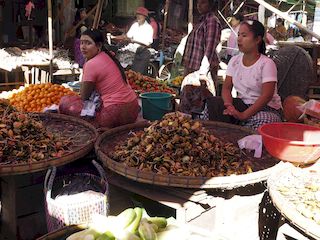
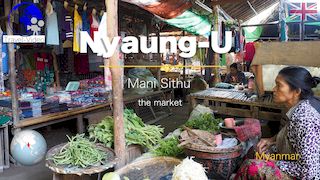
Some of the first scenes focus on the market, an essential institution in cities across Myanmar. Morning markets are not only places of trade but also centres of social interaction, where urban residents, farmers and travelling vendors meet. Vegetables, fruit, fish, spices, household goods and textiles circulate through these spaces from the earliest hours of the day.
In Bago, the market provides an important counterpoint to the religious monuments for which the city is known. It reminds visitors that historic capitals survive through commerce, work and local exchange as much as through their architectural legacy.
The market also reflects the wider economy of the region. Agricultural produce from surrounding areas enters the city, while goods and services move outward in return. In this sense, the market connects rural landscapes with urban life.
By including these scenes, the video gives Bago a human scale. Behind every pagoda and monastery stands a city sustained by labour, trade and routine daily movement.
Kya Khat Waing Monastery and the monastic tradition
A major highlight of the video is Kya Khat Waing Monastery, known for its large resident monastic community. In Theravāda Buddhist societies such as Myanmar, monasteries are not only religious institutions. They also function as centres of education, discipline, learning and moral authority.
The scenes showing monks receiving meals are especially meaningful. In Buddhist tradition, monks depend largely on lay donations for food and material support. This creates a reciprocal relationship: the monastic community dedicates itself to study and religious practice, while lay society gains merit through generosity.
The orderly movement of monks, the calm atmosphere and the precision of collective routines reveal the importance of discipline within monastic life. Even for viewers unfamiliar with Buddhist customs, these moments make visible the role of the monastery within Myanmar society.
Kya Khat Waing is therefore more than a building. It is a living institution where religion is practiced collectively every day.
Monumental Buddhas and pagodas of Bago
The video then turns to several of the city’s most famous sacred monuments. Kyaig Pun Pagoda is celebrated for its four colossal seated Buddhas placed back to back, each facing a different direction. This unusual composition creates one of the most striking religious images in Myanmar and gives the monument a strong symbolic presence.
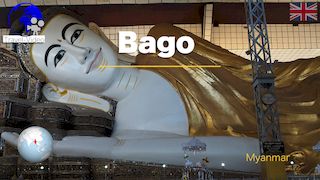
Shwe Tha Lyaung, the great reclining Buddha, is another of Bago’s most renowned sites. Its immense scale, serene expression and carefully finished details reflect a long artistic tradition in which spiritual meaning and monumental form are closely linked. Reclining Buddha images generally evoke the Buddha’s final passing into nirvana.
Shwe Maw Daw Pagoda dominates the skyline with its soaring golden stupa. For centuries it has served as a visual landmark, pilgrimage destination and major religious symbol of the city. Like other great pagodas of Southeast Asia, it combines devotional importance with civic identity.
Seen together, these monuments demonstrate the variety and richness of Burmese Buddhist architecture.
Historical and cultural background
Bago experienced several periods of prosperity, especially under the Mon kingdom of Hanthawaddy and later during the Toungoo era. Its strategic position between inland routes, river systems and maritime trade networks contributed to its wealth and political importance.
As in many parts of Asia, rulers often expressed legitimacy through religious patronage. Building or restoring pagodas, monasteries and sacred images linked royal authority with merit, prestige and public devotion.
Although wars, shifting capitals and later reconstructions altered the city over time, Bago retained its status as an important spiritual centre. Many present monuments reflect multiple historical phases, combining older traditions with later restorations.
Today, the city remains an essential reference point for understanding the history of southern Myanmar and the evolution of Buddhist urban culture.
What the videos on this site make especially clear
The videos on travel-video.info, often created from carefully selected and animated photographs, are particularly effective for a city such as Bago. They allow viewers to move gradually from the busy market to the ordered calm of a monastery, then onward to monumental sacred sites.
This format encourages close observation of details that may be missed during a fast visit: the expressions of Buddha images, the textures of gilded surfaces, the scale of monastic halls or the gestures of market vendors at work.
Transitions between scenes also help explain the relationships between places. Bago appears not as a series of disconnected attractions, but as a coherent urban world where commerce, religion and historical memory coexist.
That progressive visual reading often makes complex places easier to understand than a brief on-site impression.
A major city of Myanmar between devotion and daily life
Bago brings together several defining elements of Myanmar: grand pagodas, monumental Buddhas, monastic traditions and active urban markets. For that reason, it is far more than a simple stop on a travel route. Visitors wishing to explore further can turn to the detailed pages devoted to the monuments, market life and monastic customs, which reveal the deeper richness of this historic city.
Links to related pages











Audio Commentary Transcript
In Myanmar, there is no shortage of monks. We see them everywhere. At dawn, monks of all ages roam the streets of towns and countryside begging for food and collecting donations for the monastery. They are mainly men but it is not uncommon to see women dressed in pink as well. The color of men's clothing is brown.
And in Bago, city where one of the largest monasteries in the country is located, the Kya Kha Wain Kyaung monastery, where the monks meet around 11 a.m. to share their last meal of the day.
Imposing, these four seated Buddhas 20 meters high and who look recent are however more than 7 centuries old.
The huge reclining Buddha of Shwe Tha Lyaung is over 55 meters long and it is the oldest reclining Buddha in Myanmar in length. Its construction dates back more than 1000 years. During its existence it was restored many times and then it ended up disappearing, swallowed up by the Burmese jungle.
It was not until the 19th century that the British did not rediscover it.
To preserve this exceptional monument, a large hall was built around the statue.
The Shwe Maw Daw Pagoda is the highest in the country with its 114 meters. It was built around the 10th century but was destroyed several times by earthquakes. The Stupa would contain two hair and a tooth of Buddha.

Music:
- - YouTube video library - Missing Pieces
- - YouTube video library - People Watching
- - YouTube video library - Spying in the 60's
- - YouTube video library - Vacation Casual
Disclaimer: Despite its appropriateness, copyright issues prevent the use of burmese traditional music in "Bago (Pegu), monks and Buddhas • Myanmar", hence the use of royalty-free music. Despite our careful selection, some might regret this decision, which is necessary to avoid potential lawsuits. Although difficult, this decision is the only viable solution.