Français (France)
  Nederlands (nl-NL)
 00:00 • intro | 00:39 • outside the monastery | 01:44 • in the monastery | 03:17 • on a terrace outside the monastery
Personal creation from visual material collected during my trip Myanmar • Burma (2016)
Map of places or practices in Pa Khan Gyi on this site
• Use the markers to explore the content •
Pa Khan Gyi and the Tradition of Wooden Monasteries in Myanmar
A Religious Site Shaped by Burmese Architectural Traditions
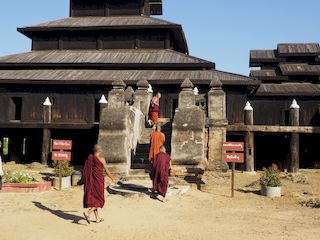
Pa Khan Gyi reflects a long-standing architectural tradition that played an important role in the religious and cultural history of Myanmar. Built primarily in wood, the monastery illustrates construction techniques that were widely used in Burmese monastic architecture before modern materials became dominant. Through its halls, terraces and exterior galleries, the site reveals how architecture was adapted both to Buddhist religious life and to the tropical climate of the region.
The video explores different aspects of the monastery and its surroundings. Exterior views highlight the elevated wooden structures, layered roofs and open spaces that characterize many traditional Burmese religious buildings. The atmosphere of the site is closely linked to the use of teak and other durable woods that allowed monasteries to withstand humidity and seasonal weather conditions for long periods.
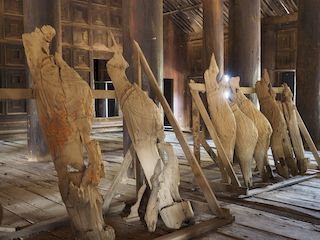
Inside the monastery, the arrangement of columns, corridors and open halls creates a succession of perspectives that emphasize balance and spatial harmony. The carved wooden elements, even when relatively restrained, demonstrate the importance of craftsmanship in Burmese religious architecture.
Architectural Spaces and Monastic Atmosphere
The journey through the monastery gradually reveals several complementary dimensions of the site. The exterior sections first focus on the overall structure of the building, allowing viewers to observe the proportions of the roofs, the raised platforms and the relationship between the monastery and its immediate environment.
The interior spaces provide a different reading of the monument. Rows of wooden pillars create deep visual perspectives that guide movement through the building while also helping ventilation and natural cooling. Openings toward the outside allow light to filter into the prayer halls, reinforcing the connection between architecture and climate adaptation.
The terrace outside the monastery introduces another important feature of Burmese monastic design. Transitional spaces between interior and exterior areas were often essential parts of daily life, serving as places for rest, observation or informal gatherings. From these terraces, the surrounding landscape becomes part of the visual experience of the monastery itself.
Historical and Cultural Context
Wooden monasteries occupy a significant place in the architectural heritage of Myanmar. For centuries, Buddhist kingdoms encouraged the construction of monasteries that functioned not only as religious centers but also as places of learning and cultural transmission. Wood remained the preferred material in many regions because of its availability and its resistance when properly maintained.
Many historic wooden monasteries have disappeared over time due to fires, conflicts, climate conditions or urban transformations. The surviving examples therefore provide valuable insight into traditional Burmese construction methods and religious environments. Architectural features such as elevated floors, wide roofs and ventilated galleries reveal how local builders adapted religious structures to monsoon conditions and high temperatures.
The monastery shown in the video also illustrates the close relationship between Buddhist practice and architectural organization. The open halls, circulation spaces and shaded terraces were designed to support both communal activities and quieter moments of contemplation.
What These Videos Make Easier to Observe
The videos on travel-video.info are largely built from carefully selected and animated photographs. This approach makes it easier to observe architectural details that can sometimes pass unnoticed in continuous motion footage. Wooden textures, carved decorations, structural alignments and spatial depth become more readable through slow transitions and carefully framed compositions.
The gradual progression between wide views and close details also helps viewers understand the organization of the monastery as a whole. Terraces, interior halls and exterior structures can be connected visually, creating a clearer understanding of how the different spaces relate to one another.
A Glimpse into Myanmar’s Wooden Monastic Heritage
Pa Khan Gyi offers an opportunity to discover an important aspect of Myanmar’s religious and architectural heritage through the preserved atmosphere of a traditional wooden monastery. The combination of exterior perspectives, interior spaces and architectural details reveals how Burmese monastic architecture balanced spiritual functions, craftsmanship and environmental adaptation. Visitors interested in exploring the subject further can continue through the detailed pages dedicated to related monuments and historical contexts.
Links to related pages














Audio Commentary Transcript
Between Magway and Mandalay in Myanmar, a magnificent teak wood monastery was built at the end of the 19th century and was completed in 1886. The construction lasted several years and about a hundred carpenters worked there, using traditional methods of the woodworking. Restored in 1996, it is now inscribed on the Uneso World Heritage List.
The structure of the monastery rests on 254 wooden pillars.

Music:
- - YouTube video library - A Fallen Cowboy
- - YouTube video library - Flowers in the Rain
Disclaimer: Despite its appropriateness, copyright issues prevent the use of burmese traditional music in "The wooden monastery of Pa Khan Gyi • Myanmar", hence the use of royalty-free music. Despite our careful selection, some might regret this decision, which is necessary to avoid potential lawsuits. Although difficult, this decision is the only viable solution.