Français (France)
  Nederlands (nl-NL)
 00:00 • intro | 00:44 • Walk in Little Petra | 02:49 • Musician: rebab player | 03:56 • The amazing cliffs of Little Petra
Personal creation from visual material collected during my trip Jordan (2017)
Map of places or practices in Little Petra on this site
• Use the markers to explore the content •
Little Petra: a rock-cut settlement between landscape and Nabataean heritage
A discreet site at the margins of Petra
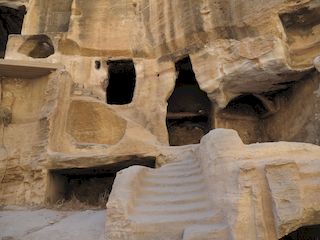
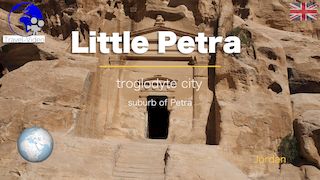
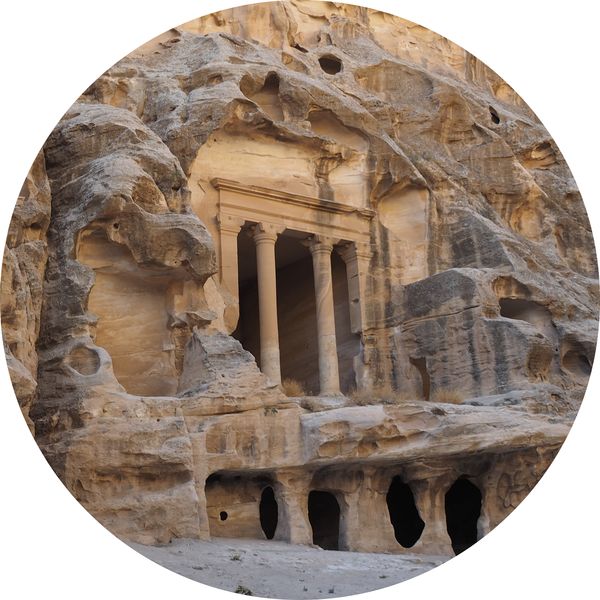
Located a few kilometres north of the famous city of Petra, Little Petra, also known as Siq al-Barid, offers a more intimate but equally meaningful insight into Nabataean culture. Carved into narrow sandstone gorges, the site unfolds within a mineral landscape shaped by erosion, where natural formations and human intervention are closely intertwined.
The video invites a gradual exploration of this environment, combining rock-cut architecture, dramatic cliff formations and a subtle presence of living cultural traditions. It highlights how the Nabataeans adapted their constructions to the geological context, creating spaces that are both functional and integrated into the surrounding terrain. The atmosphere of the site, marked by filtered light and enclosed perspectives, plays a key role in shaping its identity.
Rock-cut spaces and echoes of cultural life
As the viewer moves through Little Petra, several characteristic features of Nabataean architecture become visible. The biclinium and triclinium, carved directly into the rock, reflect the importance of communal gatherings and hospitality. These spaces, often equipped with stone benches, were designed for shared meals or receptions, suggesting a social dimension closely linked to trade and travel.
The presence of Tomb 846 introduces a funerary aspect, offering insight into Nabataean burial practices. Although less monumental than the grand façades of Petra, such structures contribute to a broader understanding of how the Nabataeans organized both their daily life and their relationship with death.
The video also incorporates a musical moment, with a musician playing the rebab. This traditional string instrument, with its simple yet expressive sound, resonates naturally within the enclosed spaces of the gorge. Its presence bridges past and present, suggesting continuity in cultural practices and enhancing the sensory perception of the site.
A landscape shaped by geology and history
The distinctive character of Little Petra is inseparable from its geological setting. The sandstone cliffs, marked by layers, colour variations and irregular forms, create a dynamic backdrop that guided the placement of architectural elements. Rather than imposing structures onto the landscape, the Nabataeans worked within it, carving spaces that respond directly to the natural contours of the rock.
Historically, the site was part of the wider Nabataean trade network that flourished between the first century BCE and the first century CE. Little Petra is often interpreted as a stopping point for caravans, complementing the more ceremonial and monumental functions of Petra itself. This role helps explain the presence of reception spaces and the relatively modest scale of the architecture.
The organisation of the site reflects practical needs as well as strategic considerations. Positioned along important routes, it offered shelter, rest and interaction for travellers, while remaining closely connected to the economic and cultural life of the region.
A visual reading that clarifies space and integration
The videos on this site are primarily built from carefully selected photographs, animated through smooth transitions and controlled framing. This approach allows for a precise reading of architectural and natural elements, particularly in sites where spatial relationships are not immediately evident.
In Little Petra, this method highlights the integration of built spaces into the rock. The viewer can observe how chambers open onto narrow passages, how light enters the carved interiors, and how textures of stone surfaces vary across the site. Details that might be overlooked during a quick visit become more legible, while the overall structure of the site remains clear.
The inclusion of the musical sequence enhances this visual continuity, adding an acoustic dimension that reinforces the perception of the site as both an archaeological space and a lived environment.
A complementary perspective on Nabataean culture
Little Petra offers a different perspective from the monumental grandeur of Petra, focusing instead on more functional and everyday aspects of Nabataean life. Through its carved spaces, its geological setting and the subtle presence of cultural expression, the site reveals a more intimate dimension of this civilisation. For a deeper understanding, the dedicated pages on individual structures provide further detail on their function and architectural characteristics.
Links to related pages


Audio Commentary Transcript
If Petra, a magnificent troglodyte site in Jordan is extremely lively and receives millions of tourists each year, Little Petra which is a few kilometers away also offers impressive monuments excavated in the rock, but in a more than appreciable calm.
A few kilometers from Petra in Jordan is another Nabataean site, much smaller than Petra (see: https://www.travel-video.info/videos/petra-jordanie.html). The site dates from the same period and also presents buildings excavated in the rock. Historians believe it was a suburb of Petra where wealthy merchants lived and enjoyed themselves.
Music:
- - YouTube video library - A Fallen Cowboy
- - YouTube video library - Desert Caravan
Disclaimer: Despite its appropriateness, copyright issues prevent the use of jordanian traditional music in "Little Petra, troglodyte city • Jordan", hence the use of royalty-free music. Despite our careful selection, some might regret this decision, which is necessary to avoid potential lawsuits. Although difficult, this decision is the only viable solution.