Français (France)
  Nederlands (nl-NL)
 00:00 • intro | 00:10 • Landscape seen from the summit of Mount Nebo | 00:47 • the basilica and its mosaics
Personal creation from visual material collected during my trip Jordan (2017)
Map of places or practices in Mount Nebo on this site
• Use the markers to explore the content •
Mount Nebo: a summit between landscape and biblical memory
A place of vision overlooking the Jordan Valley
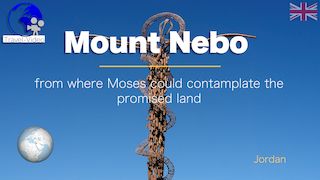
Rising west of Madaba, Mount Nebo occupies a distinctive position in both geography and tradition. From its summit, the land opens toward the Jordan Valley, the Dead Sea and, on clear days, the hills beyond. This elevated vantage point has long been associated with the final moments of Moses’ journey, when, according to tradition, he was granted a view of the Promised Land without entering it.
The site combines this symbolic dimension with a tangible landscape shaped by arid plateaus and distant horizons. The video explores this dual character, where the experience of space and the weight of cultural memory are closely intertwined. The broad panorama is not only a visual feature but also a key element in understanding the historical and spiritual significance of the place.
The panorama and the basilica
The wide view from Mount Nebo forms a central aspect of the visit. The terrain unfolds in layers, from the immediate slopes to the distant outlines of the Jordan Valley. This openness contrasts with the enclosed and more defined space of the nearby basilica, creating a transition between landscape and architecture.
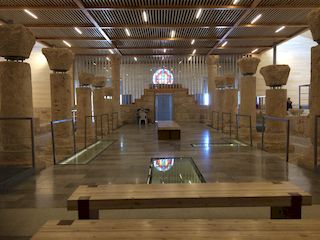
The Basilica of Saint Moses stands close to the summit and represents the architectural focus of the site. Built over earlier religious structures, it preserves a series of Byzantine mosaics that are among its most significant features. These floor decorations display a range of motifs, including animals, geometric patterns and scenes from daily life, reflecting both artistic skill and symbolic intent.
The relatively restrained architecture of the basilica serves to highlight these mosaics, which constitute the primary visual and historical interest. Together, the building and its decorative elements illustrate how sacred space was shaped and maintained across successive periods.
Historical context and cultural significance
Mount Nebo has been a place of pilgrimage since early Christian times, when the association with Moses became firmly established in religious tradition. The construction of churches on the site reflects its importance as a location of remembrance and contemplation. Over time, different phases of building and restoration have contributed to the form visible today.
The mosaics within the basilica belong to the broader tradition of Byzantine art in the region, where such works played both decorative and didactic roles. They conveyed symbolic meanings while also reflecting aspects of everyday life, offering insight into the cultural environment of the period.
The surrounding landscape further reinforces the site’s significance. Positioned at the edge of the plateau, Mount Nebo marks a threshold between different geographical zones, from highlands to valley. This transitional setting contributes to its enduring symbolic resonance.
A visual approach that connects scale and detail
The videos presented on this site rely on carefully selected photographs, arranged through smooth transitions and controlled framing. This method allows for a gradual reading of places where multiple layers of meaning coexist.
At Mount Nebo, this approach clarifies the relationship between the expansive landscape and the more intimate architectural space of the basilica. The viewer is guided from wide panoramic views to the intricate details of the mosaics, creating a coherent understanding of the site.
The textures, patterns and spatial organization become easier to observe, while the continuity between different elements is maintained. This visual progression enhances the perception of both the monument and its environment.
A site of memory and perspective
Mount Nebo remains a place where landscape and tradition converge. Through the interplay of panoramic views and architectural remains, the video offers an accessible introduction to a site shaped by history and belief. For a deeper exploration, the dedicated page on the basilica provides further insight into its structure and its mosaics, extending the understanding of this significant location.
Links to related pages


Audio Commentary Transcript
After leaving Egypt and many adventures explained in detail in the bible, Moses arrived on Mount Nebo with a splendid view of the Jordan Valley.
As Moses had done some nonsense the details of which are recorded in the sacred book, God told him that he could look at the Promised Land with his eyes ... but not enter it.
Moses therefore died at the age of 120 at the top of Mount Nebo. No guarantee that the place where Moses died is actually here, but it is here that a basilica dedicated to Moses was built around the 5th century AD and this basilica (recently restored) contains magnificent mosaics.

Music:
- - YouTube video library - Alone
Disclaimer: Despite its appropriateness, copyright issues prevent the use of jordanian traditional music in "Mount Nebo, end of Moses' journey • Jordan (EN)", hence the use of royalty-free music. Despite our careful selection, some might regret this decision, which is necessary to avoid potential lawsuits. Although difficult, this decision is the only viable solution.