

 Français (France)
  Nederlands (nl-NL)
 00:00 • intro | 00:23 • the Citadel | 02:43 • amphitheater | 03:51 • the odeon | 05:13 • the blue mosque | 06:35 • the automobile museum
Personal creation from visual material collected during my trip Jordan (2017)
Map of places or practices in Amman on this site
• Use the markers to explore the content •
Amman, a Capital Between Antiquity, Modernity and National Memory
A Hill City at the Crossroads of the Near East
Capital of Jordan, Amman is today one of the principal cities of the Levant. Built across a series of hills and valleys, it combines ancient remains, modern districts, national institutions and intense urban life. Its landscape of pale stone, steep relief and contemporary expansion gives the Jordanian capital a distinctive identity.
Amman occupies a site inhabited since antiquity, long before becoming the political centre of the Hashemite Kingdom. It was connected successively to the Ammonite world, the Hellenistic age, the Roman Empire, Byzantine traditions and Islamic rule before emerging in the twentieth century as the capital of a modern state undergoing rapid transformation.
This video explores several emblematic places reflecting that diversity: the citadel overlooking the city, Roman monuments in the historic centre, a major contemporary mosque and a museum devoted to automobiles. Together they illustrate the continuous dialogue between ancient heritage and present-day national identity.
Major Sites Featured in the Video
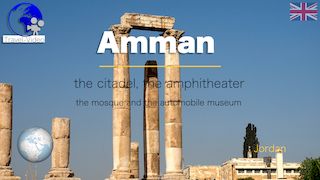
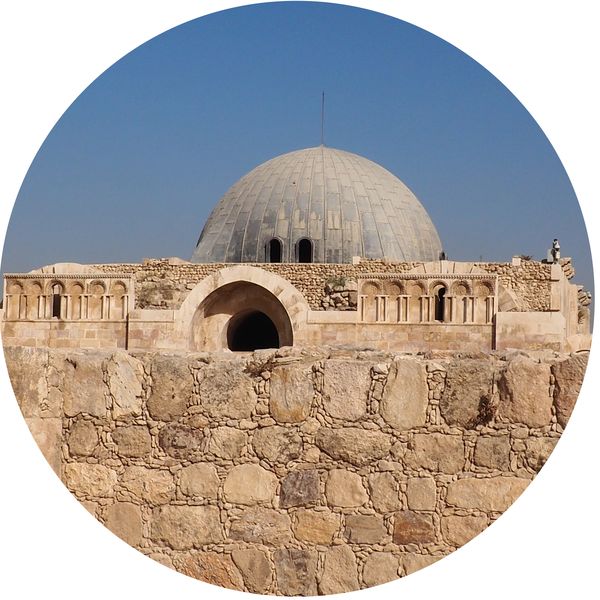
The Citadel of Amman is one of the city’s most important landmarks. Occupying a strategic hilltop, it offers broad views over the surrounding neighbourhoods. The site preserves remains from several historical periods, making it a condensed summary of local urban history. Temples, fortifications and Islamic-era structures all testify to long continuity of occupation.
At the foot of the hills stands the Roman Theatre, one of the best-known monuments in Amman. Carved into the natural slope, it reflects the importance of the city during the Roman period, when it was known as Philadelphia. Its monumental scale contrasts strikingly with the busy modern centre surrounding it.
Nearby, the Odeon complements this classical heritage. Smaller than the theatre, it was intended for more intimate performances, often musical or civic in nature. Its presence recalls the richness of Roman public life.
The Blue Mosque introduces a more contemporary dimension. Its religious architecture, domes and urban presence illustrate the role of Islam in modern Jordanian society.
The Automobile Museum adds an unexpected perspective by connecting recent national history with vehicles associated with the monarchy and key moments of the twentieth century.
Historical, Urban and Architectural Context
The site of Amman was known in antiquity as Rabbath-Ammon, centre of the Ammonite kingdom. After the Hellenistic conquests, it became Philadelphia and was later integrated into the Roman world. Several of the city’s major surviving monuments date from this period.
During the Byzantine era and the early Islamic centuries, Amman retained varying regional importance. Structures were transformed, reused or abandoned according to changing political and economic circumstances. As in many ancient cities, layers of history gradually accumulated on the same ground.
The modern revival of Amman belongs mainly to the twentieth century. With the creation of the Emirate of Transjordan and later the Hashemite Kingdom, the city became the administrative and political capital. Its population grew rapidly through regional migration and economic development.
Architecturally, Amman is distinguished by frequent use of pale limestone, which gives visual unity to districts of very different character. Residential buildings, public institutions and older monuments often share this luminous material palette. The city’s hilly terrain also creates unusual perspectives and dramatic urban settings.
What the Videos on This Site Make Especially Clear
The videos presented on this site are often built from carefully selected photographs arranged in a coherent sequence. This approach is especially suitable for a city such as Amman, where differences in elevation, chronology and urban function are essential to understanding the whole.
Views from the Citadel immediately reveal the general structure of the capital. One can perceive the succession of built hills, the density of development and the way ancient high points still dominate the modern city.
Images of the Roman Theatre make its position within today’s urban fabric easier to appreciate. Viewers understand how a major Roman monument continues to occupy the living heart of the capital.
Changing angles around the Odeon and nearby remains show the close relationship between archaeological spaces and contemporary circulation. This coexistence is one of Amman’s defining characteristics.
The Blue Mosque also benefits from this visual treatment. Domes, minarets, proportions and decorative details appear progressively, helping viewers understand its symbolic role within the cityscape.
Finally, the Automobile Museum reminds us that the history of a capital is not limited to antiquity. Twentieth-century objects and national memory usefully complete the story told by older monuments.
A Multiple Capital Looking Toward the Future
Amman is neither an open-air museum nor a metropolis detached from its past. It combines ancient heritage, modern institutions, active religious life and national memory within a single urban landscape.
The detailed pages linked to this video offer the opportunity to explore its principal monuments further, understand their history more deeply and discover the distinctive role of Amman in the development of contemporary Jordan.
Links to related pages

Audio Commentary Transcript
Amman, capital of Jordan, conceals archaeological treasures dating from Roman times. A museum of cars that belonged to the royal family is also impressive.
Amman is the capital and largest city of Jordan. Already around 7250 BC the place was inhabited. Statues from the period bear witness to this. The Romans and Greeks called it Philadelphia and the current name was given given during the Islamic period.
The city has a little over 4 million inhabitants. The population swelled following the numerous exoduses during the 20th century. Among these are the Palestinian refugees and more recently the Syrians.
Music:
- - YouTube video library - At Odds
- - YouTube video library - Becoming
- - YouTube video library - The Arid Land
Disclaimer: Despite its appropriateness, copyright issues prevent the use of jordanian traditional music in "Amman, the capital • Jordan ", hence the use of royalty-free music. Despite our careful selection, some might regret this decision, which is necessary to avoid potential lawsuits. Although difficult, this decision is the only viable solution.


