

 Français (France)
  Nederlands (nl-NL)
 00:00 • intro | 00:43 • surroundings of Shobak and the smallest hotel in the world | 01:35 • the crusader castle, Krak Montreal
Personal creation from visual material collected during my trip Jordan (2017)
Map of places or practices in Shobak on this site
• Use the markers to explore the content •
Shobak, Krak de Montréal: a Crusader fortress in a remote landscape
A strategic site between desert and highlands
In southern Jordan, the site of Shobak rises on a plateau overlooking dry valleys and rugged terrain. Its isolation gives it a distinctive character, where the openness of the landscape contrasts with the presence of a fortified structure that once controlled movement across the region. In this environment, marked by limited water resources and wide horizons, the remains of a medieval castle reveal a specific phase in the history of the Near East.
The video presents a gradual approach to the site, linking the surrounding landscape with the architecture of the fortress. It highlights how geography and strategy are closely connected, shaping both the placement and the function of the structures.
Surroundings and traces of contemporary life
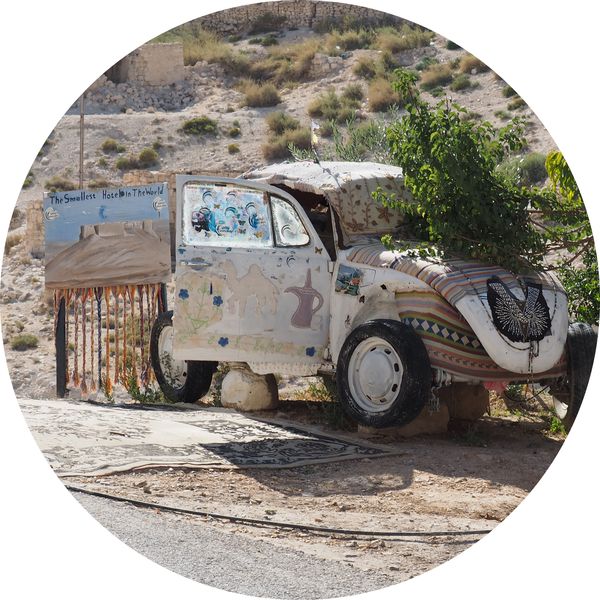
The area around Shobak offers a combination of arid plateaus and scattered signs of human activity. Cultivated patches and small constructions reflect the continued, though limited, occupation of the region. Among these elements, the presence of a very small hotel introduces a contemporary dimension that contrasts with the scale and historical weight of the nearby fortress.
This juxtaposition provides a broader perspective on the site, where modern uses of the landscape coexist with remnants of earlier periods. It also emphasizes the enduring challenges of living in such an environment, where adaptation remains essential.
The Krak de Montréal and its defensive role
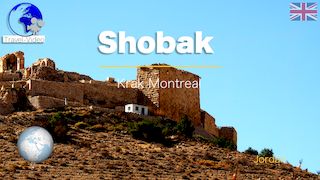
The central feature of the site is the fortress known as Krak de Montréal, built by the Crusaders in the early twelfth century. It formed part of a network of strongholds designed to control trade routes linking Arabia with the Mediterranean world. Its elevated position allowed for surveillance of the surrounding territory and reinforced its strategic importance.
The architecture reflects this defensive purpose. Thick walls, towers and internal structures were designed to withstand sieges and accommodate a garrison. Over time, the fortress underwent modifications, particularly after its capture by Muslim forces, which adapted certain parts to new uses.
Today, the ruins preserve traces of these different phases, allowing for a layered reading of the monument. Structural remains and spatial organization provide insight into both its original design and its subsequent transformations.
A visual approach connecting landscape and structure
The videos on this site are based on carefully selected photographs, assembled through smooth transitions and precise framing. This method enables a clear and progressive understanding of places where scale and context are essential.
At Shobak, this approach highlights the relationship between the fortress and its environment. The transition from wide landscape views to architectural details helps clarify the position and structure of the castle. Stone textures, wall alignments and spatial arrangements become easier to interpret, while the isolation of the site is more fully appreciated.
By linking broader perspectives with closer observations, the video offers a coherent reading of the site as a whole.
A testimony to medieval conflict and control
Shobak illustrates a period when different powers competed for control of strategic territories in the region. Through its location, architecture and historical evolution, the site reflects the interaction between military needs and geographic constraints. The video provides an accessible introduction to this context, while the dedicated page on the Krak de Montréal allows for a deeper exploration of the fortress and its history.
Links to related pages
Audio Commentary Transcript
Shobak is a fortified castle built by the king of the Crusaders Baudouin I, king of Jerusalem at the beginning of the 12th century. The name of this stronghold was the Montreal Krak but Arab historians call it Shobak. If the Crusaders went to the holy land under the pretext of delivering the tomb of Christ, their ultimate goal was much less noble. As always, everything revolves around power and conquest and there was no lack of exactions during these holy wars.
The chateau-fort was taken by Saladin after nearly two years of siege in 1189.
The fort was occupied during the 600 years following the reign of Saladin and largely destroyed by Ibrahim Pasha in 1840.
But there is another curiosity about the Shobak Bitters ... the smallest hotel in the world. But that's mostly for folklore, since it's an old converted Volkswagen Beetle.
Music:
- - YouTube video library - Air to the throne
- - YouTube video library - Anamalie, (© Anamalie by Kevin MacLeod is licensed under a Creative Commons Attribution 4.0 license. https://creativecommons.org/licenses/by/4.0/
- Source: http://incompetech.com/music/royalty-free/index.html?isrc=USUAN1500007
- Artist: http://incompetech.com/)
Disclaimer: Despite its appropriateness, copyright issues prevent the use of jordanian traditional music in "Shobak, Krak Montreal crusader fortress • Jordan", hence the use of royalty-free music. Despite our careful selection, some might regret this decision, which is necessary to avoid potential lawsuits. Although difficult, this decision is the only viable solution.


