Français (France)
  Nederlands (nl-NL)
 00:00 • intro | 01:13 • Shri Hanuman Mandir Jakhoo | 02:58 • Viceroy's Residence - Rashtrapati Niwas | 05:15 • Junga Fort - Chaurni Palace | 05:58 • Junga Fort - The Old Palace
Personal creation from visual material collected during my trip India • Hola Mohalla • Punjab • Himachal Pradesh (2018)
Map of places or practices in Shimla on this site
• Use the markers to explore the content •
Shimla, a Hill Capital Between Imperial Power and Himalayan Traditions
A Mountain City with a Political Past
Capital of today’s Himachal Pradesh, Shimla occupies a distinctive place in the history of modern India. Built across wooded ridges in the western Himalayas, the city rose to prominence during the British period, when its cooler climate made it attractive during the hot season. What began as a hill retreat gradually became an administrative centre of major importance, eventually serving as the summer capital of British India.
Topography defines the character of Shimla. Roads curve along steep slopes, neighbourhoods step across the hillsides, and many buildings command wide views over valleys and distant ranges. The video explores this unusual urban landscape through several monuments linked to religion, colonial administration and regional princely history. Together they reveal that Shimla is more than a scenic hill station: it is a place where different layers of authority and culture intersected.
Jakhoo Temple and the Sacred Landscape
One of the most visible landmarks presented in the film is Shri Hanuman Mandir Jakhoo, located on Jakhoo Hill, the highest point of Shimla. Dedicated to Hanuman, the temple remains an important devotional site for residents and pilgrims. Its elevated position gives it a symbolic and visual role far beyond its immediate precinct.
The hill itself helps explain the older identity of the area. Before Shimla became a colonial centre, surrounding heights already possessed sacred associations, local pathways and regional traditions connected with the mountain environment. The temple therefore represents continuity within a city often remembered mainly for its British-era development.
From the approaches to Jakhoo, the viewer can appreciate how religion and geography are closely linked. The temple does not stand apart from the landscape but draws meaning from height, visibility and panoramic outlooks over the ridges.
Rashtrapati Niwas and the Imperial Administration
Another major site in the video is Rashtrapati Niwas, formerly the residence of the Viceroy of India and long known as the Viceregal Lodge. This building embodies Shimla’s role as a seasonal seat of imperial government. During the summer months, leading officials moved here, and many important political discussions concerning the subcontinent took place within this setting.
The residence was designed as a prestigious administrative and ceremonial centre, suitable for receptions, meetings and official residence. Its commanding location reinforced ideas of power, order and distance from the plains below. In practical terms, Shimla allowed the colonial administration to function in a cooler environment while retaining symbolic authority.
After Indian independence, the building received new institutional uses, ensuring continuity of public significance even as its political context changed. It remains one of the clearest reminders that Shimla once stood near the centre of imperial decision-making.
Junga Fort, Chaurni Palace and Regional Courts
The sequences devoted to Junga introduce a different historical dimension. Chaurni Palace and the Old Palace of Junga recall the former princely states of the Himalayan hills. These local polities maintained their own dynasties, residences and systems of authority while existing alongside the expanding British presence.
The palaces of Junga reflect a more regional political history, centred on local rulers and territorial administration. Their inclusion in the video broadens the understanding of Shimla’s surroundings. Beyond the colonial capital there were also indigenous centres of prestige and governance, smaller in scale but historically meaningful.
Seen together, these monuments show that the history of Himachal Pradesh was shaped by overlapping structures of power: local courts, British administration and, later, modern Indian institutions.
What the Video Makes Especially Clear
Videos built from carefully selected and animated photographs are especially effective for a mountainous setting such as Shimla. They make it easier to understand how each monument relates to slope, ridge, forest and open horizon. A temple on a summit, a vice-regal residence on commanding ground and palaces linked to regional valleys can be compared within one coherent visual journey.
Gradual transitions also reveal contrasts in architectural purpose. Some sites were designed for worship, others for governance, others for dynastic residence. Differences in scale, façade treatment, approach routes and surrounding landscape become clearer when viewed through a sequence of still images rather than a hurried visit.
This format also helps connect dispersed places. Monuments separated by distance are brought into a single narrative, allowing viewers to grasp the broader historical geography of the region.
A Capital of Many Histories
Shimla brings together sacred hills, imperial memory, princely heritage and mountain scenery within one urban setting. The video offers a clear introduction to this remarkable capital and to the neighbouring sites that complete its story. For those wishing to continue the exploration, the related detailed pages provide further insight into the monuments, their architecture and their place in the history of the Himalayan foothills.
Links to related pages
• Main dynasties that ruled the region • •


Audio Commentary Transcript
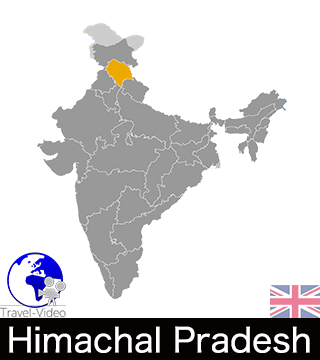
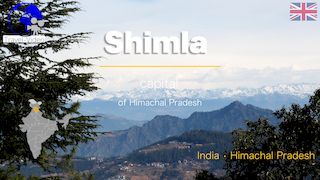
Shimla, capital of the northern state of India, Himachal Pradesh, was the summer capital of India at the time of the British Empire thanks to its temperate climate. Many traces of colonization are visible in Shimla. Churches but also a theater and the palace of the viceroy.
Shimla is the largest city in Himacha Pradesh. The Viceroy's Palace is one of the city's tourist attractions. After independence, Shimla was declared the capital of Punjab before becoming that of Himachal Pradesh. It was even the capital of British Burma between 1942 and 1945.
The city has nearly 175,000 inhabitants.

Music:
- - YouTube video library - A Fallen Cowboy
- - YouTube video library - Air to the throne
- - YouTube video library - Metamorphosis
Disclaimer: Despite its appropriateness, copyright issues prevent the use of indian traditional music in "Shimla, the capital • Himachal Pradesh, India", hence the use of royalty-free music. Despite our careful selection, some might regret this decision, which is necessary to avoid potential lawsuits. Although difficult, this decision is the only viable solution.