

 Français (France)
  Nederlands (nl-NL)
 00:00 • intro | 00:18 • Street Food and Fresh Produce | 03:02 • Goats also live in the city | 03:30 • The streets fill with colors | 04:51 • Life goes on in the streets | 05:51 • Jain devotional songs | 07:59 • Faces of Nalagarh | 08:42 • Neighbourhood temple dedicated to Durga
Personal creation from visual material collected during my trip India • Hola Mohalla • Punjab • Himachal Pradesh (2018)
Map of places or practices in Nalagarh on this site
• Use the markers to explore the content •
Nalagarh and Everyday Urban Life in Himachal Pradesh
A Different Perspective on Northern India
Located in the southern foothills of Himachal Pradesh, Nalagarh is rarely presented as a major tourist destination. Yet towns like this offer an important insight into everyday life in northern India beyond the better-known historical monuments and pilgrimage centers. The video explores this urban environment through its streets, local markets, religious practices and daily social interactions, revealing a side of India often overlooked in conventional travel narratives.
Rather than focusing on monumental architecture alone, the sequences highlight ordinary spaces shaped by commerce, community life and local traditions. Markets, neighborhood streets, devotional practices and small temples all contribute to the cultural identity of the town. Nalagarh appears not as a museum-like destination, but as a living urban landscape where religious and social activities remain deeply connected to daily routines.
Markets, Street Food and Urban Activity
Several scenes focus on local commerce and food culture. Street vendors, small neighborhood shops and displays of fresh produce illustrate the importance of informal trade in many Indian towns. These commercial spaces are not isolated from daily life but integrated directly into the streets, where business, conversation and movement continuously overlap.
The preparation of fried snacks and other street food specialties also reflects the role of public space in Indian urban culture. Food is often prepared and consumed in highly visible settings, contributing to the atmosphere and rhythm of the streets themselves.
The presence of goats moving through the town further illustrates the fluid relationship between urban and rural life. In many smaller Indian cities, domestic animals remain part of the urban environment, creating a landscape where modern traffic, traditional livelihoods and residential areas coexist within the same public spaces.
Colors, Faces and Community Life
The video pays particular attention to the people of Nalagarh. Portraits of residents, scenes of daily movement and colorful streets help convey the human dimension of the town. Clothing, shopfronts, painted walls and religious decorations contribute to a vibrant visual environment typical of many urban areas in northern India.
These details reveal how strongly social life remains connected to the street itself. Public spaces function not only as transport routes or commercial areas, but also as places of interaction, observation and shared community life.
The devotional songs performed by Jain women introduce another important aspect of local culture. Collective religious singing continues to play a major role in many Indian communities, helping preserve traditions while reinforcing social ties between families and neighborhoods. The related pages associated with the video offer a deeper exploration of these community-based religious practices.
Neighborhood Temples and Local Traditions
The small Durga temple shown in the video represents an essential feature of everyday religious life in India. Even modest neighborhood shrines often play an important role within local communities. They function not only as places of worship but also as social landmarks where residents gather during festivals, ceremonies and daily rituals.
Such temples help maintain continuity between religious traditions and ordinary urban life. In towns like Nalagarh, local shrines remain closely connected to the rhythms of the surrounding neighborhood rather than existing as isolated monuments.
Nalagarh itself also has historical roots linked to the former hill states of the Himalayan region and to trade routes connecting the Punjab plains with the mountain territories farther north. Although this historical background remains mostly indirect in the video, it helps explain the cultural diversity and social traditions still visible in the town today.
What the Videos on This Site Make Easier to Observe
The videos presented on travel-video.info are largely constructed from carefully selected and animated photographs. This approach allows viewers to observe details that often pass too quickly in conventional moving footage. Expressions, textures, architectural elements, market scenes and street activity become easier to study through gradual transitions and controlled framing.
This visual style also helps clarify the relationship between streets, religious spaces and everyday urban activity. The progressive sequencing of images encourages a slower and more attentive reading of the environment, making it possible to better understand the atmosphere and organization of the place.
Discovering the Everyday India
Through its markets, devotional traditions, neighborhood temples and street scenes, Nalagarh offers a view of ordinary urban life in northern India. The video highlights aspects of daily culture that are often overshadowed by more famous tourist sites and invites viewers to continue exploring the detailed pages dedicated to local traditions and community religious life.
Links to related pages


Audio Commentary Transcript
Traditional Shops and Local Markets
In the streets of Nalagarh, small shops still remain an important part of everyday life.
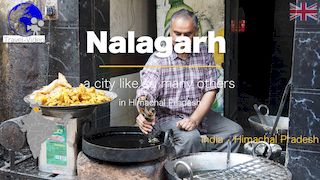
At the entrance of these modest storefronts, street vendors prepare pastries, fried snacks and traditional sweets using simple methods passed down through several generations.
In the hot oil, the golden spirals of jalebi slowly take shape, while other specialties are prepared only a few centimeters away from passersby. Here, street food is not merely a commercial activity: it accompanies the rhythm of the town, the markets, social encounters and everyday routines.
These modest shops reveal another side of urban India. Behind aging façades and narrow storefronts, they sustain a local economy based on proximity, customer loyalty and traditional craftsmanship.
In Nalagarh, these ordinary scenes still reflect a way of life largely centered on neighborhood exchanges and family-run businesses.
Street scenes
In Nalagarh, goats are a familiar part of everyday street life. They wander freely through the streets in search of food, sharing the urban space with residents, shops and daily traffic.
As Holi approaches, the streets of Nalagarh gradually fill with color. Market stalls display the powders used during the festival, while some children have already started playing with the pigments that will soon transform the atmosphere of the town. Further along the street, a fabric dyer works directly on the sidewalk outside his workshop, a reminder that colors also play an important role in many everyday crafts and trades.
Just a few streets away from the Holi preparations, everyday life quickly returns to its usual rhythm. Shopkeepers, residents and animals share the narrow streets of Nalagarh in a series of ordinary scenes reflecting the town’s constant activity. Between small workshops, utility vehicles, neighborhood shops and quieter lanes, these images provide a simple glimpse into urban life in this small town of Himachal Pradesh.
Jain songs
In a Jain neighborhood of Nalagarh, narrow lanes are lined with old houses and mansions featuring painted and decorated façades that reflect the former prosperity of merchant families. Behind these tightly packed buildings, community life still plays an important role in the daily life of the neighborhood. During religious gatherings, several women come together to perform rhythmic devotional songs, a practice that remains deeply rooted in Jain traditions.
A neighborhood temple
Small neighborhood temples like this one dedicated to Durga in Nalagarh play an important role in everyday life in India. Far more than simple places of worship, they also serve as gathering places for local residents, where religious festivals, family ceremonies and moments of reflection take place. Even modest temples help preserve traditions and strengthen community ties.

Original music – personal creation


