

 Français (France)
  Nederlands (nl-NL)
 Shri Hanuman Mandir Jakhoo, located in Shimla in the state of Himachal Pradesh, is one of the city’s best-known religious sites. Established on Jakhoo Hill, it attracts local residents, pilgrims, and visitors interested in a place closely associated with regional Hindu tradition. The temple is also appreciated for its commanding position above Shimla and for the distinctive atmosphere of its wooded surroundings. Over time, it has become an important spiritual and visual landmark of the regional capital. Its steady popularity makes it a significant element of the cultural landscape of Himachal Pradesh.
Monument profile
Shri Hanuman Mandir Jakhoo
Monument categories: Hindu Temple, Giant Statues
Monument families: Temple • Giant statues or set of statues
Monument genres: Religious
Cultural heritage: Hindu
Geographic location: Shimla • Himachal Pradesh • India
Construction period: 19th century AD
• Links to •
• List of videos about Shimla on this site •
Shimla, the capital • Himachal Pradesh, India
Shri Hanuman Mandir Jakhoo in Shimla: Historical Development of a Hilltop Sanctuary
Sacred Origins and Founding Traditions
Shri Hanuman Mandir Jakhoo stands on Jakhoo Hill, the highest point overlooking Shimla in present-day Himachal Pradesh. Its historical significance is rooted primarily in religious tradition linking the site to Hanuman, one of the central figures of the Ramayana. According to local belief, Hanuman paused on this hill while searching for medicinal herbs needed to save Lakshmana. That association gave the location enduring sacred status.
As with many shrines connected to epic traditions, the precise date of the earliest temple is not securely documented. It is likely that a modest place of worship existed before the present structures, maintained by local communities, priests, and ascetics who frequented the wooded hilltop. The continuity of devotion appears to be older than the current built fabric.
Growth During the Colonial Development of Shimla
The shrine acquired broader prominence during the nineteenth century as Shimla expanded under British rule. When the town developed into a hill station and later the summer capital of British India, roads, pathways, and urban services improved across the surrounding ridges. Jakhoo Hill became more accessible, and the Hanuman temple attracted a wider circle of visitors beyond nearby residents.
During this period, the sanctuary retained its Hindu religious role while existing beside a colonial administrative centre shaped by very different political institutions. The persistence of an established sacred site above the rapidly growing colonial town gave the temple added symbolic value for local populations. Pilgrimage, routine worship, and seasonal visits continued even as Shimla’s urban identity changed.
Twentieth-Century Expansion and Modern Alterations
After Indian independence in 1947, Shimla remained an important administrative city and later the capital of Himachal Pradesh. Population growth, domestic tourism, and improved transportation increased the number of visitors reaching Jakhoo Hill. In response, the temple complex underwent successive modifications intended to serve larger crowds.
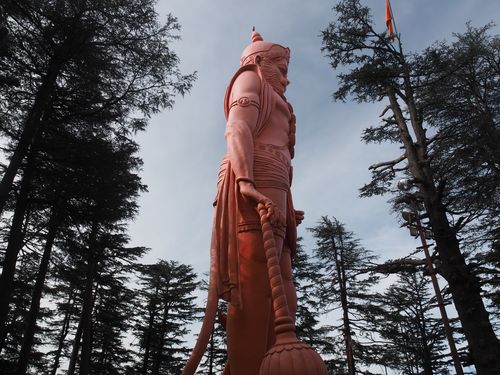
These changes included repairs to older structures, improved stairways and access routes, additional spaces for devotees, and practical facilities linked to daily management. One of the most visible modern interventions was the installation of a monumental statue of Hanuman near the temple precinct. This addition transformed the skyline of Jakhoo Hill and made the sanctuary one of Shimla’s most recognizable landmarks.
The coexistence of an older sacred core with contemporary extensions reflects the temple’s continuing religious relevance rather than a fixed historical form.
Present Role and Symbolic Importance
Today Shri Hanuman Mandir Jakhoo remains an active place of worship with daily offerings, festival gatherings, and steady pilgrimage traffic. It also receives many visitors who come for the religious atmosphere, panoramic views, and cultural significance of the site.
Its symbolic role operates on several levels. For devotees, it represents Hanuman’s strength, loyalty, and protective power. For Shimla, it is a visible spiritual marker overlooking the city. For Himachal Pradesh, it forms part of a wider network of mountain shrines where landscape and devotion are closely connected.
Ongoing preservation involves maintaining buildings, pathways, retaining walls, and visitor facilities while managing the pressures created by growing attendance and exposure to mountain weather.
Global Historical Context
The earliest phases of the shrine likely belong to a period when regional Hindu sanctuaries continued to develop across the Indian subcontinent before modern colonial rule. During the nineteenth-century rise of Shimla, Europe was undergoing industrial expansion and imperial competition. In East Asia, Japan entered the Meiji era of modernization. The temple’s modern growth took place alongside Indian independence and the political reshaping of Asia in the twentieth century.

Architectural Configuration of Shri Hanuman Mandir Jakhoo in Shimla
Hilltop Setting and Site Planning
Shri Hanuman Mandir Jakhoo occupies the summit zone of Jakhoo Hill, the highest ridge overlooking Shimla. This elevated position determines the entire architectural character of the complex. Rather than standing within a level urban plot, the temple is arranged on steep terrain surrounded by forested slopes, winding roads, stairways, and pedestrian approaches. Access is therefore an essential part of the architectural experience, as visitors ascend gradually before reaching the sacred precinct.
Because level ground is limited, the site is organized through terraces cut into the hillside. Platforms of varying size accommodate the principal shrine, circulation areas, service buildings, gathering spaces, and viewpoints. Retaining walls and stepped transitions are fundamental structural elements, stabilizing the terrain while creating usable surfaces.
The dominant topographic location also gives the temple strong visual prominence. From many parts of Shimla, the summit is identifiable through the built complex and especially through the monumental statue added in recent decades.
Main Shrine and Architectural Language
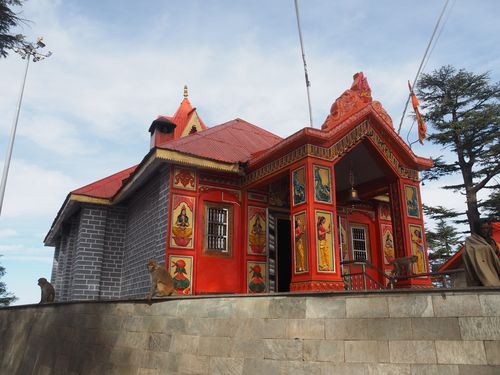
The principal temple building is relatively compact in scale, reflecting the spatial constraints of the hilltop. Its design emphasizes devotional use and continuous visitor movement rather than expansive ceremonial courts. Entrance zones lead into covered transitional areas and then toward the sanctum where the principal sacred image or symbolic focus is placed.
The elevations are composed of clear and legible volumes with painted or rendered wall surfaces. Openings are limited in number and positioned according to practical needs rather than grand façade symmetry. Bright colours commonly associated with the site, including reds, saffron tones, and white, reinforce religious identity and provide strong contrast with the surrounding vegetation and mist-prone mountain atmosphere.
Decorative features are concentrated in explicitly sacred markers: bells, flags, painted motifs, iconographic panels, and representations of Hanuman. The building does not rely on dense sculptural programmes. Instead, symbolic clarity and ritual function shape the visual language of the shrine.
Materials, Construction, and Climatic Adaptation
The mountain environment of Shimla requires robust and adaptable construction methods. The complex uses masonry walls, reinforced concrete, and modern repair materials suited to seasonal rain, fluctuating temperatures, and heavy visitor use. Older components have likely been strengthened over time through contemporary interventions rather than preserved in an untouched state.
Roof forms are especially important. Sloping or partly sloped roofs help discharge monsoon rainfall and occasional winter precipitation. Overhangs shelter entrances and circulation edges from water runoff. Exterior paving must provide traction on inclined surfaces, making textured stone, concrete, or other durable materials practical choices.
Railings, staircases, and retaining walls are as architecturally significant here as the shrine itself. On steep terrain, these elements organize movement, ensure safety, and connect fragmented levels into a coherent religious complex. Without them, the hilltop site would be difficult to occupy and maintain.
Monumental Hanuman Statue and Modern Expansion
The most visually dominant feature of the contemporary site is the colossal statue of Hanuman installed near the temple precinct. Its vertical scale dramatically alters the perception of the complex. While the historic shrine remains modest and horizontally grounded, the statue introduces a soaring landmark visible across large areas of Shimla.
This intervention changes the hierarchy of forms. The temple retains ritual centrality, but the statue functions as the principal visual sign of the site. It operates simultaneously as devotional image, urban marker, and visitor attraction. Its engineering also differs from the older shrine, relying on modern structural systems capable of supporting significant height in exposed hilltop conditions.
Recent expansions have also included widened circulation areas, waiting spaces, protective canopies, and visitor amenities intended to manage increasing attendance. The result is a layered ensemble combining older sacred architecture with contemporary pilgrimage infrastructure.
Spatial Experience and Conservation Issues
The architecture of Shri Hanuman Mandir Jakhoo is experienced through movement rather than through a single frontal view. Visitors climb paths or stairs, pass through successive terraces, encounter the statue at changing angles, and finally reach the temple itself. This ascending sequence gives the complex a processional quality closely tied to the physical act of pilgrimage.
Panoramic views over Shimla and surrounding ridges form part of the architectural composition. Landscape here is not a backdrop but an active spatial component interacting with terraces, railings, platforms, and sightlines.
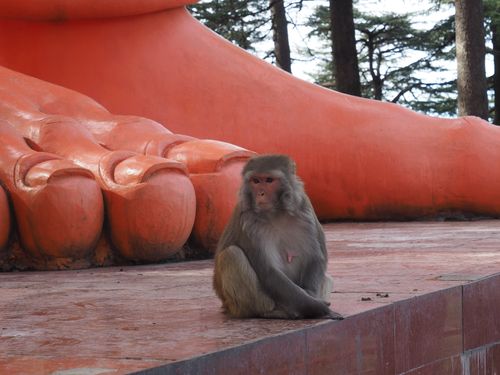
Conservation requires continuous maintenance of exposed surfaces, drainage systems, steps, retaining structures, and painted finishes. Heavy visitor traffic, mountain weather, and the well-known presence of monkeys on Jakhoo Hill create additional management demands. The site’s present form therefore depends on regular upkeep as much as on original construction.