Français (France)
  Nederlands (nl-NL)
 00:00 • intro | 00:43 • the access canyon to Petra | 02:48 • irrigation system dug in the rock | 03:55 • the Treasure (Al Khazneh) | 07:29 • 5th century church | 12:52 • the monastery
Personal creation from visual material collected during my trip Jordan (2017)
Map of places or practices in Petra on this site
• Use the markers to explore the content •
Petra, capital of the Nabataeans: a city carved into stone
A monumental landscape shaped by geology and history
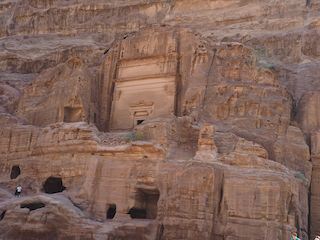
Set within the rugged mountains of southern Jordan, Petra stands as one of the most distinctive archaeological sites of the ancient world. Once the capital of the Nabataean kingdom, the city developed in a landscape of sandstone cliffs whose colours and textures define its visual identity. Rather than building with stone, the Nabataeans carved directly into it, creating an urban environment where architecture and geology are inseparable.
The video explores Petra through a selection of its most representative elements, revealing how natural formations and human interventions combine to form a coherent and structured city. It highlights both the spatial organisation of the site and the technical and symbolic dimensions that shaped its development.
From the canyon to the monumental façades
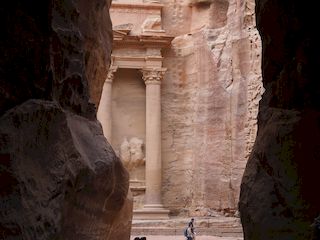
The approach to Petra begins through a narrow canyon, known as the Siq, which serves as a transitional passage into the city. Its high, enclosing walls create a controlled progression, where light and perspective shift gradually. This natural corridor plays a key role in the experience of Petra, guiding movement and framing the first encounter with its monuments.
Along this route, the remains of an irrigation system carved into the rock illustrate the ingenuity of the Nabataeans. In an arid environment, they developed methods to collect, channel and store water, ensuring the sustainability of the settlement. Channels and conduits integrated into the canyon walls reflect a sophisticated understanding of both landscape and engineering.
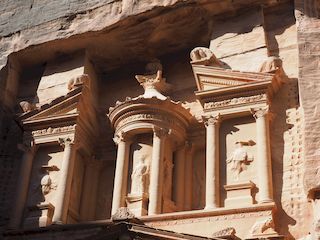
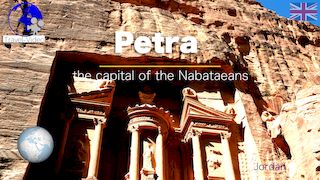
At the end of this passage appears Al Khazneh, commonly known as the Treasury. Carved into a vertical rock face, its elaborate façade combines balanced proportions with intricate decorative elements. Its position at the exit of the canyon enhances its visual impact, transforming it into a focal point within the urban sequence.
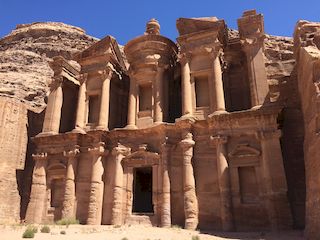
Further into the site, the remains of a fifth-century Byzantine church introduce a later phase in Petra’s history. Its mosaic floors and architectural traces indicate continued occupation and evolving religious practices. The Monastery, located on a higher plateau, offers another monumental façade, similar in scale to the Treasury but situated in a more open and isolated setting.
A city of trade, adaptation and transformation
Petra’s development was closely linked to its role in long-distance trade networks. From the first century BCE, the Nabataeans controlled caravan routes connecting Arabia, Egypt and the Levant. This strategic position allowed them to accumulate wealth and invest in large-scale architectural projects.
The city’s architecture reflects a combination of local traditions and external influences, particularly from the Hellenistic world. Columns, pediments and decorative motifs suggest cultural exchange, while the technique of carving into rock remains a defining feature of Petra’s identity. This adaptation to the environment demonstrates a practical and efficient use of available resources.
Over time, Petra underwent significant changes. Its incorporation into the Roman Empire and shifts in trade routes gradually reduced its importance. The presence of Byzantine structures shows that the site continued to be inhabited, though its function evolved. These successive layers contribute to the complexity of Petra as both a historical and archaeological landscape.
A visual reading that connects space and detail
The videos on this site are built from carefully selected photographs, assembled through smooth transitions and precise framing. This approach allows for a detailed and progressive understanding of complex sites such as Petra.
In this context, the visual sequence clarifies the relationship between movement and architecture. The transition from the canyon to the Treasury, the passage through different zones of the city and the ascent toward the Monastery become more legible. Technical features, such as the irrigation system, can be examined closely, while the sculpted façades reveal their structure and ornamentation.
By linking broad spatial views with detailed observations, the video provides a coherent reading of the site, highlighting both its scale and its intricacy.
An enduring testimony to Nabataean ingenuity
Petra remains a remarkable example of how a society adapted to a demanding environment while creating a complex and visually striking urban centre. Through its combination of natural landscape, engineering solutions and monumental architecture, the site reflects the ingenuity and cultural richness of the Nabataeans. The video offers an accessible introduction to this exceptional heritage, while the dedicated pages on individual monuments allow for a deeper exploration of their history and architectural features.
Links to related pages
Audio Commentary Transcript
This is certainly one of the less glorious aspects of Petra. The mistreatment of the horses that bring tourists to the site is matched only by that of the donkeys climbing the stairs to the monastery in the center of the site ...
But as long as we make these journeys on foot, the site of Petra is fabulous.
Petra is certainly the most famous site in Jordan.
Its origin remains mysterious but it was the capital of the Nabataeans at the beginning of our era.
Located in the desert, Petra was a commercial center on the caravan route. It is this geographical location that for a long time made the fortune of the merchants who lived in the locality.
As the city is located in a desert, water management was a major issue.
And the ingenuity of the Nabataean architects was truly remarkable and could inspire current managers. They managed to eliminate the shortage while avoiding any waste of this precious commodity that is water.