

 Français (France)
  Nederlands (nl-NL)
 The Byzantine Church of Petra stands within the urban area of the ancient city of Petra in Jordan. It belongs to the Byzantine period, when the former Nabataean capital continued to function as an important regional centre after the Roman annexation. The remains of the building provide evidence for the presence of an organized Christian community in Petra during Late Antiquity. Archaeological excavations carried out in the twentieth century revealed the structure and associated finds, which contribute significantly to the understanding of the city’s religious and social development during the Byzantine era. Today the monument forms part of the broader archaeological landscape of Petra and illustrates the continuity of settlement in the region.

Monument profile
Byzantine Church
Monument categories: Church, Ancient mosaics
Monument families: Church, cathedral, basilica, chapel • Archaeological
Monument genres: Religious, Archaeological site
Cultural heritage: Byzantine
Geographic location: Petra • Jordan
Construction period: 5th century AD
This monument in Petra is inscribed on the UNESCO World Heritage List since 1985 and is part of the serial property "Petra".See the UNESCO monuments featured on this site
• Links to •
• List of videos about Petra on this site •
Petra, the capital of the Nabataeans • Jordan
• References •
UNESCO: Petra
History of the Byzantine Church of Petra
Foundation and historical context of construction
The Byzantine Church of Petra was constructed during the sixth century CE, a period when Petra remained an inhabited urban centre within the Byzantine province of Arabia. Although the city had lost the political prominence it possessed during the Nabataean kingdom and the early Roman period, archaeological evidence indicates that a structured community continued to occupy parts of the urban area. The establishment of a church within the city reflects the consolidation of Christianity in the region during Late Antiquity.
The construction of the building appears to have been linked to the presence of a local Christian community organized within the ecclesiastical structures of the Byzantine Empire. Petra had become integrated into the administrative and religious networks of the province, and the creation of a substantial place of worship suggests institutional support from ecclesiastical authorities as well as participation by local elites. The scale and architectural organization of the monument indicate that it functioned as an important religious building within the late urban landscape of Petra.
Religious function and associated documentary evidence
During the Byzantine period, the church served as a centre of Christian worship for the population living within Petra and its immediate surroundings. Liturgical ceremonies and communal gatherings took place within the building, which formed part of the religious infrastructure of the city during the sixth century.
Excavations carried out at the site uncovered a large collection of papyrus documents dating mainly from the sixth century. These texts, known as the Petra papyri, were found within the church complex and provide rare documentary evidence concerning the administration and economic life of the region. The documents include legal contracts, records of property ownership and administrative correspondence related to local land management. Their presence indicates that the church complex may have also functioned as a place where documents were stored or managed, linking the religious institution to the civic life of the community.
The papyri reveal the existence of an active local society involved in agriculture, land administration and regional governance. Through these documents, the church emerges not only as a place of worship but also as a setting connected to the administrative practices of the late Byzantine city.
Earthquake damage and decline of use
The church was affected by a major earthquake that struck the region in 551 CE. Archaeological investigations indicate that the seismic event damaged several structures within Petra, including parts of the church complex. Evidence of repairs and architectural adjustments suggests that the building continued to be used after the earthquake, although its condition may have been altered.
During the later Byzantine period the urban importance of Petra gradually declined. Changes in trade routes and administrative structures reduced the role of the city as a regional centre. As settlement contracted, several urban areas were progressively abandoned. The Byzantine church eventually ceased to function as an active place of worship, and the building fell into disuse.
Over time the structures were partially buried beneath debris and sediments derived from the surrounding landscape. The remains of the church remained concealed until archaeological investigations undertaken in the twentieth century exposed the foundations, pavements and associated structures.
Present condition and archaeological research
Modern archaeological excavations conducted from the late twentieth century onward revealed the layout of the church and the associated papyrus archive. The excavation of the building provided significant insight into the urban organization of Petra during the Byzantine period and clarified the role of the Christian community within the city.
Today the remains of the Byzantine Church form part of the archaeological complex of Petra. The visible structures consist mainly of foundations, architectural bases and mosaic pavements uncovered during excavation. These remains allow researchers to reconstruct the historical development of the monument and its function within the late antique city.
The site of Petra was inscribed on the UNESCO World Heritage List in 1985 under the official designation “Petra.” The Byzantine Church is included within this protected archaeological landscape and benefits from the preservation measures applied to the wider site.
Global historical context
The main period of activity of the Byzantine Church of Petra occurred during the sixth century CE. At the same time the Byzantine Empire was ruled by Emperor Justinian I, whose reign was marked by major building programs and legal reforms. In western Europe, former Roman territories were governed by various Germanic kingdoms. In East Asia, China experienced the transition from the Northern and Southern Dynasties toward the Sui dynasty. In South Asia, regional kingdoms controlled important trade networks linking the Indian Ocean to the Near East.
Architecture of the Byzantine Church of Petra
Site placement and general architectural layout
The Byzantine Church of Petra stands within the urban area of the ancient city, on a terrace slightly elevated above the surrounding terrain and close to the former colonnaded street that structured Petra’s urban axis during the Roman and Byzantine periods. The building occupies a leveled platform prepared to stabilize construction on ground composed of sediment deposits and sandstone fragments derived from the surrounding cliffs.
The church formed part of a broader architectural complex including auxiliary spaces attached to the basilical structure. These annexes created an integrated ensemble within the late antique urban landscape of Petra. The building follows a west–east orientation, with the main entrance on the western side and the sanctuary located at the eastern termination of the plan.
Exterior circulation zones connected the church with adjacent urban spaces. Paved surfaces and prepared thresholds structured the transition between the surrounding streets and the interior of the ecclesiastical complex. The footprint of the monument indicates deliberate construction within an already developed urban environment rather than the establishment of an isolated religious building.
Spatial organization of the basilica
The interior plan follows a basilical configuration composed of a central nave flanked by two lateral aisles. The nave forms the principal interior space intended for the congregation and occupies the longitudinal axis of the building. The aisles are separated from the nave by rows of architectural supports that originally carried the upper structural elements of the roof.
At the eastern end lies the liturgical area. This space includes the sanctuary, which is slightly elevated above the level of the nave floor and establishes a clear spatial hierarchy between the clerical zone and the congregational area. The sanctuary terminates in a semicircular apse that forms the focal point of the interior.
The lateral aisles provided circulation routes along both sides of the nave, allowing movement within the building while maintaining visual orientation toward the sanctuary. This arrangement organized the flow of participants during religious ceremonies.
Several auxiliary rooms were attached to the sides of the basilica. These spaces were connected to the main structure through controlled passages and were associated with the administrative and ritual functions of the church complex. Their regular positioning along the flanks of the basilica indicates planned integration within the architectural design.
Construction materials and building techniques
The structural walls of the Byzantine Church were constructed mainly from locally quarried stone blocks. These blocks were cut into relatively regular shapes and arranged in horizontal courses forming thick masonry walls capable of supporting the superstructure and roofing elements.
In several parts of the building, architectural fragments from earlier structures were reused. This practice of incorporating spolia is visible in blocks integrated into the masonry and reflects the reuse of material from earlier buildings within Petra.
The foundations were adapted to the irregular terrain through leveling layers composed of rubble and compacted fill. These preparatory layers created a stable base for the walls and interior supports, compensating for uneven ground conditions.
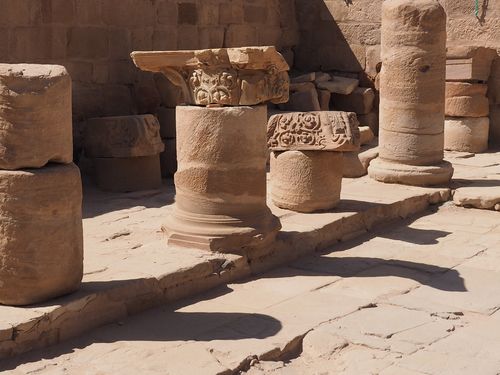
Inside the basilica, the supports separating the nave from the aisles rested on stone bases designed to distribute structural loads. These bases formed the foundation for columns or pillars that supported the upper parts of the structure and established the rhythm of the interior architectural space.
Interior decoration and architectural elements
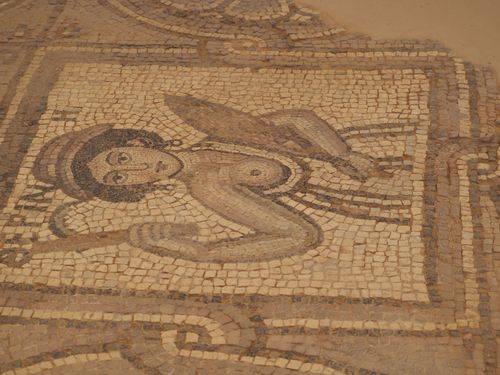
One of the most distinctive features of the Byzantine Church of Petra is the extensive mosaic pavement that once covered large portions of the interior floor. These mosaics consist of small tesserae arranged in complex decorative compositions combining geometric patterns, framed panels, and figurative representations.
The distribution of the mosaic decoration corresponds closely to the spatial organization of the basilica. Different panels mark distinct functional areas of the building, distinguishing the nave, the aisles, and the zones closer to the sanctuary. Geometric borders and framing motifs structure the floor surface and emphasize the longitudinal axis of the interior.
The sanctuary zone contained architectural installations associated with liturgical activity. Archaeological remains indicate the presence of structures that demarcated the sacred space within the church. Although these elements survive mainly as fragments, their bases and associated traces confirm the existence of installations related to ceremonial functions.
Stone bases, column fragments, and other architectural elements uncovered during excavation provide evidence for the vertical structural components that once articulated the interior. These features contributed both to the structural stability of the building and to the spatial organization of the basilical hall.
Architectural transformations and preservation
Archaeological investigations have revealed several phases of modification within the church complex. Certain sections of the walls and interior features display signs of repairs or structural adjustments undertaken during the period of use of the building. These interventions reflect attempts to maintain the stability of the structure after episodes of damage.
Evidence indicates that seismic activity affected Petra during Late Antiquity. Repairs carried out after these events altered some architectural elements while preserving the overall layout of the basilica. Variations in masonry techniques in certain areas correspond to these later phases of reconstruction.
Over time the upper parts of the building disappeared, leaving primarily foundations, lower wall sections, and floor pavements. The remains visible today consist mainly of the base structures that define the architectural plan. Mosaic pavements uncovered during excavation remain among the most prominent elements preserved on the site.
The present condition of the monument reflects both ancient structural alterations and natural erosion. Despite the loss of the superstructure, the surviving foundations, column bases, and decorative pavements make it possible to reconstruct the spatial organization of the building and to understand the architectural design of this Byzantine ecclesiastical complex within Petra.