

 Français (France)
  Nederlands (nl-NL)
 The Monastery, known as Ad Deir, is one of the most striking monuments in the archaeological site of Petra in southern Jordan. Carved directly into the sandstone cliffs, this monumental structure illustrates the historical significance of Petra during the Nabataean period. It stands on a high plateau overlooking the surrounding landscape and can be reached by a long staircase cut into the rock. Its modern name derives from the later use of the site by Christian hermits. Today, the Monastery is one of the most visited landmarks in Petra, admired for its imposing scale and for the wide views it offers across the desert mountains of the region.
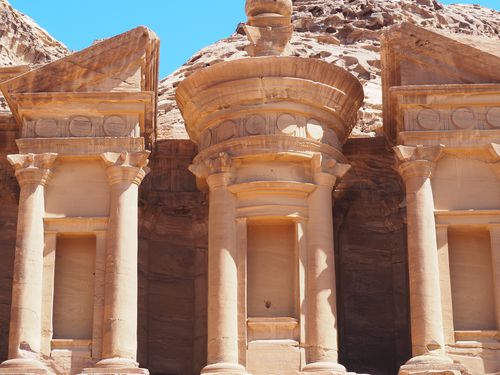
Petra • Monastery
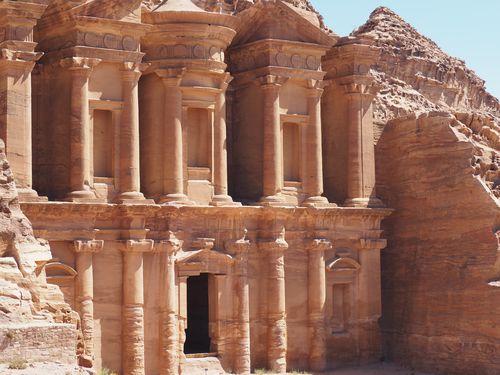
Petra • Monastery

Petra • Monastery
Monument profile
Monastery
Monument categories: Monastery, Archaeological, Rock Sanctuary
Monument families: Monastery • Rock Sanctuary and Monumental Bas-reliefs • Archaeological
Monument genres: Religious, Archaeological site
Cultural heritage: Nabatean
Geographic location: Petra • Jordan
Construction period: 2nd century AD
This monument in Petra is inscribed on the UNESCO World Heritage List since 1985 and is part of the serial property "Petra".See the UNESCO monuments featured on this site
• Links to •
• List of videos about Petra on this site •
Petra, the capital of the Nabataeans • Jordan
• References •
UNESCO: Petra
Architecture of the Monastery (Ad Deir) in Petra
Location and general architectural composition
The Monastery, commonly known as Ad Deir, occupies a high plateau at the western edge of the Petra archaeological area. The monument is carved directly into a massive sandstone cliff and faces an open terrace that forms a broad forecourt. Access to the structure is provided by a long rock-cut staircase that climbs from the lower valleys to the elevated platform where the façade stands. This elevated position creates a clear separation between the monument and the surrounding circulation routes of Petra.
The façade dominates the plateau and is oriented toward the east–southeast. In front of the monument lies a large, roughly level space formed by natural rock surfaces and minor artificial modifications. This forecourt establishes a ceremonial approach axis leading directly toward the central doorway. The relationship between the façade and the open terrace suggests that the monument was designed to be viewed from a distance across the plateau before the visitor approaches the entrance.
The structure is entirely rock-cut rather than built with assembled masonry. All architectural components visible on the façade were carved directly from the sandstone cliff. This technique integrates the monument with the geological mass of the mountain while allowing a carefully controlled architectural composition.
Monumental façade and architectural articulation
The façade of the Monastery measures approximately 47 meters in width and around 48 meters in height, making it one of the largest rock-cut façades at Petra. Its composition is organized on two principal levels arranged along a strong central axis. The lower level forms the main architectural stage and includes the entrance doorway framed by engaged columns and sculpted architectural elements.
Six large columns define the lower register of the façade. These columns are carved in high relief from the rock and support a horizontal entablature. Their proportions create a rhythmic articulation across the façade and frame the central doorway. The doorway itself is rectangular and relatively large, forming the only direct access into the interior chamber.
Above the entablature rises the second architectural tier. This upper section is characterized by a central tholos-like structure consisting of a circular drum crowned by a conical roof. The drum is flanked by two projecting structures resembling small towers or pavilions carved in relief. These elements give the façade a vertical emphasis and create a strongly centralized composition focused on the circular architectural form.
The surfaces of the façade are relatively restrained in ornamentation compared with some other monuments of Petra. Moldings, cornices, and simplified decorative bands define the architectural divisions without extensive figurative sculpture. Weathering of the sandstone has softened many details, producing rounded contours along the edges of the architectural elements.
Interior spatial organization
Behind the monumental façade lies a single large chamber carved into the rock mass. The interior space forms a roughly square hall measuring approximately 12 meters in width and depth, with a height approaching 10 meters. The walls and ceiling were excavated directly from the sandstone and retain a relatively plain finish.
The interior architecture is intentionally simple when compared with the elaborate exterior façade. The room is dominated by a large recessed niche carved into the rear wall. This niche forms the primary focal point within the chamber and is framed by a shallow architectural outline that distinguishes it from the surrounding surfaces.
The absence of interior columns or subdivisions creates a unified spatial volume. The flat floor and straight walls produce a clear geometric enclosure whose proportions emphasize the height of the chamber. Light enters only through the entrance doorway, creating a strong contrast between the illuminated façade and the dim interior space.
The relationship between the large interior niche and the central axis of the entrance indicates that the internal arrangement was conceived as a focused spatial setting. The niche is positioned directly opposite the doorway, aligning the interior composition with the external architectural axis.
Rock-cut construction techniques and material characteristics
The Monastery was carved entirely from the sandstone formation that constitutes the surrounding cliffs of Petra. The rock exhibits layered geological strata whose color ranges from pale beige to reddish tones. Variations in these strata are visible across the façade and interior surfaces.
The carving process appears to have progressed from the upper sections downward, a technique commonly used in large rock-cut monuments to allow debris to fall away from the working area. Tool marks are visible in certain interior areas and along less exposed surfaces, indicating the use of chisels and pointed tools to remove large volumes of stone.
The sandstone material allowed relatively rapid excavation but is also susceptible to erosion. Wind abrasion and occasional water runoff have gradually softened the sharper architectural details of the façade. Cornices, column capitals, and moldings show signs of surface rounding caused by long-term weathering.
Despite this erosion, the overall structural stability of the monument remains high because the architectural elements are not independent blocks but integral parts of the rock mass. The absence of joints or assembled masonry reduces the risk of structural displacement.
Architectural alterations and preservation
Architectural modifications to the Monastery appear to have been limited. The principal rock-cut form of the monument has remained largely unchanged since its creation. Some interior surfaces show evidence of later carvings, including crosses incised into the walls during a later phase of occupation.
The steps leading to the monument have undergone periodic stabilization to facilitate access along the ancient ascent route. Minor interventions have been carried out in the surrounding plateau to control erosion and manage visitor circulation. These interventions remain outside the original carved façade and do not significantly alter the monument’s architectural form.
Conservation efforts primarily focus on monitoring the sandstone surfaces and managing environmental exposure. The preservation strategy emphasizes maintaining the original rock-cut fabric while limiting physical stress caused by large visitor numbers on the approach routes and surrounding terrace.
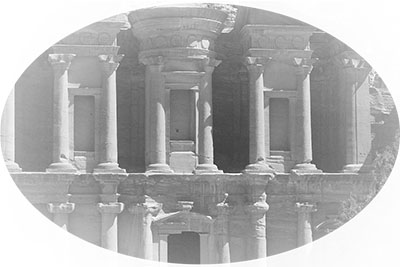
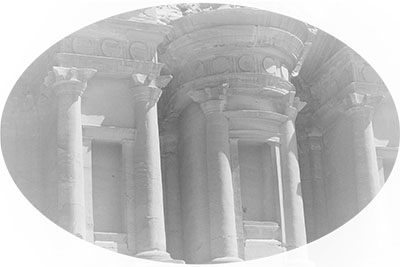
Architecture of the Monastery (Ad Deir) in Petra
Location, setting, and spatial organization of the monument
The Monastery, known as Ad Deir, is located in the western sector of the Petra archaeological area and carved directly into a sandstone cliff at the edge of a high plateau. The monument occupies an elevated position overlooking several valleys that form the western approaches to the site. Unlike many major façades of Petra, it stands in a relatively open zone rather than within a dense concentration of tomb façades. The monument therefore dominates a wide natural terrace that functions as a forecourt.
Access to the structure is provided by a long rock-cut stairway that climbs through the surrounding sandstone formations. The stairway follows the natural slope and eventually reaches the plateau directly in front of the façade. This ascent forms a gradual architectural sequence that frames the monument. As visitors approach the upper terrace, the façade gradually becomes visible and ultimately dominates the plateau.
The forecourt consists of a broad open surface formed mainly by natural bedrock that has been partially leveled. This terrace extends outward from the base of the façade and allows the monument to be viewed from several distances. The spatial relationship between the cliff façade and the open terrace establishes a frontal composition in which the architecture is perceived across an unobstructed foreground.
The cliff into which the monument is carved forms a continuous vertical rock wall that serves as the structural background of the façade. The rock mass frames the monument laterally and above, creating a contrast between geometric architectural forms and the irregular contours of the cliff. Because no major structures stand directly beside it, the monument remains visually isolated within the surrounding landscape.
Monumental façade and architectural composition
The façade of the Monastery is one of the largest rock-cut architectural compositions in Petra, measuring about 47 meters in width and nearly 48 meters in height. The structure is organized according to a symmetrical composition centered on a strong vertical axis beginning at the entrance doorway and extending through the upper architectural elements.
The lower register forms the principal architectural level. Six large columns carved in high relief define this part of the façade. These columns are partially detached from the rock surface and create a sequence of vertical bays across the façade. Their proportions divide the lower façade into evenly spaced sections.
Above the columns runs a continuous entablature composed of an architrave, a frieze, and a projecting cornice. This architectural band separates the lower register from the upper level while visually linking the columns within a unified horizontal structure.
At the center of the lower façade stands the main entrance doorway. The doorway is rectangular and relatively large compared with the surrounding architectural elements. It is framed by two central columns placed closer together than the others, reinforcing the emphasis on the central axis. The doorway leads directly into the interior chamber carved behind the façade.
The upper register is dominated by a large circular architectural element composed of a cylindrical drum surmounted by a conical roof, commonly described as a tholos. Positioned directly above the central axis, it forms the most prominent element of the façade. The circular geometry contrasts with the rectilinear forms of the lower level and introduces a vertical emphasis.
Flanking the central tholos are two projecting rectangular masses carved in relief that resemble small architectural pavilions. These elements frame the circular structure and reinforce the symmetrical arrangement of the upper façade. The combination of rectangular, triangular, and cylindrical forms creates a layered composition in which each element contributes to the monument’s vertical hierarchy.
Decorative carving remains restrained. Moldings, cornices, and simple architectural frames define the divisions between structural components without extensive sculptural ornament. This restraint highlights the monument’s proportions and the clarity of its architectural geometry.
Interior spatial organization and architectural elements
Behind the façade lies a single large chamber carved directly into the sandstone cliff. The interior space is roughly square in plan, measuring about twelve meters in width and depth, with a height approaching ten meters. The chamber forms a large enclosed volume contrasting with the open terrace outside.
The interior walls are relatively plain and lack the elaborate articulation visible on the exterior façade. The surfaces are mostly flat, with minor irregularities produced by the excavation process. The ceiling shows a gently curved profile resulting from the removal of rock during carving.
No internal columns or supporting structures divide the chamber. Because the monument is entirely rock-cut, the surrounding sandstone mass provides the necessary stability. The interior therefore forms a single uninterrupted space.
The most prominent architectural feature inside the chamber is a large recessed niche carved into the rear wall. This niche occupies the central position on the interior axis directly opposite the entrance. Its depth and scale distinguish it from the surrounding wall surfaces, and its rectangular form contrasts with the otherwise smooth wall plane.
The interior floor appears relatively level and free of major architectural features. Natural light enters only through the entrance doorway, producing a strong contrast between the bright exterior and the darker interior. This lighting emphasizes the depth of the chamber and directs attention toward the central niche.
Tool marks remain visible on parts of the interior walls, providing evidence of the excavation process and the shaping of the rock surface.
Rock-cut construction techniques and material properties
The Monastery was carved entirely into the sandstone formation that forms the surrounding cliffs of Petra. The sandstone is stratified, with layers ranging in color from pale beige to reddish and pink tones. These variations create subtle color bands across the façade and interior surfaces.
The creation of the monument required the removal of a large volume of rock. Observations indicate that the carving likely progressed from the upper sections downward. This method allowed debris to fall away from the working area while preserving the clarity of the carved architectural forms.
Artisans used metal tools to detach blocks of sandstone and gradually shape the monument. The process probably began with the excavation of the main façade and interior chamber, followed by the carving of architectural details such as columns, moldings, and cornices.
The relatively soft texture of the sandstone made it possible to sculpt large architectural volumes directly into the rock. However, this material remains vulnerable to natural weathering. Wind erosion, temperature fluctuations, and occasional water runoff have gradually softened many of the sharper edges of the carved architecture.
Despite this erosion, the structural integrity of the monument remains strong. Because the façade and interior chamber are carved from a continuous rock mass rather than assembled from separate blocks, the monument lacks structural joints that might weaken the structure.
Architectural alterations and conservation
The Monastery has undergone relatively few structural modifications since its creation. Archaeological observations indicate that the main form of the façade and interior chamber has remained largely unchanged. Architectural components such as the columns, entablature, and tholos remain integral parts of the original rock surface.
Some later alterations are visible inside the monument. Crosses carved into the interior walls indicate that the chamber was reused during a later Christian phase. These carvings are superficial and do not alter the architectural organization of the interior.
The surrounding plateau and access routes have changed over time. The long stairway leading to the monument has been stabilized and partially restored to facilitate modern access. Certain pathways across the plateau have also been adjusted to guide visitor movement.
Current conservation measures focus on monitoring the sandstone surfaces and controlling visitor circulation around the monument. The erosion of the rock surface remains the principal long-term concern. Protective management of the terrace and stairway helps reduce mechanical wear on the surrounding rock.
The architectural form of the Monastery therefore remains largely consistent with its original rock-cut design, while preservation efforts aim to maintain the stability of the sandstone surfaces and the legibility of the carved architectural elements.