

 Français (France)
  Nederlands (nl-NL)
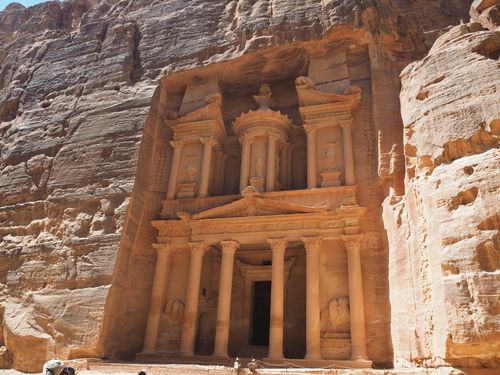
 The Treasury (Al Khazneh) is one of the most recognizable monuments within the archaeological site of Petra in Jordan. Carved directly into a sandstone cliff, it is distinguished by its monumental façade decorated with elaborate sculptural elements. Its modern name derives from a local tradition claiming that a hidden treasure was stored in the urn crowning the structure. The monument appears at the end of the Siq, the narrow gorge that forms the main entrance to Petra, creating a striking first view of the ancient city for visitors. Today, the Treasury is widely regarded as a defining symbol of Jordan’s cultural heritage and a central feature of the UNESCO World Heritage site.
Petra • Treasury (Al Khazneh)
Petra • Treasury (Al Khazneh)

Petra • Treasury (Al Khazneh)
Monument profile
Treasury (Al Khazneh)
Monument categories: Archaeological, Mausoleum, Rock Sanctuary
Monument families: Tomb, Necropolis, Mausoleum or Cenotaph • Rock Sanctuary and Monumental Bas-reliefs • Archaeological
Monument genres: Funerary, Religious, Archaeological site
Cultural heritage: Nabatean
Geographic location: Petra • Jordan
Construction period: 1st century BC
This monument in Petra is inscribed on the UNESCO World Heritage List since 1985 and is part of the serial property "Petra".See the UNESCO monuments featured on this site
• Links to •
• List of videos about Petra on this site •
Petra, the capital of the Nabataeans • Jordan
• Sources •
Digital Sources
- UNESCO World Heritage Centre - Petra
- Encyclopedia Britannica - Petra
- National Geographic - Petra
- The Metropolitan Museum of Art - The Nabataeans
Books and Publications
- Jane Taylor, Petra and the Lost Kingdom of the Nabataeans, Harvard University Press, 2002.
- Glenn Markoe, The Nabataeans: A Brief History of Petra and Madain Saleh, 2003.
- Philip C. Hammond, The Nabataeans: Their History, Culture and Archaeology, Southern Illinois University Press, 1973.
- David S. Graf, Petra and the Nabataeans in the Early Hellenistic Period, Oxford University Press, 1997.
History of the Treasury (Al Khazneh) in Petra
Construction and Nabataean Context
The monument known as the Treasury, or Al Khazneh, was carved directly into the sandstone cliff at the western end of the Siq, the narrow gorge that forms the principal entrance to the ancient city of Petra in present-day Jordan. Archaeological and stylistic analyses generally place its construction between the late first century BCE and the early first century CE, during the period when Petra served as the capital of the Nabataean kingdom.
During this period the Nabataean state controlled important caravan routes connecting southern Arabia, the Levant, and Mediterranean markets. Petra functioned as the administrative and economic center of this network. The construction of the Treasury corresponds to a phase of major urban development in the city, when monumental façades and elaborate rock-cut structures were created along the main approaches to the urban core.
The position of Al Khazneh at the exit of the Siq suggests that its construction formed part of a carefully designed sequence of monumental architecture marking the transition from the narrow canyon to the open basin of Petra. The scale of the façade and the precision of its sculptural decoration indicate the involvement of skilled artisans working under royal or elite patronage. The monument therefore reflects both the political authority and the economic resources available to the Nabataean leadership during this period.
Function and Interpretations of the Monument
Despite its prominence within the city, the precise original function of the Treasury remains uncertain. Most archaeological interpretations identify the monument as a royal or high-status tomb. This interpretation is based on the internal arrangement of chambers carved behind the façade and on comparisons with other monumental tombs within Petra’s necropolis zones.
The interior consists of a relatively simple central chamber with additional spaces cut into the rock, lacking elaborate interior decoration. This configuration corresponds to funerary architecture found elsewhere in the city. Some scholars have proposed that the monument may have been constructed during the reign of the Nabataean king Aretas IV, who ruled from 9 BCE to 40 CE and oversaw a period of extensive building activity in Petra.
The modern name “Al Khazneh,” meaning “the Treasury,” originates from a much later local tradition. According to this belief, a hidden treasure was concealed within the stone urn crowning the monument’s upper façade. This legend led local inhabitants to fire at the urn in an attempt to break it open. The visible bullet marks on the sculpture testify to these attempts and explain the persistence of the monument’s popular name.
Changes after the Nabataean Period
In 106 CE the Nabataean kingdom was annexed by the Roman Empire, and Petra became the capital of the Roman province of Arabia Petraea. The Treasury remained part of the urban landscape during the Roman period, although archaeological evidence does not demonstrate that it continued to function as an active funerary monument.
Over the following centuries Petra experienced a gradual decline as regional trade routes shifted and economic activity diminished. Earthquakes recorded in late antiquity also contributed to the weakening of the city’s infrastructure. The Treasury, carved into solid rock rather than constructed from assembled masonry, survived these changes without major structural alteration.
During the medieval and early Ottoman periods the Petra region was inhabited intermittently by local communities. The monument remained visible at the exit of the Siq and continued to be associated with the local legend of hidden treasure. Historical documentation from these centuries is limited, and no evidence indicates systematic reuse of the monument during this time.
Rediscovery and Archaeological Research
By the beginning of the nineteenth century Petra had largely disappeared from European geographical knowledge. In 1812 the Swiss explorer Johann Ludwig Burckhardt reached the site while traveling in the region disguised as a Muslim pilgrim. His account described the monumental façade of the Treasury and introduced Petra to the scholarly and exploratory communities of Europe.
During the nineteenth and twentieth centuries numerous archaeological expeditions investigated the city and documented its rock-cut monuments. Surveys and excavations helped establish the chronological framework of Petra’s development and clarified the architectural context of Al Khazneh within the Nabataean urban landscape. Despite these studies, no inscription has been discovered that definitively identifies the individual for whom the monument was constructed.
More recent archaeological work has focused on the open area in front of the façade. Investigations using modern survey techniques have revealed buried structures and archaeological layers beneath the plaza. These findings suggest that the monumental setting of the Treasury may originally have formed part of a more complex architectural arrangement connected with the ceremonial entrance to the city.
Global Historical Context
The construction of the Treasury occurred between the late first century BCE and the early first century CE. This period corresponds to the consolidation of the Roman Empire under Augustus. In China, the Han dynasty maintained imperial authority and expanded long-distance trade along routes later known as the Silk Roads. In the Indian subcontinent, regional kingdoms controlled maritime and overland trade networks linking the Indian Ocean to western Asia. In the eastern Mediterranean, formerly Hellenistic territories were progressively incorporated into Roman administration.
Present Status and Conservation
Today the Treasury is one of the most recognizable monuments of Petra and serves as a visual emblem of the archaeological site. Petra was inscribed on the UNESCO World Heritage List in 1985 under the official name “Petra.”
The monument is subject to ongoing monitoring because of the vulnerability of the sandstone cliff in which it is carved. Natural erosion, fluctuations in temperature, and the effects of wind and moisture gradually affect the sculpted surfaces. Conservation programs focus on documenting the condition of the façade, studying the stability of the rock, and managing visitor access in the immediate surroundings of the monument. The Treasury remains one of the most intensively studied and carefully monitored structures within the Petra archaeological landscape.
Architecture of the Treasury (Al Khazneh) in Petra
Location, Setting and General Architectural Composition
The Treasury, known as Al Khazneh, is carved directly into the sandstone cliff forming the eastern edge of Petra’s central basin, immediately beyond the narrow canyon of the Siq. The monument occupies a vertical rock face that was carefully leveled to create a broad architectural surface within the cliff. Its placement at the end of the gorge creates a controlled visual axis: the façade becomes visible only after the final bend of the canyon, where the narrow passage opens into a wider space.
The façade measures approximately 39 meters in height and about 25 meters in width. These dimensions give the structure a monumental presence within the confined topography of the canyon exit. The composition is strictly symmetrical along a central vertical axis and organized into two principal architectural tiers separated by a horizontal entablature.
The monument is not a constructed building assembled from masonry blocks but a rock-cut façade carved directly from the sandstone mass of the cliff. Columns, pediments, niches, and reliefs were created by removing surrounding rock rather than assembling structural elements. The technique transforms the cliff surface into a sculptural architectural composition.
A relatively level plaza lies in front of the monument and allows a full frontal view of the façade. Archaeological investigations indicate that this forecourt was probably cleared or modified to create an unobstructed architectural setting.
Rock-Cut Construction Techniques and Carving Methods
The creation of the Treasury required the removal of a substantial volume of sandstone from the cliff face. The carving process followed a descending method: work began at the uppermost portion of the façade and proceeded downward. This allowed artisans to stand on uncut rock while shaping the upper architectural elements and prevented debris from damaging completed sections.
Quarrying marks remain visible on surrounding rock surfaces. These marks indicate the use of iron chisels and hammering tools to detach layers of sandstone. Initial work defined the principal architectural volumes, after which sculptors refined columns, capitals, and decorative reliefs.
The precision of the façade’s symmetry suggests careful planning before carving began. Craftsmen likely marked reference lines directly on the rock to guide the placement of architectural elements. Because the monument was carved from a single rock mass, the entire composition had to be executed without structural joints or later assembly.
The sandstone displays layers of varying hardness and coloration. These geological variations influenced both the carving process and the long-term preservation of the façade. Harder layers permitted more precise detail, while softer layers were left slightly thicker to maintain stability.
Architectural Composition of the Lower Façade
The lower level forms a monumental portico consisting of six Corinthian columns carved in high relief from the rock surface. The columns stand in a straight line across the façade and support a continuous entablature. Their shafts are relatively slender and partially detached from the cliff surface, producing strong shadow effects that enhance the sense of depth.
The Corinthian capitals display sculpted acanthus leaves arranged in several tiers. The carving emphasizes the separation between individual leaf forms, giving the capitals a pronounced sculptural quality despite their monolithic origin. The columns rest on bases emerging directly from the rock.
Openings and niches appear between the columns. The central doorway provides access to the interior chambers, while the lateral spaces contain recessed areas framed by pilasters and decorative moldings.
Above the columns runs an entablature composed of an architrave, a decorated frieze, and a projecting cornice. The frieze contains sculptural motifs carved in low relief. The cornice establishes a clear visual boundary between the lower portico and the upper architectural structures.
A triangular pediment rises above the central section of the entablature. Its center is interrupted by the base of the circular structure dominating the second level, leaving the sloping sides visible on either side.
Upper Façade and Central Tholos Structure
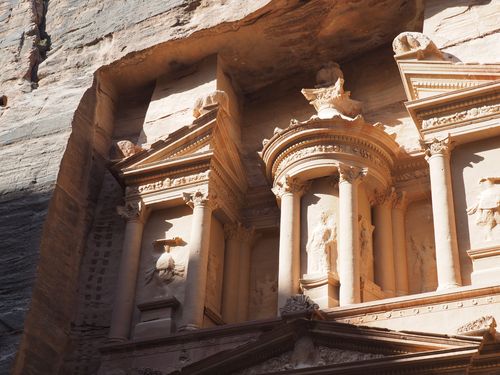
The upper level presents a more elaborate architectural arrangement dominated by a central tholos. This circular structure consists of a small colonnade supporting a domed roof carved from the same rock mass. Positioned on the central axis, the tholos rises above surrounding pedimental forms.
The columns of the tholos are more slender than those of the lower portico and are arranged around a cylindrical drum. Above them, a circular roof culminates in a large urn carved from the rock, which forms the highest sculptural element of the monument.
On either side of the tholos, broken pediments slope outward toward the edges of the façade. These half-pediments frame the circular structure and create a complex arrangement of intersecting architectural forms.
Rectangular niches framed by pilasters and topped with triangular pediments occupy the lateral sections of the upper façade. Sculptural figures carved within these niches reinforce the symmetry of the overall composition.
Additional decorative moldings link the tholos with the lateral architectural elements. The layered arrangement produces a façade where projecting forms cast strong shadows across the sandstone surface, increasing the visual depth of the monument.
Sculptural Decoration, Interior Spaces and Preservation
The façade incorporates numerous sculptural elements integrated into the architectural framework. Several niches contain standing figures carved in relief. These figures appear in both levels of the façade and are framed by architectural moldings.
Decorative motifs include mythological creatures, vegetal ornamentation, and symbolic elements. Horizontal friezes link the architectural components into continuous visual bands. The acanthus decoration of the capitals and foliage motifs carved into the friezes contribute to the façade’s intricate surface texture.
The urn above the tholos is one of the most recognizable features of the monument. Its rounded body and pedestal were carved from the upper rock mass. Visible bullet marks on its surface result from later attempts by local inhabitants to break the stone in search of a supposed treasure.
Behind the façade, a series of chambers was excavated within the rock. The central doorway leads to a rectangular hall forming the main interior space. The walls are relatively plain compared with the exterior façade. Additional rooms branch from this hall, their surfaces smooth but undecorated.
The interior spaces are relatively shallow in relation to the scale of the façade, indicating that architectural emphasis was placed on the exterior composition. Ceilings follow the natural stratification of the sandstone and were flattened through carving. Structural stability depends entirely on the surrounding rock mass.
The monument remains structurally stable because it is carved into a continuous geological formation. The principal threat to the architecture is the gradual erosion of the sandstone caused by wind, moisture, and temperature fluctuations. Certain sculptural details have become less distinct as surfaces weather.
Conservation programs focus on monitoring the condition of the rock and managing visitor access near the base of the façade. Geological studies identify areas where sandstone layers are more vulnerable to fragmentation. Preservation therefore involves protecting both the façade and the surrounding cliff, since they form a single monolithic structure.