Français (France)
  Nederlands (nl-NL)
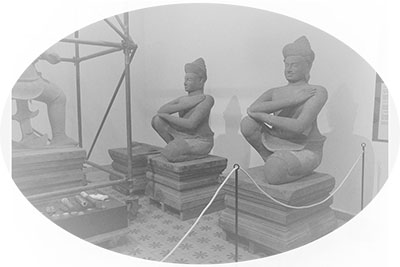
 The National Museum of Cambodia, located in Phnom Penh, Cambodia, is a major cultural institution dedicated to the preservation and presentation of Khmer heritage. It houses an extensive collection of artefacts from various periods of Cambodian history, providing a comprehensive overview of artistic and cultural development. The museum also plays a key role in research, conservation and interpretation, serving as an essential reference point for visitors seeking to understand the main expressions of Khmer civilization.
Phnom Penh • National Museum of Cambodia
Phnom Penh • National Museum of Cambodia
Phnom Penh • National Museum of Cambodia
Monument profile
National Museum of Cambodia
Monument category: Museum
Monument family: Museum, remarkable architecture or group of buildings
Monument genre: Cultural or scientific
Geographic location: Phnom Penh • Cambodia
Construction period: 20th century AD
• Links to •
• List of videos about Phnom Penh on this site •
Phnom Penh, the capital • Cambodia
• References •
Wikipedia EN: National Museum of Cambodia
National Museum of Cambodia in Phnom Penh: foundation, development and institutional role
Foundation and colonial framework
The National Museum of Cambodia was established in the early twentieth century in Phnom Penh under the authority of the French colonial administration in Cambodia. Its creation formed part of a broader institutional effort to organize the study and preservation of Khmer antiquities. The initiative was closely linked to archaeological activities conducted across the territory, particularly those coordinated by colonial research institutions.
The building, inaugurated in 1920, was conceived as a permanent repository for objects recovered from excavation sites. It replaced earlier, less structured systems of storage and display. The establishment of the museum served to centralize collections and formalize their management under a unified administrative framework. This process reinforced governmental control over archaeological heritage and facilitated its documentation.
Formation of collections and scientific functions
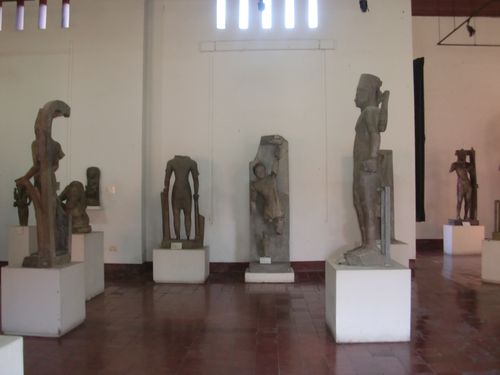
From its opening, the museum assembled a large body of artefacts originating from archaeological excavations carried out throughout Cambodia. The collections were organized according to chronological and typological criteria, allowing a structured presentation of Khmer artistic production. Sculptures, architectural fragments and ritual objects were integrated into a coherent system of classification.
The museum rapidly became a central institution for research on Khmer art and archaeology. It functioned as a place of study, storage and analysis for specialists working in the region. Scientific missions relied on the museum for cataloguing discoveries and comparing materials. This role contributed to the development of standardized methods for recording and preserving artefacts.
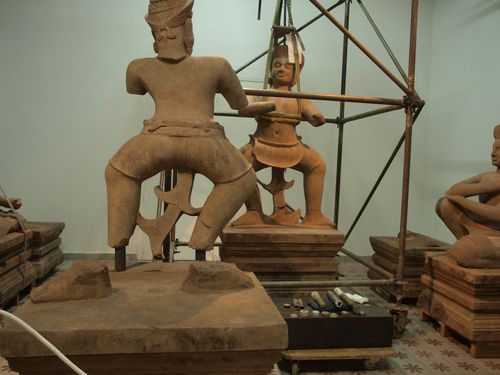
The institution also supported the establishment of conservation practices adapted to local environmental conditions. Measures were implemented to protect objects from humidity and temperature variations, ensuring their long-term stability within the museum environment.
Transformations and periods of disruption
During the mid-twentieth century, the museum experienced changes associated with the political evolution of Cambodia. Following independence in 1953, the institution was incorporated into national cultural policies while maintaining its scientific functions. Administrative control shifted from colonial authorities to Cambodian institutions.
A major rupture occurred during the period of the Khmer Rouge regime between 1975 and 1979. The museum’s activities were suspended, and the management of collections was severely disrupted. The absence of institutional oversight exposed the artefacts to deterioration and loss. This period marked a significant interruption in the museum’s operations.
From the 1980s onward, restoration and reorganization efforts were gradually implemented. These actions focused on recovering the collections, re-establishing inventories and restoring the building’s functionality. The museum progressively resumed its role as a cultural and scientific institution.
Cultural role and current status
Today, the museum remains a central institution for the preservation and presentation of Khmer heritage. It functions as a reference point for the study of Cambodian art and history, while also serving as a public exhibition space. Educational activities and interpretive programs contribute to the dissemination of knowledge.
The institution is integrated into international networks of cooperation, facilitating exchanges in conservation and research. It also participates in initiatives aimed at protecting and, where possible, recovering cultural property. These activities reinforce its role within both national and international contexts.
Current management emphasizes conservation, accessibility and the adaptation of exhibition conditions. Maintenance of the building and collections is carried out on a regular basis, ensuring the continuity of its functions and the stability of its holdings.
Global historical context
At the time of its inauguration in 1920, European colonial administrations were developing cultural institutions in overseas territories. In Europe, national museums continued to expand their collections and research activities. In the United States, major museums were consolidating their role as educational institutions. In Asia, several regions experienced transformations linked to colonial governance and modernization. These developments reflect a broader global trend toward the institutionalization of cultural heritage.
Spatial organization and architectural characteristics of the National Museum of Cambodia in Phnom Penh
Site integration and overall layout
The National Museum of Cambodia is located within the central urban grid of Phnom Penh, in Cambodia. The building occupies a rectangular plot aligned with surrounding streets and is set back from the road by a defined perimeter. The overall composition is organized around a central courtyard, which forms the structural and visual core of the complex.
The layout follows a symmetrical arrangement in which galleries are distributed along the four sides of the courtyard. This configuration creates a continuous internal circulation loop, allowing movement without interruption. The exterior façades present a continuous enclosure, while the interior remains open toward the central space.
Spatial organization of internal structures
The internal organization is based on a sequence of galleries connected through covered corridors. These galleries are arranged in a linear progression along the perimeter of the courtyard, forming an enclosed circuit. The spatial continuity allows for an uninterrupted path through the exhibition areas.
Rooms vary in size according to their function, with larger halls positioned along the principal axes and smaller spaces located in secondary sections. This hierarchical arrangement reflects the distribution of collections and the need to accommodate objects of different dimensions.
The courtyard acts as a central distribution node, providing orientation within the complex. It also introduces natural light into adjacent galleries and contributes to airflow. Openings between the galleries and the courtyard ensure visual connections while maintaining defined spatial boundaries.
Materials and construction techniques
The structure of the museum relies on load-bearing masonry walls that define the perimeter and internal divisions. These walls provide stability and support for the roof structures. The construction uses locally adapted materials designed to withstand climatic conditions, including high humidity and temperature variations.
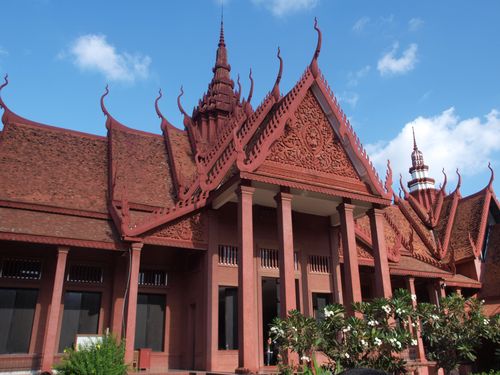
Roof systems are composed of timber frameworks supporting tiled coverings. The layered arrangement of the roofs creates a series of inclined planes that protect the walls from direct exposure to rainfall. The use of traditional roofing techniques contributes to the durability of the structure.
External surfaces are finished with plaster and painted coatings, ensuring a uniform appearance. Structural elements such as columns and beams are integrated into the overall system, maintaining continuity between load-bearing components and visible architectural features.
Architectural elements and formal characteristics
The museum is characterized by a series of pitched roofs arranged in multiple tiers. These roofs are articulated with projecting elements and decorative finials that define the silhouette of the building. Their repetition across the structure reinforces the horizontal extension of the complex.
Covered galleries are supported by regularly spaced columns that establish a rhythm along the circulation paths. These columns define transitional spaces between enclosed rooms and the open courtyard. The spacing of these elements creates a balance between structural necessity and spatial openness.
Openings are distributed in a regular pattern along the façades, allowing controlled entry of light and ventilation. Doorways and passageways are aligned with the main axes, ensuring direct movement between sections. Changes in floor level and framed thresholds mark transitions between spaces without disrupting continuity.
Modifications and conservation conditions
Since its construction, the museum has undergone conservation work aimed at preserving its structural integrity and architectural features. Interventions have primarily focused on roof maintenance, repair of masonry elements and restoration of decorative components.
Adjustments to interior spaces have been made to accommodate evolving exhibition requirements, while preserving the original spatial configuration. These modifications include improvements to circulation paths and the reinforcement of surfaces subject to frequent use.
The current condition of the building reflects ongoing maintenance and conservation efforts. The coherence of the original design remains intact, and the architectural structure continues to function according to its initial organization. The preservation strategy prioritizes material continuity and the stability of the structural system, ensuring the long-term sustainability of the complex.