Français (France)
  Nederlands (nl-NL)
 00:00 • intro | 00:44 • landscapes around Um Qais | 00:59 • ruins of the ancient city | 03:05 • theater
Personal creation from visual material collected during my trip Jordan (2017)
Map of places or practices in Umm Qais on this site
• Use the markers to explore the content •
Umm Qais, ancient Gadara: a city shaped by landscape and history
A site overlooking valleys and borders
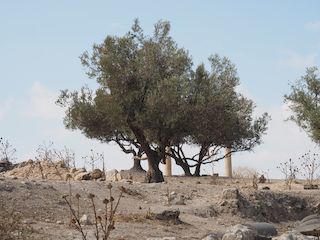
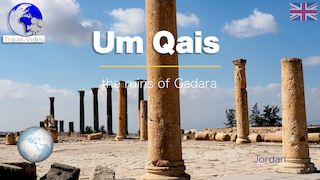
In northern Jordan, near the borders with Israel and Syria, Umm Qais occupies a commanding position on a plateau above the Jordan Valley and the Sea of Galilee. This elevated setting defines the identity of the site, where wide views extend across cultivated land, water surfaces and distant hills. The former city of Gadara was not only strategically located but also visually connected to its surroundings, making landscape an integral part of its urban character.
The video presents a gradual exploration of this environment, linking panoramic views with the remains of the ancient city. It reveals how geography influenced settlement patterns and how the site’s position contributed to its historical importance.
Landscapes and urban organisation
The landscapes around Umm Qais are essential to understanding the site. From the plateau, the terrain unfolds in layers, offering a clear reading of the region’s structure. This openness highlights the advantages of the location, which allowed both observation and control of the surrounding area while providing favourable conditions for habitation.
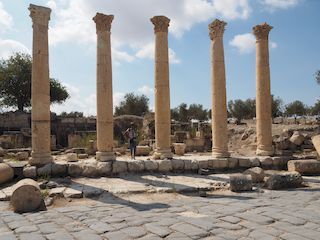
The ruins of the city reflect this relationship with the terrain. Streets, public spaces and residential areas were arranged in accordance with the natural relief, creating a coherent urban layout. Although only fragments remain today, these elements suggest the scale and organisation of the city at different stages of its development.
Monuments and public spaces
Among the most significant structures at Umm Qais is the Roman theatre, built in dark basalt stone typical of the region. Its semi-circular form and orientation towards the landscape illustrate the importance of performance spaces in ancient cities. The theatre functioned not only as a place of gathering and spectacle but also as a vantage point from which the surrounding environment could be appreciated.
Other Roman remains include sections of colonnaded streets, baths and various public buildings, indicating the integration of Gadara into the urban models of the Roman world. Byzantine structures, on the other hand, reflect a later transformation of the site, with the construction of churches and associated spaces that point to the growing importance of Christianity.
Together, these elements form a layered archaeological landscape in which successive periods have left distinct but interconnected traces.
A city between cultural influences
The history of Umm Qais, identified with ancient Gadara, is shaped by a combination of cultural influences. As part of the Decapolis, the city was integrated into a network of Hellenistic and later Roman urban centres, where local traditions interacted with broader Mediterranean models.
Under Roman rule, Gadara experienced significant development, adopting architectural forms and urban planning typical of the empire. Infrastructure and public spaces reflect this integration, while still adapting to local conditions.
During the Byzantine period, the site underwent further transformation. The spread of Christianity led to the construction of religious buildings and the adaptation of existing structures. This phase added a new dimension to the city, without completely erasing its earlier character.
A visual approach that clarifies relationships
The videos on this site are constructed from carefully selected photographs, combined through smooth transitions and precise framing. This approach allows for a clear and progressive understanding of complex sites such as Umm Qais.
In this case, the visual sequence highlights the relationship between ruins and landscape. The movement from panoramic views to architectural details makes it easier to understand the organisation of the city. The structure of the theatre, the alignment of walls and the textures of the materials become more legible, while remaining connected to their wider context.
By linking different scales of observation, the video provides a coherent reading of the site as a whole.
A place where geography and history converge
Umm Qais offers a clear example of how urban development can be shaped by both natural and cultural factors. Through its ruins and its commanding views, the ancient city of Gadara reflects strategic choices, cultural exchanges and historical transformations that have defined the region.
The video provides an accessible introduction to this site, emphasizing its main features while connecting its various dimensions. For those interested in exploring further, the detailed pages on the Roman and Byzantine remains, as well as the theatre, offer additional insight into the architectural and historical complexity of this remarkable location.
Links to related pages

Audio Commentary Transcript
Jordan is full of remarkably preserved Roman sites. Um Qais is one of those sites. Um Qais is a small town located on the border with Syria and Israel in northern Jordan.
In Greco-Roman times, it was called Gadara. Gadara was an important cultural center and preserves magnificent ruins.

Music:
- - YouTube video library - Crisis - Scoring Action, (© Crisis - Scoring Action by Kevin MacLeod is licensed under a Creative Commons Attribution 4.0 license. https://creativecommons.org/licenses/by/4.0/
- Source: http://incompetech.com/music/royalty-free/index.html?isrc=USUAN1100277
- Artist: http://incompetech.com/)
- - YouTube video library - Crusade - Video Classica, (© Crusade - Video Classica by Kevin MacLeod is licensed under a Creative Commons Attribution 4.0 license. https://creativecommons.org/licenses/by/4.0/
- Source: http://incompetech.com/music/royalty-free/index.html?isrc=USUAN1100884
- Artist: http://incompetech.com/)
Disclaimer: Despite its appropriateness, copyright issues prevent the use of jordanian traditional music in "Um Qais, the ancient Gadara • Jordan", hence the use of royalty-free music. Despite our careful selection, some might regret this decision, which is necessary to avoid potential lawsuits. Although difficult, this decision is the only viable solution.