Français (France)
  Nederlands (nl-NL)
 The Byzantine ruins of Umm Qais, located in northern Jordan, reflect the Christian presence in the ancient city of Gadara. These remnants include churches, mosaics, and architectural features that showcase the cultural and religious influence of the Byzantine Empire in the region. Umm Qais provides a unique insight into the historical and cultural development of this part of the Levant.

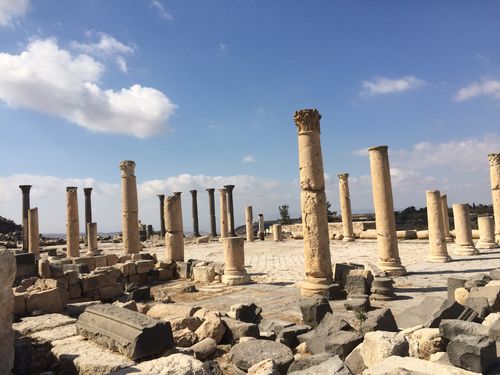

Monument profile
Byzantine ruins
Monument categories: Archaeological, Ancient mosaics
Monument family: Archaeological
Monument genre: Archaeological site
Cultural heritages: Byzantine, Christian
Geographic location: Umm Qais • Jordan
Construction period: 5th century AD
• Links to •
• List of videos about Amman, Jerash, Umm Qais on this site •
Jordan • the Roman Jordan
Um Qais, the ancient Gadara • Jordan
The Byzantine Ruins of Umm Qais: Political Motivations, Historical Transformations, and Modern Challenges
The Byzantine ruins of Umm Qais, located in the ancient city of Gadara in northern Jordan, represent a significant era of religious, political, and cultural transition. Constructed between the 4th and 7th centuries CE, these remains reflect the Byzantine Empire’s efforts to consolidate Christianity in the Levant and to integrate regional traditions into its architectural practices. This article explores the political and social motivations behind their construction, major historical events that shaped the site, and the challenges it faces today.
Political and Social Motivations for Construction
The construction of Byzantine structures in Umm Qais was driven by both political and religious objectives during a time when Christianity became the dominant religion in the Roman Empire. Key motivations included:
- Religious Consolidation: The establishment of churches and other Christian buildings aimed to reinforce the Byzantine Empire’s authority and spread Christian beliefs across its territories.
- Social Cohesion: These structures served as community hubs, providing spaces for worship, education, and social gatherings, fostering a shared identity among the region’s diverse population.
- Political Stability: By investing in monumental architecture, the Byzantine rulers demonstrated their power and commitment to the region’s integration into the empire.
Historical Context and Global Comparisons
The period of Byzantine construction in Umm Qais coincided with the empire’s efforts to secure its eastern borders and strengthen its presence in the Levant. During this time, similar architectural endeavors were undertaken in other key cities such as Jerusalem, Antioch, and Constantinople. These projects symbolized the empire’s cultural and religious transformation under Christian rule.
Globally, this era witnessed significant developments in other parts of the world:
- In East Asia, the Tang Dynasty in China was establishing its dominance, with Buddhism playing a central role in its cultural and political life.
- In Mesoamerica, the Maya civilization was constructing elaborate ceremonial centers, reflecting the importance of religion in their society.
These parallels underscore the universal role of monumental architecture in asserting authority and fostering cultural identity during periods of political consolidation.
Major Transformations Over the Centuries
The Byzantine ruins of Umm Qais have undergone significant transformations, reflecting the region’s shifting political and cultural dynamics:
- Islamic Conquest (7th Century CE): Following the arrival of the Umayyads, many Byzantine structures were repurposed or abandoned. Some materials were reused in the construction of mosques and other Islamic buildings, reflecting the integration of new cultural influences.
- Natural Disasters (8th Century CE): Devastating earthquakes caused widespread damage to the site, leading to the partial collapse of several structures and contributing to the decline of Umm Qais as a major urban center.
- Ottoman Period (16th–19th Century CE): The ruins were largely neglected, and new constructions sometimes overlapped with or disturbed the ancient remains.
- Modern Rediscovery (19th–20th Century CE): Archaeological excavations began to uncover the significance of the site, highlighting its architectural and historical value.
Cultural Significance and Current Conservation Status
The Byzantine ruins of Umm Qais hold immense cultural and historical value. They include basilica-style churches, intricate mosaics, and remnants of public buildings that illustrate the blending of local traditions with Byzantine architectural elements.
Today, the state of preservation varies across the site. While some structures have been partially restored, others remain in a fragile state due to centuries of natural and human-induced damage. The mosaics, in particular, are among the most remarkable artifacts, though many have suffered from erosion and neglect.
Challenges to Preservation
Preserving the Byzantine ruins of Umm Qais presents several challenges:
- Natural Erosion: The limestone and basalt materials used in construction are vulnerable to weathering caused by rain, wind, and temperature fluctuations.
- Seismic Activity: The region’s history of earthquakes continues to pose a threat to the stability of the ruins.
- Urban Development: Modern construction around the site encroaches on its boundaries, jeopardizing its integrity.
- Tourism Impact: Unregulated visitor access can accelerate the wear and tear of fragile structures and artifacts.
- Resource Constraints: Efforts to restore and maintain the ruins are often hindered by limited funding and technical expertise.
Global Recognition and UNESCO Potential
Although the Byzantine ruins of Umm Qais are not yet included on the UNESCO World Heritage List, they are part of Jordan’s tentative list, underscoring their international importance. Achieving UNESCO status would enhance global awareness of the site’s cultural value and provide critical support for its preservation.
Conclusion
The Byzantine ruins of Umm Qais are a testament to a pivotal era in the region’s history, reflecting the Byzantine Empire’s architectural innovation and cultural integration. Despite the challenges of preservation, these ruins remain a vital link to the past, offering insights into the religious and social dynamics of the Byzantine period. With continued efforts in conservation and potential UNESCO recognition, Umm Qais can serve as a beacon of cultural heritage and historical education for future generations.
Byzantine Ruins of Umm Qais: Technological Advancements and Artistic Integration
The Byzantine ruins of Umm Qais, located in the ancient city of Gadara in northern Jordan, are a remarkable reflection of technological innovation and cultural synthesis during the Byzantine period (4th–7th centuries CE). These remains highlight the architectural and artistic ingenuity of the Byzantine Empire while incorporating regional traditions and foreign influences. This article examines the materials, construction techniques, and unique architectural features of the ruins, as well as their historical significance and potential UNESCO recognition.
Materials and Construction Techniques
The architecture of the Byzantine ruins at Umm Qais demonstrates the effective use of local materials combined with advanced construction methods of the time:
- Basalt and Limestone: The ruins were constructed using black basalt and limestone, materials readily available in the region. Basalt was used for structural elements due to its durability, while limestone provided a softer material for intricate carvings and decorations.
- Masonry Techniques: The precise stone cutting and fitting reflect advanced masonry skills, ensuring both stability and aesthetic appeal. The use of mortar for bonding added to the strength of the structures.
- Arches and Vaults: These were key architectural elements, supporting heavy loads and creating open, functional spaces. This approach showcased the Byzantine mastery of weight distribution and spatial planning.
Architectural Features and Artistic Influences
The ruins of Umm Qais illustrate a blend of Byzantine architectural principles and regional artistic traditions, creating a unique and culturally significant site:
- Basilica-Style Churches: The Byzantine churches in Umm Qais followed the basilica plan, featuring a central nave flanked by aisles and ending in a semi-circular apse. This design facilitated large gatherings and emphasized the sacredness of the space.
- Mosaics: Floors adorned with intricate mosaics featuring geometric patterns, floral motifs, and Christian symbols highlight the artistic sophistication of the period. The mosaics not only served decorative purposes but also conveyed religious messages to worshippers.
- Sculptural Details: Corinthian capitals, friezes, and carved lintels exhibit the influence of Greco-Roman styles while incorporating local and Christian motifs, such as crosses and vine patterns.
Notable Structures and Plans
Among the Byzantine ruins, a particularly prominent structure is a basilica with an expansive nave and well-preserved mosaics. The layout includes:
- A grand entrance flanked by sculpted columns.
- A spacious nave with high ceilings supported by rows of intricately carved pillars.
- An apse adorned with mosaics depicting symbolic Christian imagery.
This architectural plan reflects both the religious and social functions of the building, serving as a center for worship and community activities.
Statistical and Anecdotal Highlights
- Mosaic Coverage: The site features some of the most extensive Byzantine mosaic floors in northern Jordan, with designs spanning hundreds of square meters.
- Reuse of Materials: Following the Islamic conquest, stones from the Byzantine structures were repurposed in the construction of mosques and other buildings, illustrating the continuity of architectural heritage in the region.
International Recognition and UNESCO Status
Although the Byzantine ruins of Umm Qais are not yet included on the UNESCO World Heritage List, their cultural and historical value has been recognized on Jordan’s tentative list. Their preservation and promotion on an international platform would enhance their visibility and provide resources for sustained conservation efforts.
UNESCO recognition would also highlight the site’s significance in illustrating the architectural and cultural transitions of the Byzantine period and its role in the historical narrative of the Levant.
Challenges and Conservation Efforts
Preserving the Byzantine ruins of Umm Qais presents several challenges:
- Natural Erosion: Weathering from rain, wind, and temperature fluctuations poses a threat to the durability of the structures and mosaics.
- Seismic Activity: The region’s history of earthquakes has left many structures in a fragile state, requiring careful restoration.
- Urban Development: Encroaching modern construction near the site endangers its integrity and authenticity.
- Tourist Management: Increasing numbers of visitors, if not properly regulated, can lead to physical damage and accelerated degradation.
Conservation efforts include partial restoration of key structures, protective coverings for mosaics, and educational initiatives to raise awareness of the site’s historical importance.
Conclusion
The Byzantine ruins of Umm Qais stand as a testament to the technological advancements and artistic integration of the Byzantine Empire. The use of local materials, innovative construction techniques, and a blend of artistic traditions make these ruins a unique cultural treasure. With sustained preservation efforts and potential UNESCO recognition, these ruins can continue to offer valuable insights into the region’s architectural and cultural history while inspiring global appreciation for this extraordinary heritage site.