Français (France)
  Nederlands (nl-NL)
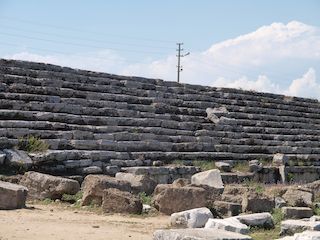
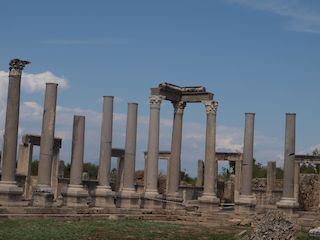
 00:00 • intro | 00:28 • the amphitheater | 02:00 • ruins of a Greek temple
Personal creation from visual material collected during my trip Turkey • Cappadocia (2014)
Map of places or practices in Perge on this site
• Use the markers to explore the content •
Perge, an ancient city between Greek heritage and Roman influence
A major archaeological site in southern Anatolia
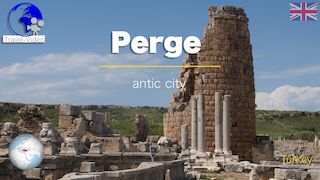
Located in the fertile plain of Pamphylia, near present-day Antalya, Perge stands as one of the most significant ancient cities in southern Turkey. Originally shaped by Greek traditions and later developed under Roman rule, the site offers a clear and compelling illustration of how urban models evolved across different historical periods. Its extensive remains, spread across a wide area, reveal the structure of a well-organized city where political, religious and social functions were closely intertwined.
The video provides a focused introduction to this archaeological landscape, linking the main visible elements into a coherent whole. Rather than presenting isolated ruins, it highlights the underlying logic of the city, allowing viewers to understand how Perge functioned as a living urban environment within its natural setting.
Monumental spaces and traces of religious life
One of the most striking features presented is the amphitheatre, located outside the city walls in accordance with Roman urban planning principles. This large structure reflects the importance of public entertainment in ancient civic life. Its semi-circular arrangement of seating around the arena demonstrates both architectural sophistication and a clear social hierarchy, with different sections designed for various groups within the population.
Within the urban area itself, the remains of a Greek temple evoke the earlier phases of the city’s history. Although only partially preserved, the structure still conveys the essential characteristics of Greek religious architecture, including balanced proportions and the use of columned spaces. These remains point to the central role of cult practices in shaping the identity of the city, where sacred buildings served both religious and symbolic purposes.
Together, these elements illustrate the diversity of urban functions in Perge, where spaces for gathering, worship and daily life coexisted within a carefully structured environment.
A city shaped by multiple cultural influences
Perge’s historical development reflects the broader dynamics of the eastern Mediterranean world. Initially influenced by Greek culture, the city adopted the principles of Hellenistic urbanism, visible in its layout and religious traditions. With the expansion of Roman power, Perge underwent significant transformations, incorporating new architectural forms and expanding its public infrastructure.
This layering of influences resulted in a city where Greek and Roman elements are not opposed but integrated. Streets, colonnaded avenues and public spaces reflect this gradual adaptation, creating an urban landscape that remained coherent despite changes over time. Perge thus represents a typical example of how Anatolian cities evolved within larger political and economic networks.
The proximity of other major sites, such as Aspendos, further emphasizes the regional importance of this area in antiquity. These cities were part of interconnected systems of exchange, where ideas, architectural techniques and cultural practices circulated widely.
A visual approach that clarifies spatial relationships
The videos on this site rely largely on carefully selected photographs, animated through smooth transitions and controlled framing. This method is particularly effective for archaeological sites like Perge, where understanding depends on the ability to read volumes, alignments and spatial relationships.
In this case, the visual progression moves from broader views of the site to more detailed observations of specific structures. The scale of the amphitheatre, the layout of religious remains and the organization of urban space become easier to grasp. Light, texture and perspective are used to reveal architectural features that might otherwise remain difficult to interpret during a brief visit.
This approach helps reconstruct the logic of the city, linking individual elements into a coherent whole and offering a clearer perception of how the site functioned in its original context.
An enduring testimony to ancient urban life
Perge stands as a significant example of the continuity and transformation of ancient urban traditions. Its remains reflect both the legacy of Greek culture and the adaptations introduced under Roman rule, within a geographical setting that supported long-term settlement and development.
The video offers an accessible entry point into this complex site, highlighting its key features and guiding the viewer through its main components. For a deeper understanding, the detailed pages dedicated to Perge and nearby sites such as Aspendos provide further insight into the historical and architectural significance of this region.
Links to related pages



Audio Commentary Transcript
Perge is an ancient Greek city abandoned around the beginning of the 8th century. It was founded around 1000 years before our era and was the capital of Pamphylia. It was also one of the first Christian religious centers and Saint Paul gave his first sermon there.
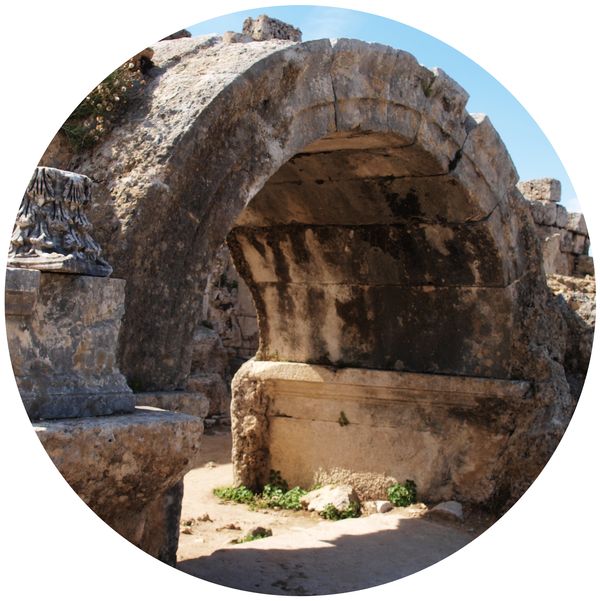
The stadium dates from the 2nd century and the arcades supporting the stands housed the stalls of local traders.
A few kilometers from Pergé is another important town, Aspendos, of which here are the ruins of the aqueduct.
Music:
- - YouTube video library - For Originz, (© For Originz by Kevin MacLeod is licensed under a Creative Commons Attribution 4.0 license. https://creativecommons.org/licenses/by/4.0/
- Source: http://incompetech.com/music/royalty-free/index.html?isrc=USUAN1100700
- Artist: http://incompetech.com/)
Disclaimer: Despite its appropriateness, copyright issues prevent the use of turkish traditional music in "Perge, ancient Greek city • Turkey", hence the use of royalty-free music. Despite our careful selection, some might regret this decision, which is necessary to avoid potential lawsuits. Although difficult, this decision is the only viable solution.