

 Français (France)
  Nederlands (nl-NL)
 00:00 • intro | 00:35 • Imagination Valley, Nevsehir | 01:40 • de kameel | 02:02 • Ortahisar | 05:07 • duivenhokken | 06:23 • ancient cave dwellings | 08:16 • Uc Guzeller | 09:18 • Imagination Valley, Nevsehir | 11:45 • Zelve Vadisi | 15:16 • Goreme Open Air Museum | 16:35 • Karanlik Kilise | 18:00 • Göreme
Personal creation from visual material collected during my trip Turkey • Cappadocia (2014)
Map of places or practices in Cappadocia on this site
• Use the markers to explore the content •
Cappadocia, Sculpted Landscapes and Rock-Cut Heritage
A singular region in the heart of Anatolia
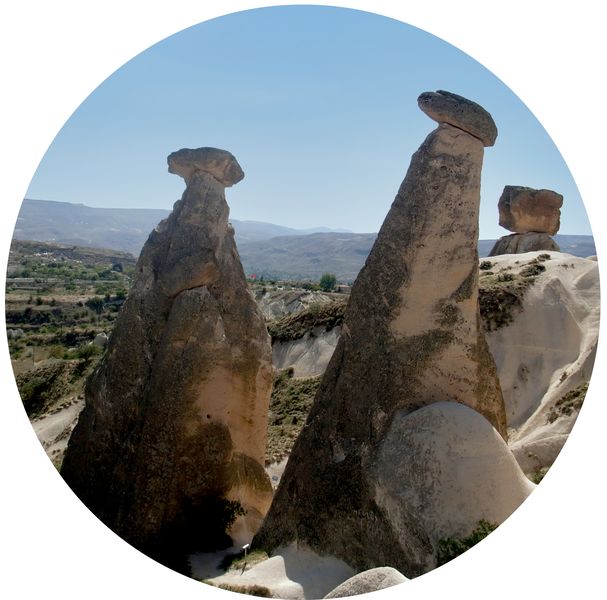
Cappadocia is one of the most distinctive cultural landscapes in Turkey. Located in central Anatolia, the region combines volcanic landforms, deeply eroded valleys, historic villages and remarkable rock-cut monuments shaped by centuries of human use. Its scenery often appears unreal at first sight, yet it is the result of precise geological processes. Layers of ash and soft tuff deposited by ancient volcanoes were gradually carved by wind, rain and seasonal temperature change.
This video follows several emblematic places where nature and history meet closely. Rock pinnacles, open valleys, cave dwellings, pigeon houses cut into cliffs and painted churches all reveal a territory where people adapted architecture to an existing landscape rather than imposing large structures upon it. Cappadocia is therefore far more than a spectacular setting. It is also a long-inhabited region of major historical value.
Valleys, villages and iconic formations
Among the featured sites is the Imagination Valley near Nevşehir, known for unusual rock formations that resemble animals, figures or abstract shapes. These visual associations, created naturally by erosion, explain the popularity of the valley. One of the best-known formations evokes the shape of a camel and has become a familiar symbol of the area.
Ortahisar presents another face of Cappadocia. This historic settlement developed around a massive rock outcrop long used as a refuge and defensive point. Traditional houses, narrow streets adapted to the slope and spaces carved directly into stone illustrate the continuity between natural relief and built environment.
The pigeon houses visible in several sectors recall an important agricultural tradition. Small chambers were cut into cliff faces to shelter pigeons, whose droppings were collected as valuable fertilizer for local farming. These modest structures demonstrate how carefully earlier communities used available resources.
Ancient cave dwellings complete this picture. Excavated in the soft volcanic rock, they provided thermal insulation, shelter and practical adaptation to the terrain. They remain one of the clearest signatures of Cappadocia’s historic way of life.
Zelve, Göreme and the Christian rock-cut legacy
Zelve Valley is one of the region’s major historic ensembles. For centuries, communities lived within a network of carved spaces including homes, storage rooms, chapels and communal areas. The site helps visitors understand how a complete settlement could function within the rock itself.
The Göreme Open-Air Museum is among Turkey’s most important heritage sites. It preserves several rock-cut churches created during the Byzantine period and decorated with notable wall paintings. These sanctuaries reflect Cappadocia’s role as a significant monastic centre of Eastern Christianity.
Karanlık Kilise, or the Dark Church, is especially renowned for the quality of its frescoes. Its limited natural light helped preserve pigments and details over time. Biblical scenes and refined iconographic programmes make it one of the most valuable interiors in the region.
Göreme today serves as the principal gateway to Cappadocia. Surrounded by valleys, cones and carved cliffs, it offers a clear introduction to the wider landscape and its layered history.
A land shaped by volcanoes and centuries of use
Cappadocia’s originality lies in the meeting of geology and human adaptation. The soft tuff made it possible to carve houses, chapels, storage chambers and even extensive underground complexes. In many regions, architecture required quarrying and transporting stone. Here, architecture often meant hollowing space from the existing rock.
This encouraged repeated occupation from antiquity through medieval and later periods. Local populations developed forms of housing suited to the continental climate of central Anatolia, with hot dry summers, cold winters and sharp temperature contrasts. Rock interiors offered natural climatic regulation.
The symbolic dimension of the landscape also mattered. Isolated valleys, protected ridges and secluded spaces were particularly suitable for communities seeking retreat, security or religious concentration.
What this site’s videos make especially clear
Videos created from carefully selected and animated photographs are particularly effective for Cappadocia. They allow viewers to study the texture of tuff, the openings cut into cliffs, the complex silhouettes of fairy chimneys and the transitions between villages and natural formations.
Gradual visual movement also helps reveal scale and distance. A valley may first appear as a broad panorama, then disclose paths, carved chambers, hidden chapels or agricultural traces. This progressive reading is valuable in a landscape where important details are easily overlooked.
For painted interiors and enclosed spaces, the same format encourages more attentive observation than a rapid moving sequence. The viewer gains a clearer understanding of how architecture, geology and daily life became inseparable here.
One of Turkey’s great cultural landscapes
To discover Cappadocia is to explore a region where volcanic history guided human settlement and where valleys still preserve traces of earlier lives. This video offers a clear introduction to its landscapes and rock-cut heritage, while the site’s detailed pages provide further insight into the natural and historical richness of the area.
Links to related pages



Audio Commentary Transcript
Cappadocia, in Anatolia, the Asian part of Turkey, is a region with amazing landscapes, mixing fairy chimneys, cave dwellings and churches and limestone cliffs. A landscape inherited from very old volcanic eruptions and the millennial erosion that followed.
Music:
- - YouTube video library - Constancy Part 1 - The Descent, (© Constancy Part 1 - The Descent by Kevin MacLeod is licensed under a Creative Commons Attribution 4.0 license. https://creativecommons.org/licenses/by/4.0/
- Source: http://incompetech.com/music/royalty-free/index.html?isrc=USUAN1100775
- Artist: http://incompetech.com/)
- - YouTube video library - Constancy Part 2 - The Descent, (© Constancy Part 2 - The Descent by Kevin MacLeod is licensed under a Creative Commons Attribution 4.0 license. https://creativecommons.org/licenses/by/4.0/
- Source: http://incompetech.com/music/royalty-free/index.html?isrc=USUAN1100774
- Artist: http://incompetech.com/)
- - YouTube video library - Constancy Part 3 - The Descent, (© Constancy Part 3 - The Descent by Kevin MacLeod is licensed under a Creative Commons Attribution 4.0 license. https://creativecommons.org/licenses/by/4.0/
- Source: http://incompetech.com/music/royalty-free/index.html?isrc=USUAN1100774
- Artist: http://incompetech.com/)
- - YouTube video library - Fall of the Solar King, (© Fall of the Solar King by Twin Musicom is licensed under a Creative Commons Attribution 4.0 license. https://creativecommons.org/licenses/by/4.0/
- Artist: http://www.twinmusicom.org/)
- - YouTube video library - For Originz, (© For Originz by Kevin MacLeod is licensed under a Creative Commons Attribution 4.0 license. https://creativecommons.org/licenses/by/4.0/
- Source: http://incompetech.com/music/royalty-free/index.html?isrc=USUAN1100700
- Artist: http://incompetech.com/)
- - YouTube video library - Meteor
- - YouTube video library - Night + Vigil
- - YouTube video library - The Battle of 1066 - Patrick Patrikios
Disclaimer: Despite its appropriateness, copyright issues prevent the use of turkish traditional music in "Cappadocia, its magical landscapes • Turkey", hence the use of royalty-free music. Despite our careful selection, some might regret this decision, which is necessary to avoid potential lawsuits. Although difficult, this decision is the only viable solution.
Due to Vimeo's copyright control system, which does not correctly filter content, and their rigid policy, we have decided to transfer all our videos to YouTube. While we have appreciated our collaboration with Vimeo for many years, this decision is necessary to ensure the continuous and uninterrupted availability of our content. Thank you for your understanding and continued support.


