Français (France)
  Nederlands (nl-NL)
 00:00 • intro | 00:31 • views from the outside | 01:21 • inside the old basilica
Personal creation from visual material collected during my trip Turkey • Istanbul (2015)
Map of places or practices in Istanbul on this site
• Use the markers to explore the content •
Hagia Irene: A Byzantine Basilica in the Heart of Istanbul
A discreet monument within an imperial setting
Located within the outer courtyard of the Topkapı Palace complex, Hagia Irene occupies a unique position in Istanbul’s historical landscape. Often overshadowed by more prominent monuments, it nonetheless represents one of the most significant surviving examples of early Byzantine church architecture. Its relative simplicity and limited transformation over time make it particularly valuable for understanding the evolution of religious buildings in Constantinople.
The video explores this monument through a sequence of exterior and interior views, highlighting its structural clarity and spatial coherence. Rather than presenting a heavily altered or richly decorated building, Hagia Irene offers a more restrained and legible architectural form, allowing the viewer to focus on proportions, volumes, and construction techniques. This approach reveals the basilica not only as a historical artifact but as a key reference point in the development of Byzantine ecclesiastical architecture.
Exterior forms and interior space
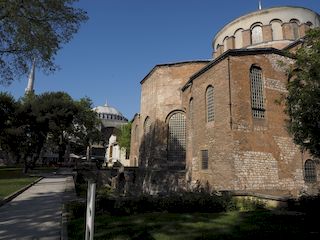
The exterior of Hagia Irene is defined by solid masonry, primarily brick, arranged in a composition that emphasizes balance and durability. The building’s silhouette is marked by a central dome rising above a rectangular base, reflecting a transitional architectural form between the longitudinal basilica and the centralized domed structure. The absence of elaborate decoration enhances the perception of its structural logic, drawing attention to the geometry of the volumes rather than to ornamental detail.
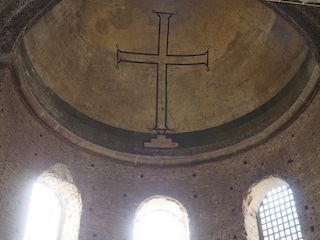
Inside, the basilica presents a strikingly austere environment. The spatial organization is clear and hierarchical, guiding the visitor from the entrance toward the apse. The interior lacks the extensive mosaics and figurative decoration found in other Byzantine churches, which contributes to a more restrained visual experience. One of the most notable features is the large cross in the apse, a rare example of symbolic decoration associated with periods when figural imagery was limited. This element provides insight into theological and artistic choices within the Byzantine world.
The proportions of the interior space reinforce a sense of verticality and openness. The dome plays a central role in structuring the space, while the supporting elements define a coherent system that remains easy to interpret. The relationship between light and structure further enhances the readability of the interior, allowing architectural features to stand out clearly.
Historical context and continuity
Hagia Irene dates back to the early Byzantine period and underwent several phases of reconstruction, particularly after damage caused by earthquakes. Despite these interventions, the building retains many characteristics of its original design. Its significance is closely tied to its location within Constantinople, then a major center of Christianity and imperial power.
Unlike many other Byzantine churches in Istanbul, Hagia Irene was not converted into a mosque following the Ottoman conquest. Instead, it served various practical functions, including use as an arsenal and storage space. This continuity of use, without major structural alteration, contributed to the preservation of its architectural identity. As a result, it offers a rare opportunity to observe a Byzantine church in a relatively unmodified state.
The name “Hagia Irene” itself refers not to a specific saint but to the concept of divine peace, reflecting the theological symbolism embedded in the naming of early Christian churches. This aspect underscores the intellectual and spiritual framework within which such buildings were conceived.
A clear architectural reading through visual sequencing
The videos on this site rely largely on carefully selected and animated photographic sequences, a method that is particularly effective for monuments like Hagia Irene. This approach allows for a gradual exploration of the building, emphasizing structure and spatial relationships rather than rapid visual impressions.
The exterior views highlight the overall composition, making it easier to understand how the different volumes interact. The progression of images reveals the balance between horizontal and vertical elements, as well as the role of the dome within the architectural system. Inside, the sequence guides the viewer through the space, clarifying the organization of the nave, the position of the apse, and the interplay between light and structure.
This method of presentation enhances the readability of the monument, allowing viewers to focus on essential features and to build a coherent mental image of the basilica. It is particularly suited to an architecture that relies more on proportion and structure than on decorative complexity.
A key monument for understanding Byzantine Istanbul
Hagia Irene offers a perspective on Istanbul’s past that complements more widely known monuments. Its restrained architecture and well-preserved structure provide valuable insight into early Byzantine design principles and the evolution of ecclesiastical spaces. By focusing on this monument, the video highlights a dimension of the city that is often less visible but equally significant.
Exploring Hagia Irene contributes to a broader understanding of Istanbul as a layered and evolving urban environment. For those interested in delving deeper into its history and architectural features, the dedicated pages linked to this monument provide additional context and analysis.
Links to related pages
Audio Commentary Transcript
Hagia Irene Church in Istanbul was the first cathedral in Constantinople, before the construction of Hagia Sophia in the 4th century AD. Since the capture of Constantinople by the troops of Mehmet II in 1453, this building no longer accommodates worship. For 3 centuries it served as an arsenal and in 1976 it was transformed into a musical performance hall, mainly for classical music.

Music:
- - YouTube video library - Cortosis - Scoring Action, (© Cortosis - Scoring Action by Kevin MacLeod is licensed under a Creative Commons Attribution 4.0 license. https://creativecommons.org/licenses/by/4.0/
- Source: http://incompetech.com/music/royalty-free/index.html?isrc=USUAN1100815
- Artist: http://incompetech.com/)
- - YouTube video library - Exciting Trailer, (© Exciting Trailer by Kevin MacLeod is licensed under a Creative Commons Attribution 4.0 license. https://creativecommons.org/licenses/by/4.0/
- Source: http://incompetech.com/music/royalty-free/index.html?isrc=USUAN1100494
- Artist: http://incompetech.com/)
Disclaimer: Despite its appropriateness, copyright issues prevent the use of turkish traditional music in "Istanbul • Hagia Irene, Turkey", hence the use of royalty-free music. Despite our careful selection, some might regret this decision, which is necessary to avoid potential lawsuits. Although difficult, this decision is the only viable solution.
Due to Vimeo's copyright control system, which does not correctly filter content, and their rigid policy, we have decided to transfer all our videos to YouTube. While we have appreciated our collaboration with Vimeo for many years, this decision is necessary to ensure the continuous and uninterrupted availability of our content. Thank you for your understanding and continued support.