

 Français (France)
  Nederlands (nl-NL)
 00:00 • intro | 00:13 • Pelling • Sangchen Pemayangtse monastery | 13:01 • Rabdentse | 14:53 • Sangocholin monastery (Sanga Choeling)
Personal creation from visual material collected during my trip Buddhist India • Sikkim • Bihar • West Bengal (2017)
Map of places or practices in Pelling on this site
• Use the markers to explore the content •
Pelling, Monasteries and Royal Memory in Sikkim
A Cultural Landmark in Western Sikkim
Located in western Sikkim, Pelling is one of the most rewarding cultural destinations in this Himalayan state of India. The town and its surroundings combine mountain landscapes, Buddhist heritage and historical remains linked to the former kingdom of Sikkim. This video offers a balanced introduction to those different dimensions through living monasteries, ritual tradition and traces of royal history.
Through active religious sites, ceremonial scenes and the remains of an old capital, viewers discover a region where spirituality and political memory have long been closely connected. Pelling is therefore more than a scenic mountain stop: it is a place where centuries of regional identity can still be read in the landscape.
Monasteries in Use and the Former Capital
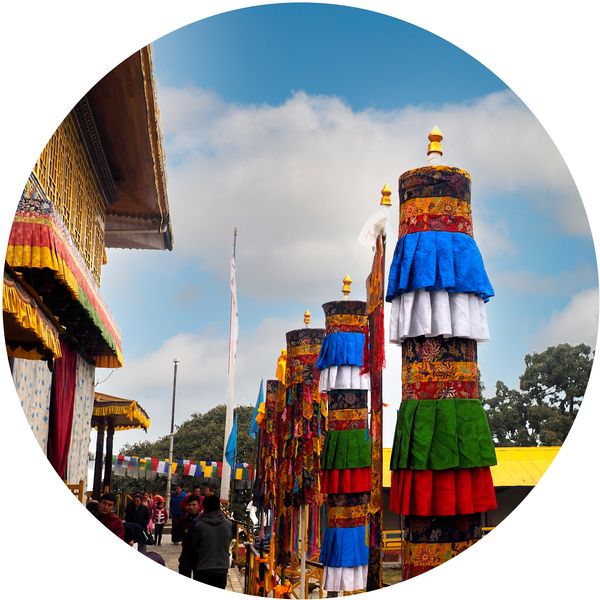
One of the central moments of the video takes place at Sangchen Pemayangtse Monastery, among the best-known monastic institutions of Sikkim. This monastery remains an important centre of the Tibetan Buddhist tradition. The inclusion of a religious ceremony allows the viewer to observe not only the building itself but also its continuing function: monks at prayer, ritual rhythms, ceremonial instruments and a carefully structured sacred atmosphere.
The journey then moves to Rabdentse, the former capital of the Kingdom of Sikkim. Now preserved as archaeological remains, the site recalls a period when royal authority was organized in close relationship with religious institutions. Terraces, foundations and the layout of the ground still suggest the scale and significance of the former capital.
Another important stop is Sangacholin Monastery, also written Sanga Choeling, one of the oldest monasteries in Sikkim. Established on higher ground, it reflects the monastic preference for calm surroundings, relative seclusion and visual connection with the mountain environment.
Historical, Religious and Himalayan Context
For centuries, Sikkim existed as an independent Himalayan kingdom ruled by the Chogyal dynasty. Political authority was closely associated with Buddhist institutions, and monasteries often played religious, educational and diplomatic roles. They were not only places of worship but also centres of continuity and administration.
Pemayangtse Monastery was founded in the seventeenth century and later restored and expanded. It occupied a leading position within the religious hierarchy of the kingdom and exercised influence beyond its immediate surroundings. Ceremonies still held there represent a notable continuity between historical tradition and present-day practice.
Rabdentse served as the capital of Sikkim until the nineteenth century. Regional conflict and later political change contributed to its decline and abandonment. Today its ruins remain among the most important material witnesses of the former kingdom.
The natural setting adds another dimension to these monuments. In a region of steep slopes and changing weather, religious buildings were adapted to terrain and climate. Timber elements, masonry walls, protective roofs and brightly coloured symbolic details are common features of Himalayan Buddhist architecture.
What These Videos Make Especially Clear
Videos built from carefully selected animated photographs are particularly effective for a place such as Pelling. They make it possible to move gradually from ritual detail to broad landscape view, and from monastic interiors to archaeological remains, without losing visual coherence. This creates a clearer understanding of the relationship between buildings, terrain and living tradition.
During ceremonial scenes, this format allows viewers to notice clothing, ritual objects, gestures, wall paintings and spatial arrangements that might pass quickly in conventional moving footage. The slower rhythm encourages observation rather than distraction.
At Rabdentse, animated still images help explain the site plan and surviving structures. Changes of angle reveal terraces, alignments and how the former capital occupied its setting. At hilltop monasteries, the same method clarifies how architecture was positioned in dialogue with the mountains.
This visual approach therefore offers progressive comprehension: the viewer does not simply see monuments, but understands how they functioned, how they relate to one another and how they remain meaningful today.
A Meeting of Spirituality and History
Within a relatively small area, Pelling brings together several essential aspects of Sikkim: active Buddhist tradition, royal memory and Himalayan scenery. This video invites viewers to explore a region where monasteries continue their religious role while Rabdentse recalls a sovereign past. The related detailed pages offer the opportunity to continue exploring each monument and tradition introduced through the images.
Links to related pages

Audio Commentary Transcript
We had planned to attend a Cham masked dance in a monastery in Pelling on the occasion of the Tibetan New Year.
Unfortunately, the lama of the monastery has just passed away, the show has been cancelled.
We attended a prayer session instead of the choreography. I'm not sure we lost out.
Music:
- - YouTube video library - A Revelation
- - YouTube video library - Anamalie, (© Anamalie by Kevin MacLeod is licensed under a Creative Commons Attribution 4.0 license. https://creativecommons.org/licenses/by/4.0/
- Source: http://incompetech.com/music/royalty-free/index.html?isrc=USUAN1500007
- Artist: http://incompetech.com/)
- - YouTube video library - People Watching
Disclaimer: Despite its appropriateness, copyright issues prevent the use of indian traditional music in "Pelling • A Buddhist ceremony at the monastery • Sikkim, India", hence the use of royalty-free music. Despite our careful selection, some might regret this decision, which is necessary to avoid potential lawsuits. Although difficult, this decision is the only viable solution.


