Français (France)
  Nederlands (nl-NL)
 The ceremony held at Sangchen Pemayangtse Monastery, located in Pelling in the Indian state of Sikkim, formed part of the celebrations associated with the Tibetan New Year. During that particular year, the monastery’s religious program was modified following the death of a lama, leading to the replacement of the Cham dance traditionally performed during the festivities by a different ceremony focused on prayers, liturgical recitations, and monastic gatherings. The event illustrates the importance of religious authorities in the organization of the Tibetan Buddhist calendar as well as the ability of monastic communities to adapt rituals according to circumstances. Losar ceremonies remain an important moment in the religious and communal life of monasteries in Sikkim.
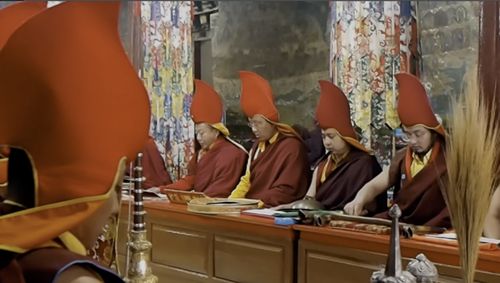
Pelling • Ceremony at Sangchen Pemayangtse Monastery

Pelling • Ceremony at Sangchen Pemayangtse Monastery
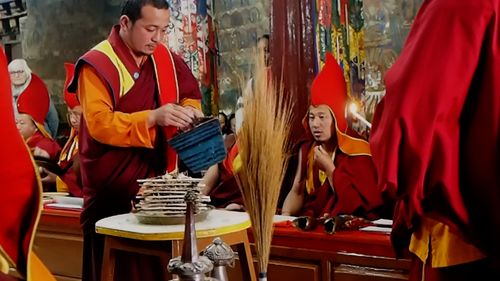
Pelling • Ceremony at Sangchen Pemayangtse Monastery
Tradition profile
Ceremony at Sangchen Pemayangtse Monastery
Tradition category: Buddhist celebrations
Tradition family: Religious traditions
Tradition genre: Religious Festivals and Celebrations
Cultural heritage: Buddhist
Geographic location: Pelling • Sikkim • India
• Links to •
• List of videos about Pelling on this site •
Pelling • A Buddhist ceremony at the monastery • Sikkim, India
Buddhist Ceremonies at Sangchen Pemayangtse Monastery in Pelling
Monastic Origins and Religious Context
The ceremonies held at Sangchen Pemayangtse Monastery belong to the religious traditions of Tibetan Buddhism practiced in the eastern Himalayas. Pemayangtse Monastery, founded during the seventeenth century in the former Kingdom of Sikkim, is associated with the Nyingma school, one of the oldest branches of Tibetan Buddhism. The rituals and annual celebrations organized there are closely connected to the Tibetan religious calendar and to the monastery’s spiritual role within the region.
The development of these ceremonies accompanied the expansion of Tibetan Buddhist monastic institutions across Sikkim. Religious authorities linked to the monarchy supported monasteries in order to strengthen both spiritual authority and political organization within the Himalayan kingdom. Pemayangtse occupied an important place within this system because of its connections with the royal court and influential Nyingma religious lineages.
The ceremonies were primarily intended to preserve liturgical continuity, transmit religious teachings, and maintain rituals associated with spiritual protection for local communities. They also reinforced the authority of the monastery as a major religious institution within western Sikkim.
Losar Celebrations and Ritual Adaptation
The ceremonies visible at the monastery are connected with Losar, the Tibetan New Year, which represents one of the most important moments in the religious calendar of Tibetan Buddhist communities throughout the Himalayas. The celebration marks both the symbolic renewal of the annual cycle and a period dedicated to purification rituals and collective prayers.
Traditionally, New Year celebrations in the monasteries of Sikkim include liturgical recitations, communal prayers, processions, and ritual Cham dances performed by monks wearing elaborate masks and ceremonial costumes. These sacred dances occupy an important place within Tibetan Buddhist traditions because they symbolize protective deities, spiritual teachings, and the removal of negative influences associated with the previous year.
During the particular year connected with this ceremony, however, the monastery’s religious program was modified following the death of a lama. The Cham dance scheduled for the celebrations was replaced by ceremonies centered more heavily on prayers, monastic recitations, and devotional gatherings. This change illustrates the adaptability of Tibetan Buddhist ritual practice while respecting mourning customs and religious obligations associated with the passing of an important spiritual authority.
The replacement of the dance by more contemplative ceremonies also altered the atmosphere of the celebrations, giving greater importance to liturgical continuity and collective prayer within the monastery.
Social Role and Community Significance
The ceremonies held at Pemayangtse extend beyond strictly monastic activities. They also play an important social role for Buddhist communities living in western Sikkim. Residents of nearby villages, families associated with the monastery, and pilgrims from other Himalayan regions participate in the religious gatherings organized during major festivals of the Tibetan calendar.
The monastery functions as a center for cultural transmission where religious ceremonies contribute to preserving liturgical chanting, ritual practices, monastic discipline, and elements of Tibetan cultural identity within contemporary Sikkim. Losar celebrations also reinforce connections between monastic communities and the wider population.
The participation of monks from different generations is particularly important for the continuity of religious traditions. Ceremonies serve not only as moments of worship but also as opportunities for younger monks to learn ritual organization, sacred recitations, ceremonial procedures, and the liturgical traditions specific to the Nyingma school.
The gatherings additionally create temporary spaces of interaction between religious institutions and local communities. Offerings, communal meals, prayers, and collective participation strengthen social ties linked to the monastery.
Contemporary Transformations and Preservation Challenges
Monastic ceremonies in Sikkim have undergone several transformations during the twentieth and twenty-first centuries. Political changes following the integration of Sikkim into India in 1975, the expansion of regional tourism, and changes in daily life have progressively modified the context in which religious traditions are practiced.
Despite these developments, major monasteries such as Pemayangtse continue to preserve the main ceremonies of the Tibetan Buddhist calendar in forms that remain closely connected to older monastic traditions. Certain adaptations concern crowd management, accommodation of visitors, and conservation measures intended to protect ritual spaces and religious objects.
The transmission of monastic practices has become an important issue for religious authorities. Efforts are made to preserve liturgical knowledge, ritual music, sacred dances, and ceremonial traditions associated with major Buddhist festivals. The ceremonies organized at Pemayangtse therefore remain an essential component of religious continuity and cultural preservation within the Himalayan region of Sikkim.
Ritual Organization of Ceremonies at Sangchen Pemayangtse Monastery
General Structure of the Ceremonies
The ceremonies held at Sangchen Pemayangtse Monastery follow a liturgical organization characteristic of Tibetan Buddhism and particularly of the Nyingma tradition practiced in Sikkim. Religious gatherings associated with the Tibetan New Year generally begin early in the morning with collective prayers performed inside the monastery’s main assembly halls. Monks occupy carefully arranged positions determined by seniority, ritual responsibility, and monastic rank.
Ceremonial sequences include the recitation of sacred texts, invocations chanted in unison, and ritual prayers marking the transition into the new annual cycle. Purification rites form an important component of the celebrations. Certain moments are dedicated to blessings, symbolic offerings, and prayers intended to remove negative influences associated with the previous year.
During the particular year connected with this ceremony, the death of a lama led to modifications in the monastery’s usual Losar program. The Cham dance normally performed during the celebrations was replaced by ceremonies more strongly focused on prayers, liturgical recitations, and monastic devotional practices. This change altered the atmosphere of the event by giving greater importance to mourning rituals and contemplative ceremonies within the monastery.
The progression of the ceremonies follows a rhythm structured by ritual recitations, instrumental sequences, and coordinated movements between different parts of the monastic complex.
Ceremonial Spaces and Spatial Organization
The ceremonies take place primarily inside the monastery’s prayer halls as well as in courtyards and exterior gathering areas used during major religious festivals. The principal halls are organized around richly decorated altars displaying Buddhist statues, butter lamps, ritual offerings, sacred texts, and ceremonial objects.
Participants move through the monastery according to routes established by monastic practice. Monks occupy the central ritual areas where prayers and recitations are conducted, while lay participants and visitors remain in peripheral sections or open courtyards during periods of large attendance.
Temporary ritual arrangements are often added during Losar celebrations. Prayer banners, hanging thangkas, offering tables, ceremonial fabrics, and symbolic decorations associated with the Tibetan calendar contribute to the visual structure of the monastery during the festivities.
Corridors and galleries function as transitional spaces connecting the various ceremonial zones. Processions of monks frequently move through these areas during liturgical sequences. Courtyards normally serve as the principal location for Cham dances performed by masked monks, although in the year described here these performances were omitted due to the death of the lama.
The architectural arrangement of the monastery helps organize the movement of participants while maintaining clear distinctions between ritual spaces reserved for monks and areas accessible to the public.
Ritual Clothing, Sacred Objects, and Symbolic Elements
The ceremonies involve a complex combination of ritual garments and ceremonial objects characteristic of Tibetan Buddhist monastic traditions. Monks wear layered robes composed mainly of red and saffron fabrics, sometimes accompanied by ceremonial hats reserved for specific liturgical functions.
Ritual objects used during the ceremonies include prayer wheels, bells, hand drums, cymbals, vajras, incense burners, and long Tibetan horns producing deep resonant sounds during major ceremonial moments. Butter lamps placed before altars create continuous illumination throughout the prayer halls.
Offerings occupy a central role in the visual organization of the ceremonies. Bowls containing water, rice, fruits, ritual cakes, and symbolic food items are arranged according to established liturgical conventions. Incense smoke continuously fills the ceremonial spaces, contributing to the ritual atmosphere within the monastery.
The decorative environment also includes painted religious imagery, sacred manuscripts, embroidered fabrics, and symbolic motifs associated with Buddhist cosmology. During New Year ceremonies, additional temporary decorations may be installed to mark the transition into the new ritual cycle.
The absence of Cham dance costumes during this particular ceremony created a noticeably different visual atmosphere compared with traditional Losar celebrations, where elaborate masks and ritual garments usually occupy an important place in the festivities.
Chants, Musical Elements, and Sound Environment
Sound plays a fundamental role in the organization of ceremonies at Sangchen Pemayangtse Monastery. Monastic recitations are performed collectively in deep rhythmic tones that structure the progression of the ritual. The chanting of sacred texts alternates between slow passages, prolonged vocal sequences, and coordinated liturgical responses.
Musical instruments accompany specific moments of the ceremonies. Tibetan horns announce major ritual transitions, while cymbals, bells, and drums emphasize changes in ceremonial rhythm. Certain prayers are performed in continuous low-frequency recitation, creating an atmosphere associated with meditation and ritual concentration.
The replacement of the Cham dance by prayer-centered ceremonies significantly changed the sound environment during this particular Losar celebration. In traditional performances, ritual dances introduce stronger rhythmic sequences and more dynamic musical accompaniment. In this case, the ceremonies remained more restrained and contemplative, with chants and liturgical recitations occupying the dominant position.
The sounds produced inside the monastery combine with natural environmental elements characteristic of Himalayan monastic settings, including wind, distant bells, and the movement of participants through the courtyards and galleries.
Participants and Transmission of Ritual Knowledge
The ceremonies involve participants occupying clearly defined roles within the monastic structure. Senior lamas supervise the principal rituals and lead the most important liturgical recitations. Monks perform chants, organize ceremonial objects, and coordinate ritual sequences throughout the celebrations.
Younger monks participate as part of their religious training. Their involvement allows them to learn sacred texts, ritual gestures, ceremonial timing, and the practical organization of monastic ceremonies according to the traditions of the Nyingma school.
Lay participants also contribute to the functioning of the ceremonies. Families and local residents bring offerings, attend prayers, light butter lamps, and participate in devotional activities surrounding the monastery. Pilgrims visiting during the New Year celebrations often perform circumambulations around sacred structures or make symbolic offerings connected with the annual renewal rituals.
The ceremonies therefore function simultaneously as religious observances, spaces of cultural transmission, and collective gatherings reinforcing the continuity of Tibetan Buddhist traditions within the Himalayan region of Sikkim.
 Links to the main sections of the site