

 Français (France)
  Nederlands (nl-NL)
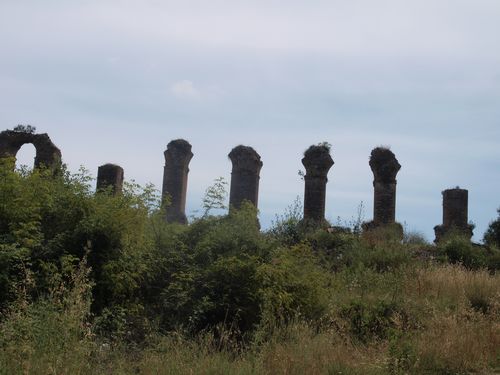
 The Aspendos site is one of the most remarkable archaeological complexes in the region of Pamphylia, Turkey. Founded during Greek Antiquity, it experienced significant development under Roman rule. The site is especially renowned for its ancient theatre, considered one of the best-preserved from the Roman world, and for its aqueduct, an impressive testament to ancient hydraulic engineering. Located near the ancient city of Perge, Aspendos reflects the economic and cultural prosperity of the region during Antiquity. The remains highlight the commercial and strategic importance of this city in the Greco-Roman era.

Perge • Aspendos site
Perge • Aspendos site

Perge • Aspendos site
Monument profile
Aspendos site
Monument categories: Archaeological, Archaelogic site
Monument family: Archaeological
Monument genre: Archaeological site
Cultural heritages: Greek antiquity, Roman antiquity
Geographic location: Perge • Turkey
Construction period: 2nd century BC
• Links to •
• List of videos about Perge on this site •
Perge, ancient Greek city • Turkey
History of the Site of Aspendos
Political and Social Context of Construction
The ancient city of Aspendos, located near Perge in present-day Turkey, was one of the most prosperous urban centers of the Pamphylia region during antiquity. Initially founded around the 5th century BCE by Greek colonists from Argos, Aspendos thrived thanks to its advantageous position along the Eurymedon River, which enabled direct access to the Mediterranean Sea. This strategic location fostered trade, agriculture, and cultural exchanges.
The construction of the Roman theatre of Aspendos, the site’s most iconic monument, took place during the reign of Emperor Marcus Aurelius, between 161 and 180 CE. This period marked the height of the Pax Romana, a time of relative peace, economic growth, and urban development throughout the Roman Empire. The theatre was built not only to provide entertainment and foster civic pride but also to demonstrate the city’s loyalty to Rome and its cultural refinement.
The political ambitions behind the construction included strengthening the city’s prestige and asserting its place within the Roman provincial hierarchy. Wealthy local citizens, such as Curtius Crispinus and Curtius Auspicatus, financed the construction, showcasing their status and contributing to the public good, a practice highly encouraged in Roman society. Rivalries between Pamphylian cities likely influenced the investment in monumental architecture, as cities competed to demonstrate their prosperity and allegiance to imperial authority.
Major Historical Events Affecting the Site
Following its golden age under Roman rule, Aspendos gradually entered a period of decline. During the Late Antiquity, the region faced repeated incursions and attacks, notably by Germanic tribes and later by Arab forces in the 7th century. These external threats, combined with internal instability, led to the partial abandonment and degradation of many urban structures, including the theatre.
Under Byzantine control, Aspendos lost much of its political and economic significance. However, the theatre was repurposed for defensive uses. The structure’s solid construction made it an ideal fortress against external threats. Modifications included fortifications and additional walls, preserving the main structure from total ruin.
The arrival of the Seljuk Turks in the 11th and 12th centuries marked another transformation. They reinforced the theatre, adapting it as a fortified palace, further ensuring its preservation through the Middle Ages. Despite these changes, the essential architectural integrity of the monument remained intact.
Global Context at the Time of Construction
The construction of the Aspendos theatre fits into a broader context of monumental building projects that characterized the Roman world during the 2nd century CE. Across the Mediterranean, from North Africa to Asia Minor, cities flourished under Roman peace and prosperity, leading to widespread urban embellishment.
Similar developments included the theatre of Leptis Magna in present-day Libya, the extensive public works of Ephesus, and the monumental forums built in cities like Sabratha. These projects reflected the Roman ideals of civilization, public life, and imperial grandeur.
The theatre of Aspendos embodies this movement, blending local Greek traditions with Roman engineering and stylistic innovations, thus participating in the global diffusion of Roman culture while maintaining distinct regional characteristics.
Transformations of the Monument
Over the centuries, the function of the Aspendos theatre evolved significantly. Originally designed for theatrical performances, including drama and music, the theatre’s use shifted as public spectacles declined with the rise of Christianity.
In the Byzantine period, the theatre’s spaces were adapted for residential and military uses. Strategic elements such as towers and fortified gateways were added, particularly during the Seljuk period. The construction techniques employed by the Seljuks included reinforcing walls and repurposing existing materials, contributing to the building’s longevity.
The theatre experienced periods of neglect but avoided total ruin, largely thanks to its military reuses, which paradoxically helped maintain its structure when many other Roman theatres fell into disrepair or were dismantled.
In the modern era, particularly from the 19th century onwards, archaeological interest in Aspendos grew. Initial explorations by Western travelers and scholars identified the site’s significance, leading to preservation efforts in the 20th century.
Current Role and Cultural Importance
Today, the Aspendos theatre stands as one of the best-preserved examples of Roman theatre architecture worldwide. It is celebrated not only for its historical and architectural value but also for its ongoing role as a cultural venue.
Each year, the theatre hosts the Aspendos International Opera and Ballet Festival, which brings together artists and audiences from around the world. This continued use of the site for artistic performances perpetuates its original function, reinforcing its cultural relevance.
Aspendos contributes significantly to Turkey’s national heritage and is an emblem of the country’s rich multicultural history. It serves as a powerful reminder of the fusion between Greek and Roman civilizations in Asia Minor and highlights the enduring legacy of ancient engineering and aesthetics.
Conservation Status and Challenges
The preservation of the Aspendos theatre faces numerous challenges. High tourist traffic accelerates the erosion of the limestone seating and pathways. Environmental factors, such as humidity, seismic activity, and vegetation growth, also pose risks to the structure’s stability.
Urban development around the site has been managed carefully, but pressures remain to balance accessibility with conservation. Restoration efforts carried out during the 20th century, though sometimes criticized for their interventions, helped stabilize the monument and make it accessible to visitors.
The site is listed on Turkey’s Tentative List for UNESCO World Heritage status, underlining its international importance. This designation carries the responsibility of implementing sustainable preservation policies to safeguard the theatre for future generations, ensuring that its architectural and historical significance continues to inspire.
Architecture of the Site of Aspendos
Technological and Architectural Innovations of the Period
The architecture of the ancient site of Aspendos, especially its renowned Roman theatre, reflects the advanced technological knowledge and architectural sophistication of the second century CE. Built during the reign of Marcus Aurelius, the theatre showcases a perfect synthesis of Greek and Roman building traditions adapted to the specific environmental and cultural context of Pamphylia.
One of the key innovations lies in the structural design. Unlike purely Roman theatres, which were generally constructed on flat terrain with complex substructures, the theatre of Aspendos strategically uses the natural slope of a hill for the upper seating sections, while employing robust vaulted foundations to support the lower tiers. This method provided enhanced stability while economizing on construction materials and labor, reflecting a practical adaptation of classical architectural knowledge to local conditions.
Aspendos is also notable for its outstanding acoustic design. The semi-circular configuration of the cavea, combined with the specific proportions of the orchestra and stage building, creates an acoustic environment in which even a whisper on stage can be heard clearly by spectators seated in the highest tiers. The architects incorporated ventilation systems through peripheral corridors and galleries, ensuring not only sound amplification but also cooling airflow throughout the structure.
Urbanistically, the theatre was strategically located along one of the city’s main arteries, linking it to the agora and other civic spaces, thus integrating public entertainment seamlessly into the urban fabric.
Materials and Construction Methods
The primary material used in the construction of Aspendos’ theatre was locally sourced limestone, chosen for its strength, availability, and ease of carving. The quality of the limestone provided both structural integrity and a pleasing aesthetic, with a light hue that enhanced visibility and brightness within the theatre space.
The seating rows (cavea) were laid directly onto the hillside, with the lower sections resting on carefully constructed barrel vaults composed of limestone blocks bonded with hydraulic mortar. These vaults provided not only foundational support but also allowed for efficient distribution of crowds through vomitoria—arched entrances and exits facilitating swift movement of spectators.
The scaenae frons, or stage building façade, was an elaborate, multi-tiered structure adorned with Corinthian columns, niches, and intricate friezes. Blocks were joined with metal clamps and poured lead to ensure long-term stability without the use of visible mortar joints, a technique that enhanced both durability and visual refinement.
The aqueduct of Aspendos, another remarkable architectural achievement, employed large stone blocks fitted precisely to minimize leakage. The structure included siphon systems, a sophisticated method that allowed water to be transported across deep valleys by utilizing hydraulic pressure—a technological marvel of Roman engineering.
Architectural and Artistic Influences
The theatre of Aspendos is a vivid testament to the blending of Hellenistic and Roman architectural traditions. The Greek influence is evident in the semi-circular arrangement of the seating and the theatre’s partial integration into the natural landscape, reflecting the traditional Greek preference for harmonizing architecture with nature.
Roman influence is most apparent in the design of the monumental scaenae frons and the fully enclosed nature of the theatre, which allowed for greater control of acoustics and light. The presence of richly decorated architectural elements—such as Corinthian capitals, floral motifs, and mythological reliefs—illustrates the adoption and adaptation of Roman decorative arts.
At the same time, some stylistic choices, such as specific ornamental details and localized motifs, reflect Anatolian traditions and the cultural syncretism of Pamphylia during the imperial period. The theatre’s restrained yet elegant ornamentation aligns with the aesthetic values of a prosperous yet provincial Roman city.
Organization and Structure
The theatre’s layout is organized around a harmonious semi-circular plan with a diameter of approximately 96 meters. The cavea is divided into two main tiers by a diazoma, a wide horizontal passage that allows spectators to move easily between seating levels. The upper and lower sections were further segmented by staircases, ensuring efficient circulation.
The orchestra, nearly a perfect semicircle, measures about 24 meters across and was paved with large stone slabs. It was separated from the first rows of seats by a low parapet, reflecting Roman safety norms and hierarchical audience arrangements.
The scaenae frons stands as one of the most complete examples of Roman stage architecture, with a height exceeding 20 meters. Its elaborate design includes three levels of superimposed columns, richly carved friezes, and niches that once held statues of deities, emperors, and benefactors. The stage itself is wide and deep, enabling complex theatrical performances and ensuring optimal visibility for the entire audience.
Access to the theatre was managed through monumental vaulted corridors (vomitoria), which provided rapid entry and exit to accommodate large crowds. These structural elements were crucial not only for functionality but also for maintaining the safety of spectators.
The nearby aqueduct, spanning over 19 kilometers, includes remarkable inverted siphon towers, a unique feature that highlights the technical prowess required to supply a growing city with a reliable water source.
Notable Statistics and Anecdotes
The theatre of Aspendos could accommodate between 7,000 and 8,500 spectators, a remarkable figure for a regional city of its size. The precision of its construction ensured that the building retained much of its original structure, even after centuries of natural wear and human intervention.
One famous legend associated with the theatre recounts that its architect, named Zeno of Aspendos, constructed the theatre to such perfection that the local ruler, upon hearing a whisper from the stage while standing at the top tier, rewarded Zeno with his daughter’s hand in marriage.
The theatre’s acoustics remain so effective that modern performances can still be held without the need for artificial amplification, underscoring the enduring genius of its original design.
International Recognition and Conservation Challenges
The architectural excellence of Aspendos contributes to its status as one of the most important surviving monuments of Roman engineering and design. Its near-intact scaenae frons makes it a unique case among ancient theatres, which are often heavily ruined.
Today, the theatre is protected as a national heritage site by Turkey and is listed on UNESCO’s Tentative List for World Heritage designation. Conservation efforts focus on managing tourist impact, mitigating environmental damage, and maintaining structural integrity.
Challenges include erosion of seating due to visitor traffic, biological growth affecting the stone, and the need for careful restoration that respects the authenticity of the original materials and techniques. Preservation projects emphasize minimal intervention, aiming to retain the theatre’s ancient character while ensuring its continued use for cultural events, such as the internationally renowned Aspendos Opera and Ballet Festival.
Through these efforts, the architectural legacy of Aspendos continues to inspire admiration for the ingenuity and artistry of ancient builders, preserving a vital link between past and present.