

 Français (France)
  Nederlands (nl-NL)
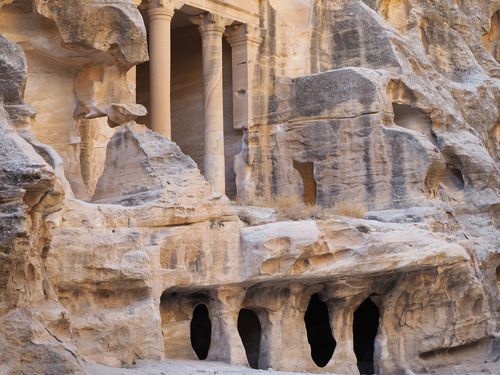
 The Triclinium of Little Petra is a rock-cut chamber carved into the sandstone cliffs of Siq al-Barid, an archaeological site located a few kilometers north of the ancient city of Petra in southern Jordan. The space forms part of a broader complex of Nabataean excavations distributed along the narrow canyon that structures the site. The term triclinium refers to a dining chamber equipped with stone benches arranged along the walls, allowing participants to recline during communal meals. Within Little Petra, such rooms illustrate the social and ceremonial functions connected with gatherings of merchants, travelers, and local communities active in this satellite settlement of the Nabataean kingdom.

Little Petra • Triclinium
Little Petra • Triclinium

Little Petra • Triclinium
Monument profile
Triclinium
Monument categories: Archaeological, Rock Sanctuary, Rock-Cut Habitats and Halls
Monument families: Rock Sanctuary and Monumental Bas-reliefs • Archaeological
Monument genres: Religious, Archaeological site
Cultural heritage: Nabatean
Geographic location: Little Petra • Jordan
Construction period: 1er siècle
This monument in Little Petra is inscribed on the UNESCO World Heritage List since 1985 and is part of the serial property "Petra".See the UNESCO monuments featured on this site
• Links to •
• List of videos about Little Petra on this site •
Little Petra, troglodyte city • Jordan
• References •
UNESCO: Petra
History of the Triclinium of Little Petra
Foundation and Nabataean Context
The Triclinium of Little Petra is located within the archaeological site of Siq al-Barid, a narrow sandstone canyon situated approximately eight kilometers north of Petra in southern Jordan. The monument belongs to a group of rock-cut spaces created during the period of expansion of the Nabataean kingdom, roughly between the first century BCE and the first century CE. Siq al-Barid developed as a secondary settlement connected to the Nabataean capital and functioned as an organized stop along the caravan routes that linked the Arabian Peninsula with the Levant and the Mediterranean world.
The creation of the Triclinium reflects social and ceremonial practices that were integrated into Nabataean urban and semi-urban environments. Rock-cut dining chambers were designed to host formal communal meals. In the archaeological vocabulary used to describe such spaces, the term triclinium refers to a room equipped with stone benches arranged along the walls, allowing participants to recline during banquets. This spatial arrangement corresponds to dining customs inherited from the Hellenistic world and adapted within Nabataean cultural traditions.
The establishment of such a structure at Siq al-Barid indicates that the settlement had functions extending beyond the accommodation of caravans. The Triclinium formed part of a network of spaces intended for gatherings connected with social cohesion, ceremonial events, and the reception of groups active in the commercial life of the Nabataean kingdom.
Social and Ceremonial Role of the Monument
The primary function of the Triclinium was the organization of communal banquets conducted within a formal setting. In Nabataean society, collective meals held in specially prepared rooms carried social and symbolic significance. These gatherings reinforced bonds among participants and provided a structured environment in which communal identities could be expressed.
Banquets conducted in such spaces were often connected with commemorative practices. In several Nabataean sites, rock-cut dining rooms appear alongside monuments associated with funerary or cultic activity. Within this cultural framework, communal meals could serve as occasions to honor deceased individuals, to celebrate protective deities, or to reinforce alliances between families and merchant groups.
The spatial configuration of the Triclinium supported this function. Participants occupied the benches carved along the sides of the room, while the central area remained open for movement and for the service of food. This arrangement created a controlled environment in which individuals faced one another across the interior space. The architectural design therefore reinforced the social structure of the gathering itself.
Because Siq al-Barid served as a stopping point along important caravan routes, the Triclinium may also have functioned as a place where visiting merchants and travelers were received. Such meetings would have allowed the hosts to incorporate outsiders into a ritualized context of hospitality. The monument thus played a role in maintaining the networks of cooperation and exchange that sustained the Nabataean trading system.
Transformation of Use After the Nabataean Period
The political situation of the region changed in the early second century CE when the Nabataean kingdom was annexed by the Roman Empire. Petra remained an important regional center within the newly established Roman province of Arabia. However, shifts in trade patterns gradually altered the role of several secondary settlements associated with caravan activity.
Within this evolving context, structures such as the Triclinium at Siq al-Barid may have experienced changes in use. Rock-cut rooms originally designed for ceremonial gatherings could be adapted for practical purposes, including temporary shelter, storage, or habitation. Evidence from other areas of the site indicates that several carved spaces continued to be occupied intermittently during later historical phases.
Environmental factors also influenced the long-term preservation of the monument. The sandstone formations of Siq al-Barid are subject to erosion caused by wind, water infiltration, and temperature fluctuations. Over time these processes have modified the surfaces of the carved structures and have contributed to the partial deterioration of architectural details. Despite these transformations, the essential features of the Triclinium remain identifiable and continue to provide evidence of its original purpose.
Rediscovery and Archaeological Study
Siq al-Barid attracted the attention of travelers and explorers during the nineteenth century, when the broader region of Petra began to be documented by European scholars. Early descriptions of the site noted the presence of numerous rock-cut chambers distributed along the canyon. Some of these rooms were recognized as spaces intended for communal dining because of the benches carved along their walls.
Archaeological research conducted during the twentieth century provided a clearer understanding of the organization of the site. Detailed surveys and architectural analyses identified several structures interpreted as triclinia within the Nabataean landscape. These studies demonstrated that dining rooms carved into rock formations formed a recurring architectural type associated with social gatherings and ritualized banquets.
More recent investigations have focused on documenting the architectural features of these monuments and their relationship to the surrounding environment. Measurements, architectural drawings, and contextual analysis have contributed to reconstructing the spatial organization of Siq al-Barid. Through these studies the Triclinium has been recognized as part of a broader network of spaces reflecting the social life and ceremonial practices of the Nabataean communities that inhabited the region.
World Historical Context
The construction and use of the Triclinium of Little Petra correspond to the period of Nabataean prosperity between the first century BCE and the first century CE. During this time the Roman Empire consolidated its authority across the Mediterranean under Augustus. In East Asia the Han dynasty expanded long-distance trade across Central Asia. In the Near East several regional kingdoms maintained varying degrees of autonomy while interacting with Roman political influence.
Current Status and Heritage Protection
The Triclinium forms part of the archaeological landscape of Siq al-Barid, commonly known as Little Petra. This site is included within the property inscribed in 1985 on the UNESCO World Heritage List under the official designation “Petra.” The inscription recognizes the exceptional historical and archaeological significance of the Nabataean remains preserved in the region.
The conservation of the monument depends largely on the stability of the sandstone into which it was carved. Monitoring programs implemented by Jordanian authorities and research teams aim to assess the effects of natural erosion and visitor activity. Protective measures are intended to preserve the architectural integrity of the site and to maintain the visibility of structures such as the Triclinium within the wider Nabataean landscape.
Architecture of the Triclinium of Little Petra
Topographical Setting and Integration into the Canyon Landscape
The Triclinium of Little Petra is located within the narrow sandstone gorge of Siq al-Barid, approximately eight kilometers north of Petra in southern Jordan. The monument is carved directly into the vertical canyon walls and forms part of a sequence of rock-cut architectural spaces distributed along the main passage of the site. Its configuration is strongly conditioned by the natural morphology of the canyon, whose stratified sandstone formations were shaped by long-term erosion.
The chamber occupies a section of the gorge where the passage widens slightly, creating a small open space in front of the carved façade. This widening functions as a forecourt that mediates the transition between the circulation route through the canyon and the interior of the monument. The architectural sequence therefore begins in this open area, where visitors approach the rock face before entering the chamber.
Unlike freestanding buildings assembled from masonry blocks, the Triclinium was excavated directly from the sandstone formation. The natural rock wall simultaneously forms the façade and the structural envelope of the space. Creating the chamber required removing material from the interior while preserving the surrounding rock as a continuous shell. This monolithic relationship between architecture and geological context defines the structural logic of the monument.
The canyon walls frame the façade and accentuate the entrance. Because the chamber is carved directly along the principal route through Siq al-Barid, its architectural presence relies primarily on the geometry of its opening rather than on external ornamentation.
Façade Composition and Architectural Treatment of the Entrance
The façade consists of a vertical rock surface produced by leveling a portion of the sandstone wall. During excavation, irregularities in the natural surface were partially removed to create a flatter architectural plane around the entrance. This treatment distinguishes the façade zone from the surrounding canyon rock.
At the center of this surface lies the rectangular entrance opening leading to the chamber. The sides of the doorway are sharply cut, producing clean edges that contrast with the natural texture of the stone. The lintel above the doorway is carved directly from the same rock mass, forming a horizontal line that visually stabilizes the composition.
Architectural emphasis is concentrated on the doorway itself. In contrast to the elaborate façades of some Nabataean monuments, the Triclinium displays a restrained exterior. The absence of sculpted decoration reinforces the functional nature of the structure and directs attention toward the interior space.
The dimensions of the entrance allow daylight to penetrate the chamber. Because the interior is relatively shallow, light entering through the doorway illuminates most of the room. This design maintains a strong visual continuity between the forecourt and the interior.
Seen from the canyon floor, the doorway appears as a geometric incision in the sandstone wall. The contrast between the regular lines of the opening and the layered surfaces of the canyon contributes to the architectural clarity of the monument.
Interior Spatial Organization and Functional Layout
The interior consists of a rectangular chamber excavated into the sandstone. The room was created through the systematic removal of rock, leaving a hollowed volume enclosed by the surrounding stone mass. Walls, ceiling, and floor form a continuous structural unit carved from the same geological formation.
The most distinctive architectural elements inside the chamber are the stone benches extending along the sides of the room. These benches were carved directly from the bedrock and therefore form an integral part of the structure rather than independent elements. Their surfaces were shaped into relatively flat platforms suitable for reclining or seating.
The benches run parallel to the longitudinal axis of the chamber and define a central corridor extending from the entrance to the rear wall. This corridor provides circulation space while allowing occupants seated on the benches to face one another across the room.
Such an arrangement corresponds to the traditional layout associated with triclinia. Participants in communal meals reclined along the sides while attendants moved through the central space. The architectural organization of the chamber therefore reflects a spatial configuration designed to accommodate this social practice.
The rear wall closes the chamber without architectural articulation. No internal columns or supports are present. Structural stability depends entirely on the thickness of the surrounding sandstone, which acts as a continuous load-bearing mass.
Carving Techniques and Surface Treatment
The Triclinium was created through successive stages of excavation carried out directly in the sandstone formation. Craftsmen removed rock progressively using metal tools until the interior volume was obtained. Evidence of this process remains visible in the tool marks preserved on several surfaces.
These marks appear as linear grooves and ridges produced by repeated blows from chisels and picks. Some areas retain a rough texture corresponding to the early excavation stage. Other sections were subsequently smoothed to create more regular planes, particularly on the benches and along portions of the walls.
The ceiling shows a slightly curved profile resulting from the method used to remove the rock. This curvature distributes structural stress within the surrounding stone and contributes to the stability of the cavity. Because the chamber remains embedded within a substantial mass of sandstone, the rock itself functions as the primary structural support.
Surface finishing inside the chamber was selective. Functional areas such as the benches were smoothed more carefully to produce comfortable surfaces. Other sections retain irregular textures reflecting the natural characteristics of the stone.
The coexistence of rougher and smoother areas reveals the successive phases of excavation and finishing that shaped the interior of the monument.
Painted Decoration and Architectural Conservation
A notable feature of the Triclinium is the presence of painted decoration preserved on parts of the interior surfaces. Remnants of pigment survive on sections of the ceiling and on the upper zones of the walls. These paintings form an integral component of the interior architectural treatment.
Before pigments were applied, portions of the rock were covered with a thin layer of plaster that created a smoother surface. This preparation improved the adherence of pigments and enhanced the visibility of the motifs. Surviving fragments indicate the use of red, yellow, and darker tones applied against a lighter background.
The decorative program includes vegetal motifs such as vine scrolls and clusters of grapes arranged across the ceiling and upper wall surfaces. These designs follow the curvature of the ceiling and extend along the junction between the walls and the overhead surface. Their placement emphasizes the upper zone of the chamber while leaving the benches and lower walls unobstructed.
The integration of painting with the carved surfaces contributes to the spatial composition of the interior. The painted band forms a decorative frame above the seating area and reinforces the perception of the room’s geometry.
The preservation of these paintings is influenced by the properties of the sandstone environment. Temperature fluctuations, moisture infiltration, and salt crystallization gradually deteriorate both plaster and pigments. In several areas the plaster layer has detached from the stone, causing the loss of painted sections.
Conservation programs focus on stabilizing the remaining fragments and controlling environmental conditions. Monitoring humidity and regulating visitor access help limit further damage. These measures aim to preserve both the carved architecture and the surviving decorative elements of the Triclinium within the archaeological landscape of Siq al-Barid.