

 Français (France)
  Nederlands (nl-NL)
 Tomb 846 is a rock-cut funerary monument located at Little Petra, an archaeological site near the well-known Nabataean city of Petra in Jordan. Carved into the region’s distinctive sandstone cliffs, the tomb reflects the funerary practices and spatial organization developed by the Nabataean civilization. Like other monuments at the site, it forms part of a broader architectural landscape where carved façades interact with the natural canyon environment. Today, Tomb 846 represents one of the archaeological elements that illustrate the historical and cultural significance of Little Petra and its connection to the wider Nabataean heritage of southern Jordan.
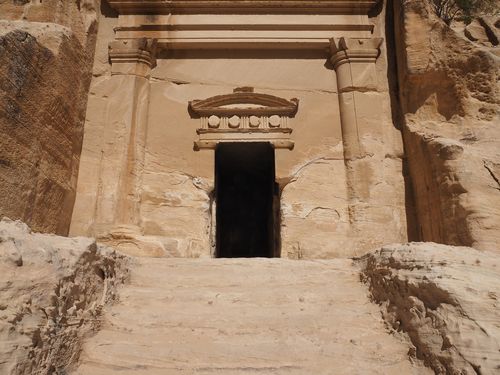
Little Petra • Tomb 846
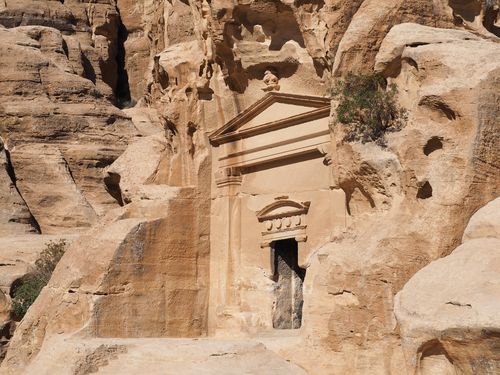
Little Petra • Tomb 846
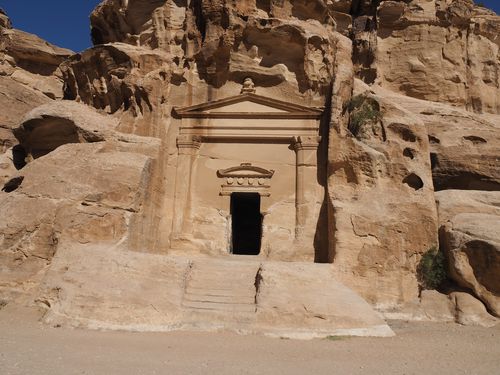
Little Petra • Tomb 846
Monument profile
Tomb 846
Monument categories: Tomb, Archaeological, Rock Sanctuary
Monument families: Tomb, Necropolis, Mausoleum or Cenotaph • Rock Sanctuary and Monumental Bas-reliefs • Archaeological
Monument genres: Funerary, Religious, Archaeological site
Cultural heritage: Nabatean
Geographic location: Little Petra • Jordan
Construction period: 1er siècle
This monument in Little Petra is inscribed on the UNESCO World Heritage List since 1985 and is part of the serial property "Petra".See the UNESCO monuments featured on this site
• Links to •
• List of videos about Little Petra on this site •
Little Petra, troglodyte city • Jordan
• References •
UNESCO: Petra
History of Tomb 846 at Little Petra
Construction during the Nabataean occupation of Siq al-Barid
Tomb 846 is a rock-cut funerary monument located in Little Petra, known archaeologically as Siq al-Barid, a secondary Nabataean settlement situated north of Petra in southern Jordan. The monument was created during the period when the Nabataean kingdom controlled the region and developed the surrounding valleys as complementary spaces connected to Petra’s economic and residential system. Archaeological observations indicate that the tomb belongs to the group of funerary structures carved into the sandstone cliffs that border the narrow passageways of the site.
The excavation of Tomb 846 reflects the practice of cutting burial chambers directly into the rock formations surrounding inhabited or frequented areas of the settlement. The monument appears to have been designed for collective burial, as suggested by the internal chamber capable of accommodating multiple interments. Its position within a cluster of similar cavities indicates that it formed part of a defined funerary sector associated with the occupation of Little Petra.
Function and funerary use
The primary role of Tomb 846 was funerary. The internal chamber was intended to receive the remains of individuals belonging to a family group or a small social unit connected to the local community active at Little Petra. The internal arrangements of the chamber allowed repeated use of the space, suggesting that burials could take place over an extended period rather than during a single event.
The tomb’s location along a rock face containing other carved cavities indicates an organized distribution of burial spaces within the settlement. These tombs were integrated into the broader spatial layout of the site, where habitation areas, storage spaces and carved chambers coexist within the sandstone landscape. Tomb 846 represents one of the individual burial units within this funerary network documented by archaeological surveys of Siq al-Barid.
The monument’s numbering reflects its identification during modern archaeological documentation of the site. The numerical designation does not correspond to an ancient name but results from systematic recording carried out by researchers studying the rock-cut structures of Little Petra.
Abandonment and archaeological identification
The use of Tomb 846 likely declined after the political transformation of the Nabataean kingdom in the early second century CE, when the region was incorporated into the Roman Empire in 106 CE. As patterns of settlement and funerary practice evolved, many rock-cut tombs at Little Petra ceased to function as burial spaces.
Over time the monument remained as an empty rock-cut chamber within the sandstone cliff. Modern exploration of the Petra region during the nineteenth and twentieth centuries led to the identification and mapping of numerous cavities at Siq al-Barid. Tomb 846 was recorded during these archaeological surveys and incorporated into the site’s documented inventory of rock-cut monuments.
Its current identification therefore derives from archaeological cataloguing rather than from historical textual sources. The classification allows researchers to distinguish the tomb from neighbouring cavities and to document its architectural and spatial characteristics within the broader complex of Little Petra.
Global historical context
The probable period of use of Tomb 846 corresponds to the height of Nabataean political and economic activity between the first century BCE and the first century CE. During the same period the Roman Empire expanded across the Mediterranean basin. In East Asia the Han dynasty governed China and maintained long-distance trade routes. In northern India the Kushan Empire emerged as a regional power. In Mesoamerica the earliest large Maya urban centres were beginning to develop.
Present status and preservation
Today Tomb 846 forms part of the archaeological landscape of Little Petra. The monument is preserved as a rock-cut chamber integrated into the sandstone cliffs of Siq al-Barid. Its identification and documentation contribute to the understanding of the funerary organization of the settlement.
Little Petra is associated with the cultural landscape of Petra, which was inscribed on the UNESCO World Heritage List in 1985 under the official name “Petra”. Within this broader heritage context, Tomb 846 represents one of the many carved monuments illustrating the funerary practices and spatial organization connected to the Nabataean presence in the region.
Architecture of Tomb 846 at Little Petra
Position within the sandstone cliff and external layout
Tomb 846 is carved directly into the sandstone cliff forming the rock walls that line the narrow passageways of Little Petra, also known as Siq al-Barid. Rather than a constructed building, the monument consists of a cavity excavated within the natural rock face. Its external configuration follows the geometry of the cliff, with the façade created by cutting back the sandstone to form a vertical plane suitable for the entrance.
The façade occupies a flattened section of rock where natural irregularities were removed to create a clearly defined architectural surface. The limits of this worked area remain visible where the smoothed plane meets untouched sandstone strata. The monument does not project outward but remains fully integrated within the geological mass of the cliff.
The entrance is positioned centrally within the prepared façade and aligns with the axis of the internal chamber, providing direct access to the excavated interior. The threshold lies close to the natural ground level and may be slightly raised by a narrow rock step created during the cutting of the façade. Tomb 846 forms part of a sequence of rock-cut cavities distributed along the same cliff face and separated by sections of untouched sandstone that preserve the continuity of the rock wall.
Entrance façade and carved access
The façade of Tomb 846 is defined by a rectangular opening cut directly into the sandstone. The doorway has straight vertical sides and a horizontal lintel carved from the surrounding rock rather than constructed with inserted architectural elements. The opening penetrates the cliff face to form a short recessed passage leading into the burial chamber.
The rock surface surrounding the doorway shows evidence of levelling work carried out to create a planar exterior face. Tool marks remain visible where the sandstone was cut through repeated horizontal or diagonal strokes, documenting the gradual removal of rock during excavation.
The thickness of the cliff surrounding the entrance creates a recessed doorway that clearly marks the transition between exterior and interior space. The jambs and lintel are integral parts of the sandstone mass and display slightly softened edges produced by natural erosion. The threshold forms a shallow horizontal platform separating the burial chamber from the exterior rock surface.
No architectural frame, sculptural relief or carved decorative element is identifiable on the façade. The visual definition of the monument therefore relies mainly on the geometric clarity of the opening and the planar surface created around it.
Internal chamber and spatial organization
Behind the entrance, Tomb 846 contains a single chamber excavated within the sandstone cliff. The internal plan is approximately rectangular, with vertical walls created by cutting away the rock from the entrance toward the rear of the cavity. The chamber is entirely defined by the surrounding sandstone without masonry construction or inserted architectural components.
The ceiling follows the excavation plane produced during the hollowing of the chamber and appears generally flat, although slight curvature may occur depending on the structure of the sandstone layers encountered during excavation. Interior surfaces display traces of smoothing where the rock was levelled after the primary excavation phase.
Funerary installations are carved directly into the chamber walls in the form of benches or shallow niches cut into the sandstone. Their placement along the side walls and at the rear of the chamber indicates areas intended for the placement of burials. Each installation is carved from the same rock mass as the surrounding surfaces, creating a continuous interior space without additional construction materials.
The chamber’s proportions correspond to the thickness of the sandstone cliff at the point where the tomb was excavated. Its internal depth reflects the available volume of rock rather than a predetermined architectural module.
Excavation techniques and material characteristics
Tomb 846 was created entirely through rock excavation within the local sandstone formation characteristic of Little Petra. This material is sufficiently workable to allow excavation using metal tools capable of gradually removing layers of stone.
The excavation process began with the preparation of the external façade. Workers cut back the cliff surface to produce a flat vertical plane suitable for the entrance. Once this plane had been established, the doorway was opened and excavation of the interior chamber progressed inward from that point.
Tool marks remain visible on several interior surfaces, particularly where the rock was only partially smoothed after excavation. These marks appear as parallel grooves or shallow ridges produced by repeated strikes during the cutting process. The final stage involved levelling the chamber walls and shaping the funerary benches directly within the rock.
The sandstone layers visible on the façade and inside the chamber show colour variations ranging from pale beige to deeper reddish tones. These bands correspond to natural stratification within the rock and influence the appearance of the carved surfaces.
Structural condition and architectural preservation
The architectural condition of Tomb 846 depends largely on the stability of the sandstone cliff in which it was excavated. Because the monument is carved from a continuous rock mass, its stability relies primarily on the cohesion of the surrounding geological formation rather than on assembled building components.
The exterior façade shows signs of gradual weathering caused by wind exposure, temperature variation and natural erosion. These processes have softened the edges of the entrance and reduced the sharpness of certain carved surfaces. Small fissures occasionally appear where sandstone layers respond differently to environmental conditions.
The interior chamber is generally better preserved because it is protected from direct weather exposure. Tool marks and the geometry of the funerary installations remain visible on several walls. The chamber remains structurally supported by the surrounding rock.
Modern archaeological documentation focuses on the geometry and position of the tomb within the cliff face. Tomb 846 survives today as a rock-cut funerary chamber defined by the relationship between its carved façade, recessed entrance and interior chamber excavated within the sandstone formation.