Français (France)
  Nederlands (nl-NL)
 00:00 • intro | 00:39 • Lamayuru monastery
Personal creation from visual material collected during my trip Unknown India • Ladakh, Karnataka, Telangana (2022)
Map of places or practices in Lamayuru on this site
• Use the markers to explore the content •
Lamayuru Gompa, Ancient Monastery and Sacred Landscape of Ladakh
A Major Buddhist Site in the Himalayas
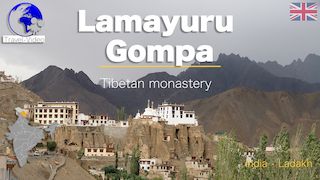
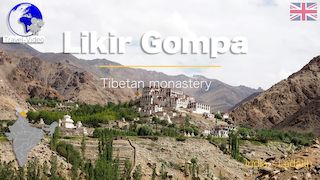
Lamayuru Gompa, located in the Ladakh region of northern India, is one of the best-known monastic sites of the western Himalayas. Set on dramatic slopes above a dry mountain valley, it combines religious heritage, distinctive architecture, and a powerful natural setting. This video offers the opportunity to discover a place where buildings appear to grow from the mountain itself, following a pattern often found in Himalayan regions where monasteries occupied both symbolic and strategic positions.
Lamayuru is immediately recognizable through the density of its structures rising along the hillside, the whitewashed walls contrasting with ochre earth and rock, and the continuing presence of an active religious community. The site is not a single monument but a monastic complex made up of temples, assembly halls, monks’ quarters, terraces, stairways, and circulation passages adapted to uneven terrain.
What the Video Primarily Reveals
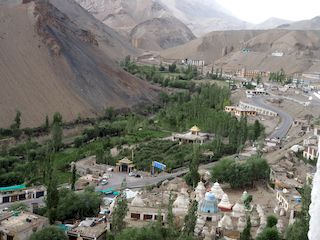
The central subject of the video is the monastery itself. Wider views show how the buildings are layered across the slope, forming a stepped composition dominated by key religious structures. This elevated arrangement gives Lamayuru one of the most distinctive silhouettes in Ladakh.
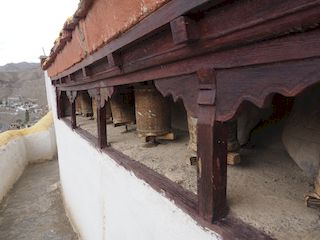
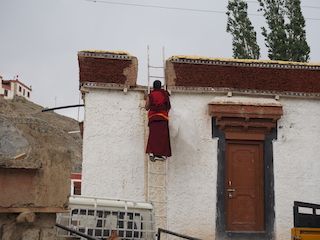
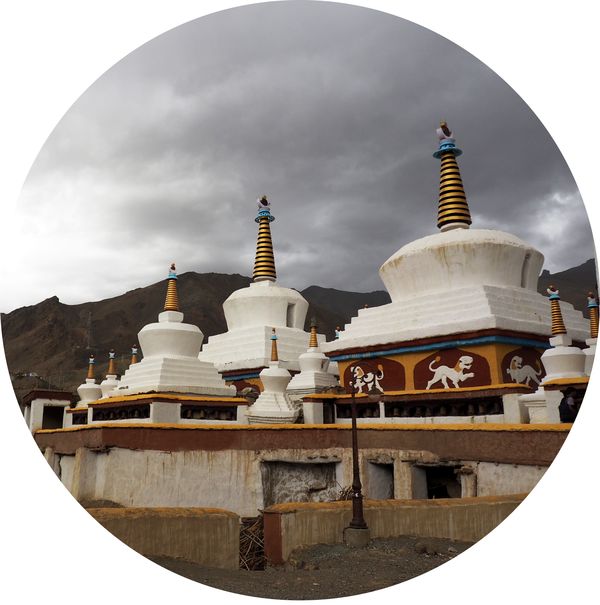
Closer images make it easier to observe whitewashed walls, dark timber-framed windows, flat roofs, and irregular volumes created through successive additions over centuries. The principal temples stand out through their scale, color accents, banners, and ceremonial zones.
Another major theme is the relationship between architecture and landscape. The monastery overlooks an eroded terrain sometimes described as “moonland” because of its unusual geological forms. The close connection between sacred buildings and stark mountain scenery is one of the defining characteristics of Lamayuru.
Historical, Religious, and Architectural Context
Local tradition places the origins of Lamayuru in the eleventh century, an important period in the renewal and spread of Tibetan Buddhism across the western Himalayas. The monastery was later enlarged and transformed according to the needs of its religious community and the support of regional rulers. Today it is associated with the Drikung Kagyu school of Tibetan Buddhism.
Like many Himalayan gompas, Lamayuru served several purposes at once. It was a place of worship, learning, manuscript preservation, ritual activity for surrounding communities, and at times a place of refuge during instability. Its elevated position also allowed visual control over routes that once linked Ladakh with Tibet, Kashmir, and Central Asia.
The architecture uses materials suited to climate and local availability: earth, stone, timber, and protective plaster finishes. Thick walls help regulate temperature in a region marked by cold winters and strong daily contrasts. Openings are relatively limited, reducing heat loss, while flat roofs suit the dry environment. Rather than following rigid symmetry, the monastery developed organically through additions responding to terrain and function.
What the Videos on This Site Make Especially Clear
The videos on travel-video.info are often built from carefully selected photographs animated through smooth movement and thoughtful sequencing. This method is especially effective for a complex site such as Lamayuru. It allows viewers to understand an ensemble that can be difficult to read in a single glance. Gradual framing changes reveal terraces, stacked volumes, circulation paths, and the logic of construction on steep ground.
Closer views also highlight textures that may otherwise be missed: weathered plaster, timber details, shadows within openings, and the contrast between white walls and dark rock. Instead of a rapid passing impression, the viewer gains time to study surfaces and proportions.
By moving from distant panoramas to architectural details, the video continually reconnects the monastery with its wider environment. Lamayuru appears not only as a religious building, but as a complete cultural landscape shaped by faith, geography, and time.
One of Ladakh’s Great Monastic Landmarks
Watching this video means discovering one of Ladakh’s most significant Buddhist sites, where spiritual history, mountain architecture, and dramatic scenery remain closely linked. For a deeper exploration, the detailed page dedicated to Lamayuru Gompa offers further insight into its history and architectural character.
Links to related pages


Audio Commentary Transcript
In the heart of a lunar landscape on the high plateau of Ladakh, there is a small village within which stands a thousand-year-old monastery, built on a rocky peak during the 11th century.
This is the oldest working monastery in Ladakh, the Lamayuru Gompa.
Gompa means a place of prayer and meditation in Tibetan. These monasteries are often located in isolated places, thus reflecting one of the fundamental values of Buddhism, tranquility and serenity favoring meditation and spiritual contemplation, far from city temptations and distractions.
This explains the location of Lamayuru Gompa, a monastery currently housing a hundred monks.
Often the creation of such monasteries is shrouded in mystery and many legends circulate. Among those recounting the foundation of Lamayourou Gompa, it is said that the founder, Mahasiddhacharya Naropa succeeded, after years of fasting and meditation, in causing the nagas (kind of mythical snakes) to leave the lake which was at the site of the monastery. , and to drain it to found the Gompa. Hard to believe, that this place was under water, when you observe the landscape..., but the legends do not address our Cartesian mind and have a mythical dimension which very often escapes us.
Music:
- (Live Music) - - Live music