Français (France)
  Nederlands (nl-NL)
 00:00 • intro | 01:31 • Landscapes around the monastery | 03:31 • Colossal Buddha | 04:27 • Frescoes and furniture
Personal creation from visual material collected during my trip Unknown India • Ladakh, Karnataka, Telangana (2022)
Map of places or practices in Shey on this site
• Use the markers to explore the content •
Shey Gompa, Spiritual and Historical Heritage of Ladakh
A landmark site between landscape and royal memory
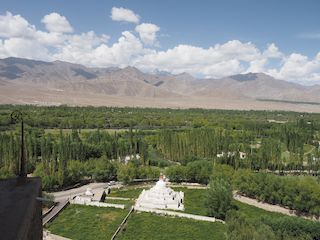
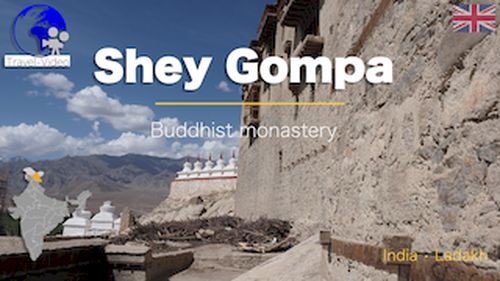
Located a short distance from Leh in the Indus Valley, Shey Gompa rises above a wide open landscape characteristic of Ladakh. Built on a hill, the monastery forms part of a larger complex that includes the remains of a former royal palace, reflecting Shey’s past role as an earlier capital of the Ladakh kingdom. The surrounding environment, composed of cultivated fields, river terraces and arid mountain slopes, contributes to both the visual clarity and the strategic positioning of the site.
The video offers a gradual exploration of this setting, where religious architecture, political history and natural environment converge. It highlights how the monastery is both integrated into its surroundings and visually dominant within the landscape.
Landscapes, structures and spatial organization
The exterior views emphasize the relationship between the monastery and its environment. From the slopes around Shey Gompa, the perspective opens onto the Indus Valley, revealing the structure of the terrain and the distribution of human settlement. This elevated position reinforces the symbolic and strategic importance of the site.
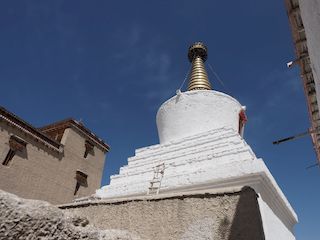
The architecture itself closely follows the topography. Built in successive levels along the hillside, the structures form a coherent composition in which religious buildings and remnants of the royal residence coexist. The partially ruined palace still conveys the political significance of Shey before the capital was relocated to Leh.
The colossal Buddha, spiritual focal point
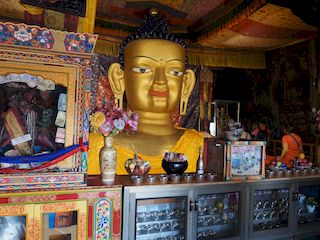
Inside the monastery stands one of its most striking features: a monumental statue of Buddha Shakyamuni. Occupying a central position within the main hall, this large-scale representation defines the spiritual core of the site. Its presence reflects both religious devotion and the importance of monumental imagery in Ladakhi Buddhist tradition.
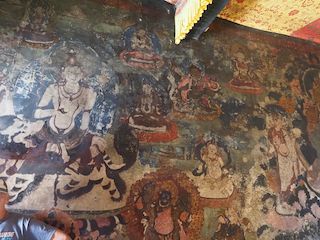
This statue is not an isolated element but part of a broader interior setting. The surrounding walls are adorned with frescoes depicting religious themes, offering insight into the symbolic universe of Tibetan Buddhism. The furniture and ritual objects further illustrate the practices associated with monastic life, providing a tangible connection to the daily functioning of the monastery.
A site shaped by royal power and religious tradition
Shey Gompa must be understood within the historical context of the Ladakhi dynasties, particularly under the Namgyal rulers in the 17th century. The construction of the monastery alongside the royal palace reflects a close relationship between political authority and religious institutions.
This dual function is visible in the spatial organization of the site, where the sacred and the secular are closely intertwined. While Shey later lost its status as a political center when the capital moved to Leh, it retained its religious significance. The preservation of its structures and continued use of its spaces illustrate this enduring role.
The site therefore offers insight into both governance and spirituality in Ladakh, where monasteries often played a central role in shaping regional identity.
A visual approach that clarifies form and detail
The videos presented on this site are primarily based on carefully selected and animated photographs. This approach is particularly effective for exploring complex locations such as Shey Gompa, where understanding relies on both overall structure and fine detail.
Through gradual transitions, the viewer can move from wide landscape views to close observations of architectural and artistic elements. The proportions of the monastery, the scale of the Buddha statue and the intricacy of the frescoes become more accessible. This method enhances the perception of volume, perspective and spatial relationships.
By structuring the visual sequence in this way, the video provides a coherent reading of the site, linking exterior context with interior spaces.
A lasting expression of Ladakh’s cultural identity
Shey Gompa stands as a place where political history, religious tradition and environmental adaptation intersect. Its architecture, artistic elements and location together offer a nuanced understanding of Ladakh’s heritage.
The video provides a structured introduction to this complex site, highlighting its defining features and guiding the viewer through its different dimensions. For a deeper exploration, the dedicated page on Shey Gompa offers further insight into its historical development and architectural significance.
Links to related pages


Audio Commentary Transcript
Shey, today a modest village about fifteen kilometers from Leh, was once the thriving capital of Ladakh in the 11th century. The royal palace and monastery of Shey constitute a unique architectural complex. While the monastery, built in the 17th century, has benefited from multiple restorations and remains in use, the royal palace has resisted the passage of time less well. Of this ancient residence, only ruins remain, almost indistinguishable from the more recent architecture of the monastery.
The majestic landscape observable from the terraces of the Shey complex undoubtedly influenced the decision of the Namgyal dynasty to establish their capital here a millennium ago. The panoramic view offered an undeniable strategic advantage, while the presence of water in the region transformed the surroundings into a fertile oasis, favorable to agriculture.
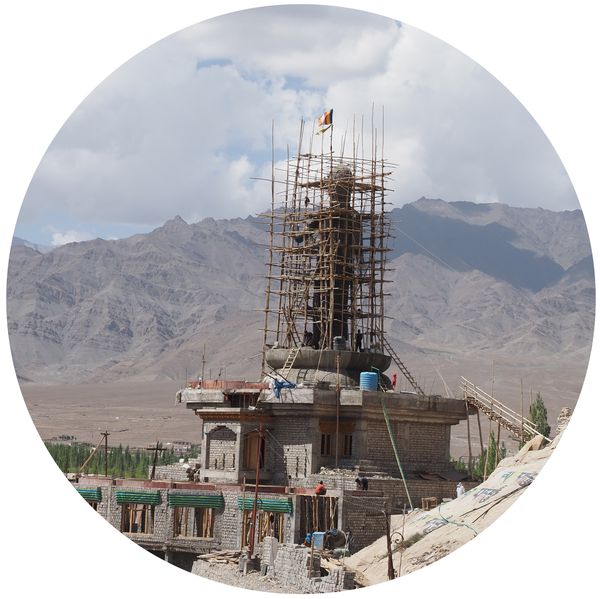
The Shey Monastery is renowned for housing a striking Buddha statue that stands out not only for its size, measuring nearly 12 meters in height, but also for its unique architectural design. Constructed in the 17th century by King Deldan Namgyal in tribute to his late father, Singay Namgyal, this statue serves as the guardian and protector of Ladakh. Its distinctiveness lies in the way it spans across the monastery's floors: on the ground level, visitors are greeted by the statue's massive base and feet; ascending to the first floor, its majestic abdomen takes center stage; and at the top, the serene face and chest of the Buddha unveil, providing a step-by-step discovery experience of this iconic work.
Music:
- - - Live_Likir_Gompa
- - - Live_Likir_Gompa 3
Disclaimer: Despite its appropriateness, copyright issues prevent the use of indian traditional music in "Shey Gompa • Spiritual & Historical Gems of Ladakh", hence the use of royalty-free music. Despite our careful selection, some might regret this decision, which is necessary to avoid potential lawsuits. Although difficult, this decision is the only viable solution.