

 Français (France)
  Nederlands (nl-NL)
 Shey Gompa is a Buddhist monastery located in Shey, Ladakh. Known for its long-standing religious environment, it houses sacred images, ritual spaces, and areas used for meditation. The site reflects the historical position of Shey as a local political and spiritual reference point. Monumental statues and ceremonial chambers reinforce its function as a place of worship. Today, Shey Gompa continues to serve as an active centre of Buddhist practice, valued for its cultural significance, its enduring spiritual traditions, and its contribution to the heritage of Ladakh.

Monument profile
Shey Gompa
Monument categories: Monastery, Giant Statues
Monument families: Monastery • Giant statues or set of statues
Monument genres: Religious
Cultural heritage: Buddhist
Geographic location: Shey • Ladakh • India
Construction period: 17th century AD
• Links to •
• Dynasties that contributed to the construction of the monument •

• List of videos about Shey on this site •
Shey Gompa • Spiritual & Historical Gems of Ladakh
History of Shey Gompa in Shey (Ladakh)
Political and Social Context of Construction
Shey Gompa, together with the adjacent palace complex, emerged as one of the earliest major centres of royal patronage in Ladakh. Its origins can be traced to a period when Ladakh was consolidating its political institutions and redefining itself as a Buddhist kingdom influenced by Tibet. The rulers of the Namgyal dynasty selected Shey as their capital site, seeking to anchor their authority in both a fortified residence and a religious centre. The foundation of the monastery, therefore, represented more than the establishment of a spiritual institution; it was an expression of dynastic legitimacy.
The construction reflected ambitions to integrate worldly and religious power. Establishing a royal palace aligned with a Buddhist monastery signalled that the monarchy derived its authority from spiritual principles. This strategy mirrored a model common in Tibetan and Himalayan political cultures, where rulers cultivated relationships with high-ranking monks to secure ritual protection, moral authority and popular support. Rivalries with other regional powers, notably western Tibetan polities and Kashmiri forces, further motivated the ruling dynasty to strengthen its symbolic landscape. Shey became both a seat of government and a display of political prestige.
Historical Events and Transformations
Shey retained its central position until the seventeenth century, when the capital relocated to Leh. This shift reflected administrative reorganisation and new geopolitical realities, including growing trade connections and changing defensive priorities. Although the palace at Shey declined in importance, the monastery continued to be used for ritual activities, particularly ceremonies linked to royal commemoration.
The site was affected by conflicts that touched Ladakh, including intermittent incursions from neighbouring polities. During the nineteenth century, periods of instability and shifting governance led to episodes of neglect. Nevertheless, Shey was never abandoned entirely. Monastic communities maintained its religious functions, and some royal ceremonies continued to be performed there. Under British colonial influence and later Indian administration, the governance of religious institutions changed, assigning responsibility for preservation and management increasingly to monastic bodies and local heritage authorities.
Twentieth-century political integration into India brought new layers of transformation. Institutional reforms, tourism development and regional cultural policy created incentives to stabilise the site. Targeted restoration campaigns addressed structural weaknesses caused by centuries of climatic stress, while efforts to safeguard ritual practice ensured the continued functioning of Shey as a living religious space.
Global Context of Monumental Building
The development of Shey Gompa occurred within a broader global phenomenon of monumental religious construction. Across Asia and Europe between the eleventh and seventeenth centuries, kings and religious elites invested substantially in symbolic architecture. In Tibet, monasteries such as Sakya and Tashi Lhunpo assumed central political roles. In China, Buddhist imperial projects developed artistic and architectural motifs disseminated along trade routes. In Europe, cathedrals and royal chapels fulfilled comparable purposes, materialising spiritual power to reinforce secular rule.
Shey Gompa fits this pattern: it embodies an architecture of authority where palace and monastery form a unified statement. Its monumental statue of Buddha and its ritual infrastructure reflect the Himalayan tendency to fuse sovereignty, religion and landscape into a coherent spatial regime.
Physical Evolution and Adaptation
Over time, Shey Gompa underwent significant alterations. The palace superstructure decayed as political functions relocated, while monastic spaces persisted. Renovations were often pragmatic rather than comprehensive, stabilising walls, consolidating roof structures or renewing the iconic statue’s surface. The rise of Leh as the main urban centre reshaped Shey’s environment; increasing accessibility brought more visitors but also diluted its isolation.
Recent interventions reflect changing expectations. Conservationists and monastic authorities have attempted to address erosion, cracking, and degradation of frescoes. Adjustments included inserting support beams, resurfacing key pathways and improving circulation for ceremonial use. The balance between maintaining authenticity and accommodating contemporary needs remains an ongoing tension at the site.
Cultural Role and Modern Significance
Shey Gompa today plays a prominent role in Ladakh’s cultural identity. While no longer a royal residence, its memory as an early seat of power enriches its symbolic value. People visit to offer prayers, mark seasonal festivals and maintain links with ancestral heritage. One major event is Shey Do, a festival drawing villagers, monks and visitors to participate in processions, rituals, and offerings. The site also functions as a representational monument frequently cited in official narratives of Ladakhi heritage.
Monasteries such as Shey contribute to Ladakh’s religious economy, sustaining networks of artisans, monks, ritual specialists and pilgrimage flows. Through tourism, the monument gains additional relevance as an ambassador of Ladakhi culture, though this visibility comes with pressures and expectations that shape how tradition is maintained or reinterpreted.
Conservation Challenges
The site confronts environmental and social threats common to Himalayan heritage. Extreme temperature variation weakens walls, roofs and painted surfaces. Limited rainfall combined with occasional snowmelt produces erosion and infiltration effects compromising stability. Wooden elements are vulnerable to rot or insect activity, while frescoes fade through exposure and age. Increasing tourism intensifies wear on surfaces and complicates visitor management.
Efforts to stabilise Shey Gompa include documentation, small-scale restoration campaigns and collaboration between monastic communities and government bodies. While not inscribed as a UNESCO World Heritage Site, it is recognised as a major heritage location within the Ladakh region, prompting discussions on more extensive conservation frameworks. The future of Shey Gompa depends upon continued transmission of ritual knowledge alongside architectural conservation adapted to climatic realities.
Conclusion
Shey Gompa represents a unique intersection of political ambition, religious symbolism and artistic achievement. Its history reflects the formation of Ladakhi identity, the negotiation of geopolitical pressures and the persistence of Buddhist practice in a challenging environment. Though no longer a functional seat of power, it remains a focal point of memory, pilgrimage and cultural expression. Ongoing preservation issues underline the fragility of Himalayan heritage and the necessity of integrating technical expertise with local custodianship. As both monument and living institution, Shey Gompa continues to shape and reflect the evolving heritage of Ladakh.
Architecture of Shey Gompa in Shey (Ladakh)
Technological and Architectural Context
The architecture of Shey Gompa belongs to the broader Himalayan tradition of fortified monastic-palace complexes, where religious spaces and royal residences are closely linked. Built and developed between the medieval and early modern periods, the site reflects construction knowledge adapted to a high-altitude, semi-arid climate with strong temperature variations and limited resources. Builders had to combine defensive concerns, ritual requirements and domestic functions within a compact layout shaped by the rocky outcrop on which the complex stands.
From a technical point of view, Shey demonstrates the mature use of thick masonry walls, timber floors and layered roofs as an integrated system. The arrangement of volumes honours both the symbolic hierarchy of spaces (palace above, monastery and statue chapels below or adjacent) and the constraints of circulation on steep terrain. The architectural vocabulary is not experimental in a modern sense, but it represents a sophisticated application of regional techniques, pushed à leur maximum in terms of scale with the creation of a monumental Buddha statue housed within a carefully calculated interior.
Materials and Construction Methods
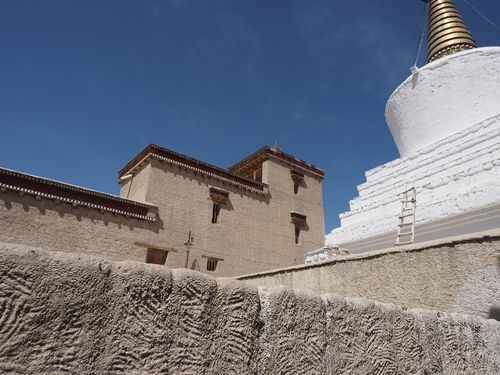
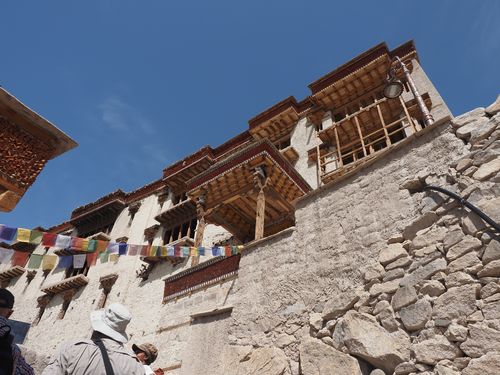
The core materials of Shey Gompa are stone, mud brick, earth plaster and timber. Stone is used for the main load-bearing walls, drawn from local outcrops to minimise transport. Masonry is generally composed of rough, uncut stones laid in irregular courses with mud mortar, forming massive walls that offer both structural stability and thermal inertia. The thickness of these walls helps regulate interior temperatures, buffering the extremes of summer heat and winter cold.
Mud brick and rammed earth are employed in upper sections and internal partitions. These elements lighten the structure while remaining compatible with the stone base in terms of movement and behaviour. Earth-based plasters, applied in successive layers, smooth and unify surfaces, creating the characteristic pale façades associated with Ladakhi monastic architecture.
Timber, scarce but crucial, is reserved for major structural components: beams, joists, lintels and roof frames. Poplar and willow, the main species available in the valley, are used in stacked layers to distribute weight and reduce the risk of local failure. Roofs consist of timber decking covered with branches and compacted earth, a system that insulates against cold but requires regular maintenance. The combination of stone, earth and wood produces a robust yet flexible ensemble, able to absorb minor seismic movements and withstand the strong winds of the Indus valley.
Structural Solutions, Stability and Climate Adaptation
Shey Gompa shows a clear awareness of stability requirements. The base of the complex is firmly anchored into the rocky substrate, with walls stepping up the slope in staggered terraces. This creates a natural buttressing effect: upper volumes rest on lower ones in a cascade of loads that follow the topography. Corners are often reinforced, and window openings remain modest in size, preserving wall integrity.
Ventilation is controlled rather than abundant. Small windows and occasional high-level openings allow limited air circulation, enough to refresh interiors and evacuate smoke while minimising heat loss. In the main assembly halls, where more people gather, slightly larger windows and doors, combined with the height of the volume, promote stratification of warm air and evacuation of fumes from butter lamps and incense.
Urbanistically, the complex defines a focal point in the landscape: the palace-monastery mass dominates the agricultural fields and scattered dwellings below. Access routes, paths and stairways are organised to lead gradually upwards, reinforcing both the defensive logic and the symbolic ascent towards the sacred.
Artistic and Architectural Influences
The architectural language of Shey Gompa reflects the influence of Tibetan monastic building, while integrating local and regional contributions. The general composition, with a cluster of structures embracing the natural rock and topped by a royal palace, recalls Tibetan fortified monasteries. The interior organisation of prayer halls, subsidiary chapels and residential cells follows liturgical and communal patterns observed across the western Himalaya.
Artistically, the influence of western Tibetan styles is visible in mural paintings, sculptural programs and decorative borders. Motifs derived from Kashmiri art, such as stylised lotus bands, vegetal scrolls and certain treatment of jewellery and drapery, testify to long-standing exchanges between Ladakh and Kashmir. Some iconographic details and pigment choices also point to connections with broader Central Asian and Chinese Buddhist traditions, carried along trade and pilgrimage routes.
The monumental copper-gilt statue of the Buddha, one of the defining features of Shey, illustrates this synthesis. Its proportions, hand gestures and seated posture conform to canonical Tibetan models, while its scale and technique of assembly in sections reveal advanced metallurgical and structural knowledge for the region and period.
Spatial Organisation and Layout
The Shey complex can be read in vertical layers. The uppermost zone corresponds to the former royal palace, a cluster of multi-storey structures with small rooms, balconies and vantage points overseeing the valley. Below or adjacent are the main monastic spaces: entrance courtyards, a principal assembly hall (dukkhang), subsidiary chapels and storage or service rooms. Further down, terraces, paths and walls articulate the transition to the surrounding landscape and agricultural plots.
Internally, the principal hall is characterised by a forest of timber columns supporting richly painted beams and a flat roof. Around the central space, benches for monks, altars and platforms for ritual objects structure the volume. The chapel housing the large Buddha is designed almost as a vertical shaft, its height dictated by the statue. The arrangement of floors and galleries around this central figure allows access for maintenance and ritual circulation, while also controlling how devotees approach and perceive the image.
There are no arches, domes or minarets in the sense seen in Indo-Islamic architecture; instead, the emphasis lies on straight lines, flat roofs, stepped profiles and rectangular openings. The particularity of Shey lies less in introducing new typologies than in combining palace and monastery into a single architectural statement, anchored visually by the towering image of the Buddha.
Dimensions, Facts and Anecdotes
The most striking numerical aspect of Shey Gompa is the height of its principal Buddha statue, often described as around twelve metres. This makes it one of the larger metal statues of the region. Its construction required large quantities of copper, reportedly obtained through combined royal funding and donations, and a careful staging of assembly within the chapel.
Local oral traditions evoke groups of craftsmen from different regions – including Tibet and Kashmir – collaborating on the project, each bringing specific skills in metalwork, woodcarving or painting. Another recurring story links the siting of the complex to auspicious readings by religious specialists, who identified the rock and its orientation as suitable for a major religious and royal foundation.
International Significance and Conservation Issues
Architecturally, Shey Gompa contributes to the global importance of Ladakh’s monastic heritage by embodying the fusion of secular and religious architecture in a Himalayan context. Its palace-monastery configuration, monumental interior statue and layered use of traditional materials make it a key reference for the study of Himalayan built environments.
The site does not currently enjoy the status of a UNESCO World Heritage property, but it is recognised regionally as a significant cultural asset. Conservation challenges are considerable: earth-based materials are vulnerable to water damage and freeze–thaw cycles; timber elements suffer from ageing and occasional biological attack; and painted surfaces are fragile. Increased visitor numbers add to mechanical wear, especially on stairs, thresholds and interior floors.
Current conservation approaches aim to respect traditional construction while introducing discreet structural reinforcement and improved drainage. The long-term preservation of Shey Gompa depends on maintaining this balance between authenticity, ritual use and necessary adaptation to environmental and social change.