

 Français (France)
  Nederlands (nl-NL)
 Of Buddhist tradition, the Namgyal of Ladakh dynasty ruled for approximately 281 years, ± between 1553 and 1834 over all or part of the Himalayan region, during the Medieval Period and the Colonial Period.
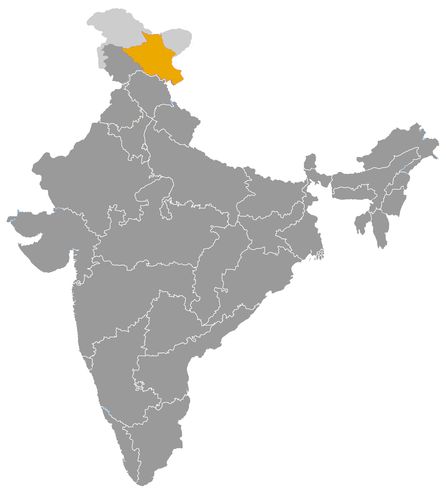
This map illustrates the maximum territory that the Namgyal of Ladakh Dynasty had reached at its height, covering the current regions of Ladakh in India. Its main purpose is to provide a visual aid to understand the geographical extent of this dynasty. However, it's important to note that the contemporary borders of these regions may not necessarily coincide with the historical territories.
The Namgyal Dynasty of Ladakh and Its Role in the History of India
A Himalayan kingdom between India, Tibet and Central Asia
The Namgyal dynasty of Ladakh occupies an important place in the history of the Himalayan regions that are now part of India. It ruled over the kingdom of Ladakh from the late fifteenth century until the nineteenth century, when Dogra expansion from Jammu ended its effective sovereignty. Its rulers bore the Tibetan title of Gyalpo, generally translated as “king”, reflecting Ladakh’s close cultural relationship with the Tibetan world while also indicating its independent political identity.
Ladakh was not a large kingdom of the Indian plains. It was a high altitude polity shaped by mountain valleys, passes, caravan routes, Buddhist monasteries and fortified settlements. Its historical importance derived from its location between Kashmir, Tibet, Baltistan, Central Asia and the northern approaches to the Indian subcontinent. Through this position, the Namgyal dynasty became a regional intermediary between several cultural and political worlds.
A royal authority consolidated in western Himalaya
The rise of the Namgyal dynasty represented a major phase in the political consolidation of Ladakh. The dynasty emerged after the earlier ruling order of Maryul and gradually strengthened royal authority over Leh, the upper Indus valley, Zanskar and several strategic frontier zones. Its rulers built their power through a combination of military control, dynastic legitimacy, alliances with local elites and patronage of Buddhist institutions.
The political importance of the dynasty reached one of its high points under rulers such as Tsewang Namgyal and especially Sengge Namgyal. Sengge Namgyal is remembered as one of the most prominent kings of Ladakh. His reign is associated with military assertion, architectural patronage and the strengthening of Leh as a royal centre. The palace of Leh, rising above the town, symbolised the ambition of the Namgyal kings to present Ladakh as a structured and prestigious Himalayan kingdom.
Yet the dynasty’s power remained exposed to regional pressures. Ladakh had to maintain relations with Kashmir to the west, Baltistan to the northwest, Tibetan polities to the east and smaller Himalayan principalities to the south and southeast. These relations alternated between diplomacy, trade, religious exchange, marriage alliances and military conflict. The Namgyal rulers therefore played a political role based less on imperial expansion than on the management of a sensitive frontier.
Cultural patronage and the strengthening of Tibetan Buddhism
The cultural impact of the Namgyal dynasty was substantial. The kings of Ladakh acted as patrons of Tibetan Buddhism, which became one of the main foundations of Ladakhi identity. Monasteries were not only religious centres. They also served as centres of education, manuscript preservation, ritual authority, landholding and artistic production.
Under Namgyal rule, monasteries were restored, expanded or newly supported by the crown. This patronage reinforced the connection between royal power and religious merit. The king was expected to protect the Buddhist order, while monastic institutions helped legitimise dynastic authority. This relationship between kingship and religion was central to Ladakh’s political culture.
The dynasty also encouraged artistic and architectural forms that linked Ladakh to the wider Tibetan cultural world while developing local expressions suited to its environment. Palaces, gompas, mural paintings, stupas and manuscripts from this period show a society deeply connected to Tibetan religious traditions but also shaped by the specific conditions of Ladakh. The Namgyal period therefore contributed strongly to the formation of Ladakh’s distinctive Himalayan identity.
Economic importance of caravan trade and mountain resources
The economy of Namgyal Ladakh depended on the combination of limited local resources and far reaching trade networks. Agriculture was constrained by altitude, aridity and the scarcity of cultivable land. Barley, pastoral products, livestock, taxation and local exchange formed part of the economic base, but the kingdom’s wider importance came from its role in trans Himalayan commerce.
Ladakh stood on routes connecting Tibet, Kashmir, Central Asia and the Indian plains. Caravans transported salt, wool, pashmina, tea, grain, horses, metals and manufactured goods. Control over passes, markets and tolls gave the monarchy revenue and diplomatic influence. This trade enabled a relatively small mountain kingdom to participate in broader regional economies.
Pashmina was especially significant. Produced in high altitude regions and traded through Ladakh, it supplied the famous textile industry of Kashmir. This made Ladakh economically valuable to neighbouring powers. At the same time, it increased the kingdom’s vulnerability, because control over trade routes and wool supplies became a political objective for outside forces.
Relations with neighbouring powers shaped by geography
The Namgyal dynasty’s role cannot be separated from Ladakh’s position between powerful neighbours. With Tibet, Ladakh shared religion, language, artistic models and monastic networks, but it also competed for influence in western Tibetan regions. Military conflicts in the seventeenth century showed both the ambitions and the limits of Ladakhi power.
Relations with Baltistan were often tense, especially because both regions contested routes, frontier valleys and political influence. At the same time, the frontier was not a closed barrier. It allowed exchanges, marriages, diplomacy and cultural contact. Relations with Kashmir were also complex. Trade created economic interdependence, while political ambition from the west eventually became a threat to Ladakh’s autonomy.
The decisive transformation came in the nineteenth century, when Dogra forces from Jammu conquered Ladakh. The kingdom was incorporated into the princely state of Jammu and Kashmir, ending the effective sovereignty of the Namgyal kings. This event shifted Ladakh from an independent Himalayan kingdom to a frontier region within a larger political structure connected to the Indian subcontinent.
A lasting legacy in India’s Himalayan history
The Namgyal dynasty is important in the history of India because it represents a political tradition that developed outside the major imperial centres of the plains. Its history shows that the Indian world also included high mountain kingdoms linked to Tibet, Central Asia and Kashmir. Ladakh’s later integration into the political structures of Jammu and Kashmir, and eventually into modern India, brought this Himalayan legacy into the broader history of the Indian state.
The dynasty’s heritage remains visible in Ladakh’s monasteries, palaces, settlement patterns, trade memories and Buddhist cultural identity. Its role was not that of a vast empire, but of a strategic kingdom that connected several worlds and helped shape the northern frontier of India.
The Geographic Extent of the Namgyal Dynasty of Ladakh in the Western Himalayas
A high altitude kingdom centred on the upper Indus valley
The Namgyal dynasty of Ladakh ruled a mountain kingdom whose territorial organisation was shaped by valleys, passes, plateaus and caravan routes rather than by broad agricultural plains. Its core lay in the upper Indus valley, in the region now forming part of the Indian Union Territory of Ladakh. From the late fifteenth century until the Dogra conquest in the nineteenth century, the Namgyal rulers governed a compact but strategically important Himalayan state.
The kingdom’s main political centres were located in central Ladakh. Leh became the most important royal and commercial centre, while earlier and related sites such as Shey, Basgo and Stok formed part of the dynastic landscape. These settlements controlled irrigated valleys, fortified positions and routes crossing the dry highlands of the western Himalayas. In such an environment, political power depended less on continuous occupation of large territories than on the ability to command settlements, monasteries, water resources, pasturelands and passes.
The central Ladakhi heartland as the base of royal authority
The most stable area under Namgyal control was central Ladakh, especially the Indus valley around Leh and its neighbouring settlements. This region provided the administrative, agricultural and symbolic base of the kingdom. Although cultivation was limited by altitude and aridity, irrigated fields supported local communities, monasteries and royal establishments.
The Namgyal rulers used fortresses, palaces and monastic patronage to anchor their authority in this landscape. The palace of Leh, associated especially with the period of Sengge Namgyal, represented the elevation of the town into a major royal centre. Basgo and Shey also had political and ceremonial significance. These sites show how the dynasty linked territorial control with architectural visibility and religious legitimacy.
The central territory was not only a political heartland. It was also the point from which the kingdom interacted with surrounding regions. From Leh, routes led westward toward Kashmir and Baltistan, eastward toward western Tibet, southward toward Zanskar and Himachal regions, and northward toward the Karakoram and Central Asian routes.
Western and north western zones facing Baltistan and Kashmir
To the west and northwest, the Namgyal kingdom bordered Baltistan and the wider Kashmir sphere. These areas were among the most politically sensitive frontiers of Ladakh. Baltistan, culturally and religiously distinct in many respects from Buddhist Ladakh, was both a rival and a neighbour with which the Namgyal rulers maintained military, diplomatic and matrimonial relations.
Conflicts with Baltistan influenced the political history of the dynasty, especially during the sixteenth and seventeenth centuries. Control over frontier valleys and routes was a recurring issue. These regions were important not only for defence, but also for communication between Ladakh, Kashmir and Central Asia. The frontier was therefore a zone of both confrontation and exchange.
Relations with Kashmir were equally significant. Kashmir was economically linked to Ladakh through trade, especially the movement of pashmina wool, which supplied Kashmiri textile production. This commercial connection made Ladakh valuable to powers based west of the Himalayas. The same economic importance also made the kingdom vulnerable, since external forces had an interest in controlling the routes and resources that passed through Ladakhi territory.
Southern connections with Zanskar and neighbouring Himalayan valleys
South of central Ladakh, the Namgyal rulers exercised influence over Zanskar and related Himalayan valleys. Zanskar was geographically difficult to access, especially in winter, but it formed an important part of the wider Ladakhi sphere. Its valleys, monasteries and seasonal routes linked Ladakh to other parts of the western Himalayas.
Control over Zanskar strengthened the territorial depth of the kingdom. It helped protect the approaches to central Ladakh and connected the Namgyal realm to routes leading toward present day Himachal Pradesh and Kashmir. As in other parts of the Himalayas, authority in Zanskar probably depended on local elites, monastic institutions and seasonal patterns of movement rather than constant direct royal administration.
These southern and southwestern zones also shaped relations with neighbouring hill states. The Namgyal kingdom did not function as an isolated mountain polity. It was part of a chain of Himalayan societies linked by pilgrimage, trade, warfare, pastoral movement and religious networks.
Eastern expansion toward western Tibet
The eastern frontier was one of the most important dimensions of Namgyal geography. Ladakh shared deep religious, linguistic and cultural ties with Tibet, but these connections did not prevent political rivalry. The Namgyal rulers, especially during periods of strength, sought influence in western Tibetan regions such as Ngari, Guge and Purang.
This eastern orientation was particularly visible under Sengge Namgyal. Ladakh’s expansion toward western Tibet reflected both political ambition and religious connection. The region was culturally close to Ladakh, but it also lay within a broader Tibetan sphere where authority was contested. Ladakhi involvement in these areas brought the kingdom into conflict with Tibetan powers and their allies.
The wars between Ladakh and Tibet in the seventeenth century demonstrated the limits of Namgyal expansion. Ladakh could project influence eastward, but it could not permanently dominate the wider Tibetan plateau. After these conflicts, the kingdom had to accept a more balanced relationship with Tibet. Religious and commercial links remained strong, while political ambitions became more constrained.
Caravan routes as the real framework of territorial power
The geographic reach of the Namgyal dynasty cannot be understood only through formal borders. The kingdom’s influence depended heavily on the control of routes. Ladakh stood between Tibet, Kashmir, Central Asia and the northern Indian world. Caravans moved through its valleys carrying salt, wool, pashmina, tea, grain, horses, metals and manufactured goods.
The control of passes, markets and tolls gave the Namgyal kings revenue and diplomatic weight. A small mountain kingdom could therefore play a role greater than its population or agricultural base might suggest. The same routes, however, also attracted neighbouring powers. Tibet, Baltistan, Kashmir and later Jammu all had reasons to influence or control Ladakh.
The reduction of Namgyal sovereignty under Dogra expansion
In the nineteenth century, the territorial independence of the Namgyal kingdom was ended by the Dogra expansion from Jammu. The conquest of Ladakh transformed the kingdom from an independent Himalayan state into part of the princely state of Jammu and Kashmir. The dynasty lost its effective sovereignty, although its historical and cultural prestige remained important in Ladakh.
The territorial history of the Namgyal dynasty is therefore the history of a mountain kingdom whose strength rested on strategic location. Its core was central Ladakh, but its influence reached toward Zanskar, Baltistan, Kashmir, western Tibet and the caravan corridors of Central Asia. It was never a vast empire, yet its position made it a crucial actor in the political geography of the western Himalayas and in the formation of India’s northern frontier.
The rulers of the Namgyal dynasty of Ladakh bore the Tibetan title Gyalpo, usually translated as “king”. The reign dates are indicative, especially for the earlier rulers, and some chronologies include overlaps, interruptions or periods of regency.
- Lhachen Bhagan (c. 1460–1485) • Founder of the Namgyal dynasty, he overthrew the earlier Maryul dynasty and established his authority over Ladakh.
- Unknown ruler (c. 1485–1510) • This period is poorly documented and probably represents a phase of little-attested dynastic continuity.
- Lata Jughdan (c. 1510–1535) • He belongs to the early phase of consolidation after the establishment of Namgyal rule.
- Kunga Namgyal I (c. 1535–1555) • He ruled during a period of stabilisation within the Ladakhi kingdom.
- Tashi Namgyal I (c. 1555–1575) • He repelled incursions from Central Asia and strengthened the kingdom’s defences.
- Tsewang Namgyal I (c. 1575–1595) • He expanded Ladakh’s influence and reinforced its position in the western Himalayas.
- Namgyal Gonpo (c. 1595–1600) • His reign is listed in some chronologies with a partial overlap with that of Jamyang Namgyal.
- Jamyang Namgyal (c. 1595–1616) • He ruled amid rivalries with neighbouring powers in Baltistan and the western Himalayan regions.
- Sengge Namgyal (1616–1623) • His first reign began the period associated with Ladakh’s architectural and religious expansion.
- Norbu Namgyal (1623–1624) • He briefly held power between the two reigns of Sengge Namgyal.
- Sengge Namgyal (1624–1642) • His second reign was marked by the construction of Leh Palace and major monastic patronage.
- Deldan Namgyal (1647–1694) • He ruled after a troubled period and had to deal with Mughal and Tibetan pressures.
- Delek Namgyal (princely regency, 1678–1691) • As prince regent under Deldan Namgyal, he played a political role during tensions between Ladakh, Tibet and neighbouring powers.
- Nyima Namgyal (1691–1729) • He governed after the conflicts of the seventeenth century and contributed to the kingdom’s stabilisation.
- Deskyong Namgyal (1729–1739) • His reign belongs to a phase of dynastic continuity in a less expansionist Ladakh.
- Phuntsog Namgyal (1739–1753) • He maintained royal authority within a regional context shaped by Himalayan balances of power.
- Tsewang Namgyal II (1753–1782) • He ruled during a period of political and economic transition for the kingdom.
- Tseten Namgyal (1782–1802) • He governed at the end of the eighteenth century, before the upheavals caused by Dogra expansion.
- Tsepal Dondup Namgyal (1802–1837, 1839–1840) • His reign was interrupted by Dogra interventions and by the progressive loss of Ladakhi autonomy.
- Kunga Namgyal II (1840–1842) • The last effective Gyalpo of Ladakh, he ruled until the kingdom was annexed by the Dogras of Jammu.