

 Français (France)
  Nederlands (nl-NL)
 The Royal Palace of Stok, located in the state of Ladakh, is one of the best-known heritage sites of this Himalayan region. Associated with the former royal family of Ladakh, it retains strong historical and symbolic importance. The palace attracts visitors interested in local political history, the collections displayed on site, and the traditional organization of aristocratic mountain residences. Its distinctive silhouette contributes to the visual identity of Stok and the surrounding valley. Today, it remains an important cultural landmark, illustrating the continuity between dynastic heritage and contemporary life in Ladakh.
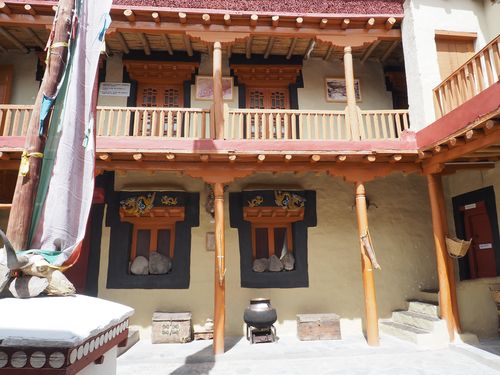
Stok • Royal Palace
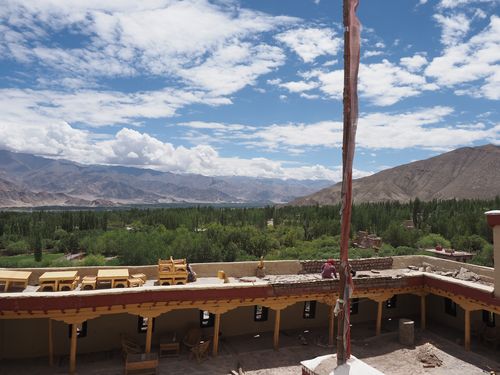
Stok • Royal Palace
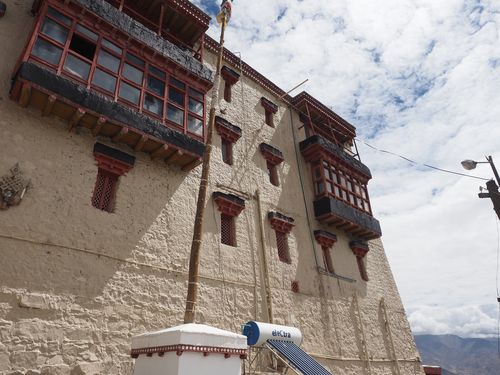
Stok • Royal Palace
Monument profile
Royal Palace
Monument category: Palace
Monument family: Palace and Annexes
Monument genre: Residential
Cultural heritage: Buddhist
Geographic location: Stok • Ladakh • India
Construction period: 19th century AD
• Links to •
• Dynasties that contributed to the construction of the monument •

• List of videos about Stok on this site •
Stok: Royal Splendours and Buddhist Devotion, Ladakh • India
Royal Palace of Stok in Ladakh: Dynastic Residence and Political Memory
Foundation of the Palace and Transfer of Power
The Royal Palace of Stok stands in the village of Stok on the southern bank of the Indus, opposite Leh, in present-day Ladakh. Its history is directly connected to the political upheavals of the early nineteenth century. In 1834, forces of the Dogra kingdom of Jammu invaded Ladakh, ending the effective sovereignty of the Namgyal dynasty, which had ruled the region since the sixteenth century.
Within this altered political landscape, Stok became the principal residence of the displaced royal family. The palace was built in the first half of the nineteenth century, commonly dated to around the 1820s or 1830s, depending on the phase considered. It was intended to house the court after the loss of earlier royal centres such as Leh Palace and Shey Palace.
The selection of Stok combined practical and symbolic considerations: proximity to Leh, access to agricultural land, relative security, and continuity with the historical heartland of the former kingdom.
Residence of the Namgyal Family under Dogra Rule
During the nineteenth century, the palace functioned as the residence of the Namgyal family within a Ladakh now incorporated into the princely state of Jammu and Kashmir. After subsequent treaties, that state operated under increasing British influence. The palace therefore no longer served as the seat of an independent government, but as an aristocratic and ceremonial household.
Members of the royal family continued to live there, maintaining courtly customs, domestic administration, and dynastic prestige. Reception rooms, private quarters, chapels, and storerooms supported a reduced but still significant household structure.
In this context, the palace acquired a new historical role. It preserved the continuity of Ladakh’s former ruling lineage at a time when political authority had shifted elsewhere. The building became a material symbol of legitimacy and historical memory rather than active state power.
Twentieth-Century Changes and New Functions
The twentieth century gradually transformed the meaning and use of the palace. The decline of princely political systems, administrative reforms, and Ladakh’s integration into modern India further reduced the formal status of the residence. Nevertheless, descendants of the royal family continued to occupy parts of the building.
At the same time, growing scholarly and public interest in Ladakh’s past encouraged the opening of selected sections to visitors. Portions of the palace were adapted into a private museum displaying royal objects, ceremonial dress, jewellery, arms, manuscripts, thangkas, and household possessions linked to the Namgyal dynasty.
This shift gave the palace a renewed function. It remained a family residence while also becoming a cultural institution that interpreted the history of Ladakh through dynastic collections preserved in situ.
Present Role, Symbolism, and Preservation
Today the Royal Palace of Stok is one of the principal historical sites associated with Ladakh’s monarchy. It differs from many former royal residences because of the continued connection between the building and descendants of its original occupants.
For visitors, the palace offers insight into regional political history, domestic royal life, and the transition from independent kingdom to modern administrative region. For Ladakhis, it remains an important reference point in local identity and collective memory.
Preservation involves balancing residential use, museum access, and the maintenance of a historic structure built with traditional materials in a harsh high-altitude climate. Conservation work typically focuses on structural stability, earthen walls, timber elements, and protection of collections housed within the palace.
Global Historical Context
The main construction phase of the palace belongs to the early nineteenth century. Europe was then emerging from the Napoleonic Wars while imperial competition expanded overseas. In the Indian subcontinent, the East India Company was extending its territorial influence. Across Central Asia, regional rivalries intensified between neighbouring powers. Later in the century, the opening of the Suez Canal reshaped connections between Europe and Asia.
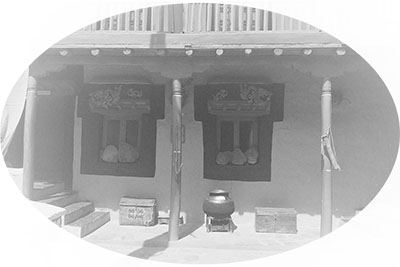
Architectural Configuration of the Royal Palace of Stok in Ladakh
Landscape Setting and Overall Composition
The Royal Palace of Stok rises above the village of Stok on the southern bank of the Indus River, facing Leh and the mountain ranges of central Ladakh. Its placement reflects a balance between visibility, accessibility, and residential function. Unlike hilltop fortresses built on steep defensive crags, the palace occupies a moderate slope above cultivated land and village houses. This elevated yet connected position allows the building to dominate its surroundings without complete separation from daily settlement life.
The palace establishes a clear hierarchical relationship with the village below. Smaller domestic buildings spread across the lower ground, while the palace forms a concentrated vertical mass above them. From upper terraces, views extend across the Indus valley, irrigated fields, and surrounding mountains. The landscape becomes part of the architectural composition rather than a distant backdrop.
The general form is asymmetrical yet ordered. Instead of a rigid axial plan, the palace is composed of stacked volumes, stepped wings, projecting sections, and terraces adjusted to the terrain. This creates the rising silhouette associated with many Ladakhi elite residences.
Construction Materials and Climatic Adaptation
The palace relies on materials traditionally available in Ladakh: stone for foundations and retaining walls, sun-dried mud brick or rammed earth for upper walls, and timber for beams, floors, balconies, window frames, and roof supports. These materials responded directly to a high-altitude environment with cold winters, strong sunlight, and low annual rainfall.
Exterior walls are thick, providing thermal mass that moderates temperature differences between day and night. Their depth also increases structural stability. Surfaces are usually finished with earth or lime-based plaster in pale tones that reflect intense solar radiation.
Timber is especially important in the upper levels, where lighter structural elements reduce weight and allow larger openings. Horizontal wooden bands and visible beam ends often remain on the façades, adding rhythm to otherwise massive wall planes.
Flat roofs are well suited to Ladakh’s dry climate. Built from timber framing, brush layers, compacted earth, and protective finishes, they served not only as weather covers but also as usable surfaces for drying crops, storage, or circulation between sections of the palace.
Internal Organization and Hierarchy of Space
The palace is vertically organized according to function. Lower levels traditionally housed storage rooms, service areas, stables, and logistical spaces. Their direct relationship with the slope and village approaches made them suitable for deliveries and support functions.
Middle floors contained the principal residential quarters of the royal family. These levels benefited from better light, greater privacy, and improved climatic comfort. Reception rooms and family apartments were positioned where views, sunlight, and access could best be controlled.
Upper levels and selected chambers were associated with ceremonial or religious use. Private chapels, audience spaces, and rooms containing dynastic objects occupied more elevated positions, reinforcing symbolic hierarchy through vertical ascent.
Circulation is achieved through narrow staircases, corridors, internal passages, and terraces connecting separate blocks. The movement pattern suggests incremental growth over time rather than execution from a single fixed blueprint. This layered circulation system creates sequences of compressed and open spaces typical of historic Himalayan residences.
Façades, Details, and Visual Identity
The façades combine large solid wall surfaces with carefully placed openings. Rows of relatively small windows contrast with expansive plastered planes, giving the building both defensive restraint and controlled access to light. This balance between enclosure and exposure is central to the palace’s appearance.
Wooden frames around windows and doors provide much of the decorative emphasis. Dark timber elements stand out against light walls, producing a strong graphic contrast visible from a distance. In some areas, projecting balconies or enclosed wooden galleries add depth to the elevations while improving observation and air circulation.
Cornice lines, parapets, and stepped roof edges contribute to the palace silhouette. Ornament is generally restrained and concentrated in carpentry rather than extensive carved stone programmes. The visual authority of the building depends more on massing, elevation, and proportion than on abundant surface decoration.
Its height relative to surrounding village houses gives the palace a symbolic presence. Even without monumental towers, the stacked composition clearly communicates former royal status.
Alterations, Museum Use, and Conservation Challenges
The palace has undergone adaptations linked to changing functions. Continued partial residential use by descendants of the royal family, together with the opening of museum rooms to visitors, required selective modernization. Floors have been reinforced in some areas, circulation routes secured, and interiors adjusted for the display of collections.
Conserving a structure built largely of earth and timber in Ladakh’s climate requires constant attention. Freeze-thaw cycles, moisture infiltration from occasional storms, roof erosion, and timber ageing can weaken historic fabric. Replastering walls, repairing roof layers, stabilizing cracks, and replacing damaged wood members are recurring maintenance tasks.
A central challenge is preserving authenticity while accommodating tourism. Excessive modernization would diminish the building’s historic character, yet insufficient intervention would threaten structural survival. The Royal Palace of Stok remains notable because it still reads as a lived dynastic residence while functioning as a heritage monument and museum.