Français (France)
  Nederlands (nl-NL)
 Of Hindu tradition, (with additional Islamic and Jain influence), the Jadeja of Kutch dynasty ruled for approximately 801 years, ± between 1147 and 1948 over all or part of , during the Classical Period, the Medieval Period, the Colonial Period and the Modern Period.
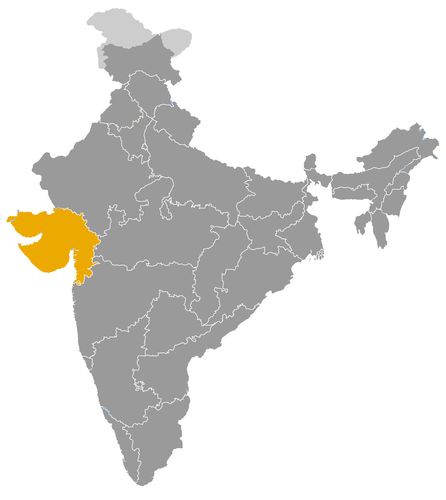
This map illustrates the maximum territory that the Jadeja of Kutch Dynasty had reached at its height, covering the current regions of in India. Its main purpose is to provide a visual aid to understand the geographical extent of this dynasty. However, it's important to note that the contemporary borders of these regions may not necessarily coincide with the historical territories.
The Jadeja Dynasty of Kutch and Its Role in the History of Western India
A Rajput house shaped by a frontier environment
The Jadeja dynasty of Kutch occupies a distinctive place in the history of western India. It belonged to the wider Jadeja Rajput lineage, but the Kutch branch developed a political identity of its own in a region marked by salt marshes, semi arid plains, pastoral communities, ports and long distance trade. Its history should therefore be distinguished from that of other Jadeja houses, especially Nawanagar, Rajkot, Gondal and Morbi in Kathiawar.
The early genealogy of the Jadejas in Kutch is partly traditional, but the political consolidation of the kingdom becomes clearer from the sixteenth century, especially under Rao Khengarji I. From that period onward, Kutch emerged as a more structured regional state, with Bhuj as its principal capital and Mandvi as one of its major maritime outlets. The Jadejas of Kutch did not create a large Indian empire, but they built a durable frontier kingdom whose influence exceeded the size of its territory.
Political authority between Sindh, Gujarat and the Arabian Sea
The political role of the Jadejas of Kutch was determined by geography. Kutch lay between Sindh, Rajasthan, mainland Gujarat and the Arabian Sea. The Great Rann and the Little Rann of Kutch formed natural barriers that made the region difficult to invade and difficult to administer from outside. This gave the rulers of Kutch a degree of autonomy, even when larger powers claimed influence over western India.
The Jadeja rulers had to manage a complex political society. Their authority depended on relations with clans, local chiefs, pastoral groups, merchants, religious communities and port based elites. This produced a form of government that was less centralised than that of larger imperial states, but well adapted to the conditions of Kutch. Royal power rested on negotiation, military strength, control of forts, recognition by local groups and the ability to protect commercial routes.
The dynasty also had to deal with external powers. The Gujarat Sultanate, the Mughal Empire, the Marathas and later the British all affected the political history of the region. Yet Kutch often preserved significant internal autonomy because its geography made direct control difficult. Under British paramountcy, it became a princely state, retaining internal administration while losing independent control over external affairs.
Bhuj as the centre of dynastic representation
Bhuj became the main political and cultural centre of the Jadejas of Kutch. As capital, it concentrated royal authority, administration, ceremonial life and military organisation. Its palaces, gates, fortifications and public buildings expressed the position of the ruling house within Kutchi society.
The Aina Mahal, associated with Rao Lakhpatji, is one of the most important cultural monuments of the dynasty. It reflects a court culture open to local, Indian, Persian and European influences. This mixture was characteristic of Kutch, whose rulers and merchants were connected not only to inland Gujarat and Rajasthan, but also to maritime networks across the Arabian Sea.
In the nineteenth century, the Prag Mahal at Bhuj represented another stage in the visual language of princely rule. Its architecture reflected the colonial period and the changing tastes of Indian princely courts. Together, these monuments show how the Jadejas used architecture to express legitimacy, prestige and adaptation to changing political circumstances.
Mandvi and the maritime economy of Kutch
The economic role of the Jadejas of Kutch was closely linked to the sea. Mandvi was one of the principal ports of the kingdom and became a centre of trade and shipbuilding. Through Mandvi, Kutch was connected with Bombay, Sindh, Oman, East Africa and other parts of the Indian Ocean world.
This maritime orientation was especially important because the inland economy of Kutch faced environmental limits. Agriculture existed in suitable zones, but the semi arid climate made the region vulnerable to drought and famine. The rulers therefore depended on a diversified economy that included pastoralism, salt, customs duties, caravan routes, port revenues and maritime commerce.
Merchants, shipbuilders, sailors, artisans and trading communities played a major role in the prosperity of Kutch. The Jadeja rulers benefited from this activity, but they also had to protect it. Their authority was strengthened when they could maintain security, regulate ports and ensure stable relations with commercial groups.
Religious and cultural plurality under a Hindu dynasty
The Jadejas of Kutch were Hindu Rajput rulers, and their dynastic legitimacy was rooted in Hindu political and ritual traditions. However, Kutch was a religiously diverse region. Jain merchant communities, Muslim groups linked to trade and Sindh, and various Hindu communities all contributed to the social and economic life of the kingdom.
The dynasty’s patronage reflected this plural environment. Hindu temples and royal religious traditions remained central, but Jain and Muslim communities were also important to urban life, commerce and local society. The rulers’ ability to govern such a diverse region depended on maintaining a workable balance among these communities.
Kutch also became known for rich artistic traditions. Textiles, embroidery, metalwork, woodwork, leatherwork and decorative arts developed within a society where royal patronage, merchant wealth and local craftsmanship interacted. The Jadeja court did not create these traditions alone, but it formed part of the political and economic environment in which they flourished.
Administrative change during the princely period
The incorporation of Kutch into the British system of princely states changed the role of the Jadeja rulers. Military expansion and frontier warfare became less central, while administration, infrastructure and ceremonial status gained importance. The Maharaos of Kutch continued to govern internally, but within the limits imposed by British paramountcy.
Some rulers encouraged administrative reforms, irrigation works, port development, roads, railways and public buildings. These policies were partly responses to the environmental challenges of Kutch and partly expressions of princely modernisation. The port of Kandla and other infrastructure projects belong to this broader effort to adapt the state to new economic conditions.
A regional dynasty with a lasting identity
The Jadeja dynasty of Kutch was not an imperial power, but its historical role was substantial. It gave political structure to a difficult frontier region, connected inland society with maritime trade and maintained a distinct regional identity across several centuries.
Its impact was political through the formation of a durable state centred on Bhuj, cultural through architecture and artisanal traditions, and economic through ports, trade routes and local resources. By adapting to the geography of the Rann, the coast and the desert margins, the Jadejas of Kutch became one of the most characteristic regional dynasties of western India.
The Geographical Extent of the Jadeja Dynasty of Kutch in Western India
A regional state defined by the geography of Kutch
The Jadeja dynasty of Kutch ruled a distinctive territory in the far west of India, within the region that now forms the Kutch district of Gujarat. Its geographical expansion was shaped less by imperial conquest than by the gradual consolidation of a frontier landscape bordered by the Great Rann of Kutch, the Little Rann of Kutch, Sindh, mainland Gujarat and the Arabian Sea. This setting gave the dynasty both protection and strategic importance.
The early Jadeja presence in Kutch belongs partly to genealogical tradition, but the political consolidation of the kingdom became clearer from the sixteenth century, especially under Rao Khengarji I. From this period, the Jadejas established a more durable authority over Kutch, with Bhuj as their inland capital and Mandvi as their principal maritime outlet. Their territory was not a large empire, but it occupied a crucial position between desert, coast, trade routes and neighbouring regional powers.
Bhuj and the inland districts as the political core
Bhuj became the central seat of Jadeja power in Kutch. Its inland position allowed the rulers to control the main inhabited zones of the region while remaining relatively protected from direct coastal attack. From Bhuj, the dynasty administered villages, forts, pastoral lands, agricultural pockets and routes crossing the interior of Kutch.
The territory controlled from Bhuj included a varied landscape. Some areas supported agriculture, while others were better suited to pastoralism, salt production or caravan movement. The rulers therefore had to govern through a flexible system that involved clans, local chiefs, merchants, pastoral communities and religious groups. Control over the land did not depend only on military occupation. It also required negotiation, tribute arrangements, protection of routes and recognition by local elites.
This inland base gave the Jadejas their political stability. It allowed them to resist outside domination more effectively than many more accessible states of western India. The difficulty of the terrain made Kutch hard to conquer, but it also required constant local management.
Mandvi and the maritime dimension of the kingdom
The coast gave the Jadeja state a second geographical dimension. Mandvi was one of the most important ports of Kutch and became essential to the kingdom’s economy and external relations. Through Mandvi, Kutch was connected with Sindh, Bombay, Oman, East Africa and other parts of the Indian Ocean world.
This maritime access gave the Jadejas a wider influence than the size of their territory might suggest. The rulers could draw revenue from customs duties, maritime trade, shipbuilding and commercial activity. Merchants and seafaring communities linked Kutch to long distance networks, while the state benefited from the movement of goods, people and capital.
The existence of a strong port also influenced relations with neighbouring powers. The Jadejas were not entirely dependent on land routes through mainland Gujarat or Kathiawar. Their coastal connections gave them alternative economic channels and strengthened their capacity to preserve autonomy in a politically competitive region.
The Rann of Kutch as barrier and contact zone
The Great Rann and Little Rann were central to the geography of the Jadeja kingdom. These salt marshes separated Kutch from Sindh, Rajasthan and mainland Gujarat. They acted as natural barriers that made large scale military invasion difficult, especially during seasons when the terrain was flooded or unstable.
At the same time, the Rann was not an absolute frontier. It could also function as a seasonal passage, a zone of pastoral movement, a commercial corridor and a route for raids or military expeditions. This dual role made the borders of Kutch both protected and vulnerable. The Jadejas had to monitor these margins carefully and maintain relations with communities who moved across them.
The Rann helped explain why Kutch often retained considerable autonomy. Larger powers could pressure the kingdom, demand tribute or intervene politically, but direct and permanent control was difficult. The Jadejas used this geography to negotiate with stronger neighbours while preserving a distinct regional authority.
Relations with Sindh and western frontier powers
Kutch’s proximity to Sindh strongly influenced Jadeja political geography. The two regions were linked by trade, migration, clan traditions and frontier rivalries. The Jadejas had to deal with Muslim powers and local ruling groups in Sindh, and their relations alternated between cooperation, conflict and negotiation.
This western orientation made Kutch a zone of transition between Gujarat and Sindh. The Jadejas were not isolated rulers of a peripheral territory. They controlled a region that connected the northwestern frontier with the Arabian Sea and the Gujarat mainland. This position gave them diplomatic importance and required constant attention to cross border relations.
Contacts with Gujarat, Kathiawar and other Jadeja branches
To the east and southeast, the Jadejas of Kutch interacted with mainland Gujarat and the states of Kathiawar. These relations were shaped by trade, marriage alliances, territorial disputes and political rivalry. The emergence of Nawanagar, founded by Jam Raval after his departure from Kutch, shows how internal Jadeja conflict could create another powerful dynastic centre in Kathiawar.
The Kutch branch therefore existed within a wider Jadeja and Rajput political world. Relations with Nawanagar and other regional states were not always simple. Shared lineage could support prestige and alliance, but it could also coexist with competition over territory, status and influence.
The Gujarat Sultanate, the Mughal Empire, the Marathas and later the British all affected the regional position of Kutch. The Jadejas sometimes had to acknowledge superior powers or accept external intervention, but they usually maintained internal control over their own territory.
British paramountcy and the fixing of boundaries
During the British period, Kutch became a princely state under British paramountcy. This changed the meaning of territorial control. Expansion by warfare became less important, while recognised borders, internal administration and infrastructure gained greater weight.
The Jadeja rulers retained authority within Kutch, but their external relations were restricted. Conflicts with neighbouring states were increasingly controlled by colonial political agencies. The dynasty’s geographical role shifted from frontier defence and regional negotiation to the administration of a defined princely territory.
A compact territory with strategic reach
The geographical extent of the Jadeja dynasty of Kutch remained centred on Kutch itself, with Bhuj as the political capital and Mandvi as the maritime outlet. Its influence reached Sindh, mainland Gujarat, Kathiawar and the Arabian Sea through trade, diplomacy, migration and dynastic relations.
The dynasty’s importance came from its ability to govern a difficult frontier region. The Rann protected it, the coast enriched it, Bhuj organised it and Mandvi connected it to the wider Indian Ocean. Through this combination, the Jadejas of Kutch created one of the most durable regional powers of western India.
The Jadeja dynasty of Kutch has an early genealogical continuity, but the documentation is uneven before the sixteenth century. The earliest rulers belong to a formative dynastic phase, with indicative dates; the political consolidation of Kutch becomes clearer from Rao Khengarji I onward. Titles varied between Jam, Rao and Maharao, which justifies a general formulation.
Early phase of dynastic formation in Kutch
- Lakho Jadani (c. 1147–1175) • Early Jadeja chief, he is traditionally associated with the establishment of the lineage in Kutch.
- Ratto Rayadhan (c. 1175–1215) • Early Jadeja ruler, he consolidated the family’s presence in the Kutch region.
- Othaji (c. 1215–1255) • Jadeja ruler, he belongs to the early phase of territorial formation of the Kutch house.
- Rao Gaoji (c. 1255–1285) • Rao of Kutch, he continued the dynastic anchoring of the lineage in western Gujarat.
- Rao Vehanji (c. 1285–1321) • Jadeja Rao, he ruled during a still poorly documented period of Kutch history.
- Rao Mulvaji (c. 1321–1347) • Rao of Kutch, he maintained the authority of the lineage in a fragmented regional context.
- Rao Kaiyaji (c. 1347–1386) • Jadeja Rao, he governed during a phase of dynastic continuity based on local networks.
- Rao Amarji (c. 1386–1429) • Rao of Kutch, he belongs to the medieval rulers before the firmer unification of the country.
- Rao Bhimji (c. 1429–1472) • Jadeja Rao, he ruled in the period preceding the succession conflicts of the sixteenth century.
- Rao Hamirji (c. 1472–1536) • Rao of Kutch, he was an important figure of the lineage before Jam Raval’s seizure of power.
- Jam Raval (c. 1536–1548) • Jadeja Jam, he controlled Kutch before leaving the region and founding Nawanagar in Kathiawar.
Consolidated Jadeja kingdom of Kutch
- Rao Khengarji I (1548–1585) • Rao of Kutch, he reunified the territory, firmly established Jadeja authority and developed Bhuj and Mandvi.
- Rao Bharmalji I (1585–1631) • Rao of Kutch, he maintained the Jadeja state against the powers of Gujarat and the early Mughal presence.
- Rao Bhojrajji (1631–1645) • Rao of Kutch, he ruled during a phase of continuity after the long reign of Bharmalji I.
- Rao Khengarji II (1645–1654) • Rao of Kutch, he governed briefly in a context of relative dynastic stability.
- Rao Tamachiji (1654–1665) • Rao of Kutch, he preserved the authority of the Jadeja house over the Kutchi territory.
- Rao Rayadhan II (1665–1698) • Rao of Kutch, his reign preceded a contested succession within the Jadeja family.
- Rao Pragmalji I (1698–1715) • Rao of Kutch, he came to power after a succession crisis and strengthened his branch.
- Rao Godji I (1715–1719) • Rao of Kutch, he is associated with the strengthening of Bhuj and its fortifications.
- Rao Deshalji I (1719–1741) • Rao of Kutch, he resisted an attack from Gujarat and enhanced the military prestige of the state.
- Rao Lakhpatji (regent 1741–1752, ruler 1752–1760) • Rao of Kutch, he patronised the Aina Mahal and encouraged maritime trade and court culture.
- Rao Godji II (1760–1778) • Rao of Kutch, his reign continued the commercial activity and regional balances of the eighteenth century.
- Rao Rayadhan III (1778–1786, then 1813) • Rao of Kutch, his authority was strongly contested and shaped by successive regencies.
- Rao Prithvirajji (1786–1801) • Rao of Kutch, he ruled during a period of internal unrest and strong influence from military advisers.
- Fateh Muhammad (regency, 1801–1813) • Regent of Kutch, he exercised effective power during the disturbances linked to the reign of Rayadhan III.
- Husain Miyan (regency, 1813–1814) • Regent of Kutch, he briefly administered the state before the accession of Bharmalji II.
- Rao Bharmalji II (1814–1819) • Rao of Kutch, his reign ended after British intervention and the reorganisation of princely authority.
- Maharao Deshalji II (1819–1860) • Maharao of Kutch, he first ruled under British supervision and developed the state administration.
- Maharao Pragmalji II (1860–1875) • Maharao of Kutch, he introduced administrative reforms and commissioned the Prag Mahal at Bhuj.
- Maharao Khengarji III (1875–1942) • Maharao of Kutch, he had a long reign marked by the railway, Kandla port and modern reforms.
- Maharao Vijayaraji (1942–1948) • Maharao of Kutch, he continued irrigation works and ruled until the end of effective sovereignty.
- Maharao Madansinhji (1948, effective ruler) • Last effective Maharao of Kutch, he ruled briefly before the administrative merger with the Indian Union.
 Links to the main sections of the site