Français (France)
  Nederlands (nl-NL)
 Buddhism is a religious and philosophical tradition that originated in northern India in the 5th century BCE. Based on the teachings of Siddhartha Gautama, known as the Buddha, it seeks to end suffering by understanding the nature of desire and attachment. Core principles include the Four Noble Truths, the Noble Eightfold Path, and the pursuit of enlightenment (nirvāṇa). Within a few centuries, Buddhism spread to South Asia, Central Asia, East Asia, and Southeast Asia, giving rise to various schools and interpretations. It has had a lasting impact on local cultures through moral philosophy, art, and religious architecture. Monasteries, stupas, and Buddhist temples remain enduring markers of its historical and architectural influence across much of Asia.
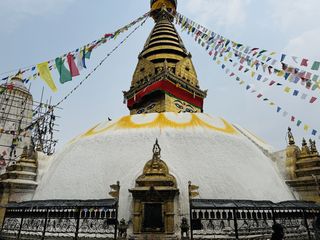
Kathmandu, Swoyambhu Mahachaitya
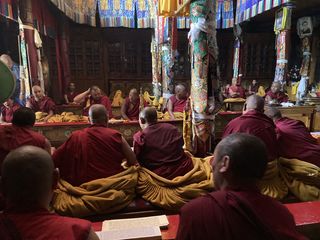
Ladakh, monks’ prayer ceremony at Likir Gompa
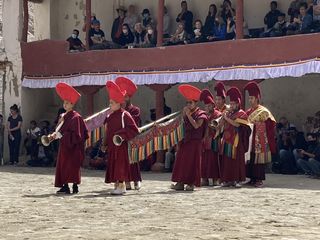
Cham dance during the Phyang Tsedup festival in Ladakh
Buddhism: History, Doctrines, and Cultural Role
Historical Background
Buddhism is a religious and philosophical tradition that originated in northern India during the 5th century BCE, in a context of spiritual reform and intellectual ferment. Its founder, Siddhartha Gautama, was born into a noble family of the Śākya clan in the region of the Ganges. After renouncing his princely life, he undertook a long period of ascetic practices and meditation, ultimately attaining “awakening” (bodhi) under the Bodhi tree in Bodh Gaya. From that point, he became known as the Buddha, meaning “the Awakened One.”
His teachings, transmitted orally and written down centuries later, focus on understanding the nature of human suffering and the path to liberation from it. Unlike theistic religions, early Buddhism emphasizes ethical conduct, mental discipline, and experiential insight rather than devotion to a creator god.
Geographic Expansion
Buddhism began spreading beyond its Indian birthplace within a few centuries. Under the reign of Emperor Aśoka in the 3rd century BCE, it received strong political support and was promoted as a moral and unifying force across the Mauryan Empire. Aśoka sent emissaries to regions such as Sri Lanka, where Theravāda Buddhism took root.
From Sri Lanka, it expanded into Southeast Asia—present-day Myanmar, Thailand, Cambodia, and Laos—where it remains dominant. Simultaneously, Buddhism moved northwest into Central Asia and eastward into China via the Silk Road, adapting to local cultures and giving rise to new interpretations. From China, it spread to Korea and Japan by the 6th century CE. In the Himalayan regions, particularly Tibet and Mongolia, Tibetan Buddhism developed from the 7th century onward.
Although Buddhism largely disappeared from India in the medieval period, it has maintained a strong presence across much of Asia and has seen renewed global interest since the 19th and 20th centuries, especially in Western countries.
Major Traditions
Over time, diverse schools of thought emerged within Buddhism. Three main branches are generally recognized:
- Theravāda (“Doctrine of the Elders”), primarily practiced in Sri Lanka and Southeast Asia. It relies on texts in the Pāli language and emphasizes monastic discipline, personal effort, and the ideal of the arhat, an enlightened being who attains liberation through individual insight.
- Mahāyāna (“Great Vehicle”), widespread in China, Korea, Japan, and Vietnam. It emphasizes compassion and universal salvation through the ideal of the bodhisattva, an enlightened being who delays personal liberation to assist others. Mahāyāna includes a wide array of texts and interpretations.
- Vajrayāna (“Diamond Vehicle”), also known as Tantric Buddhism, is practiced mainly in Tibet, Mongolia, and the Himalayan regions. It incorporates esoteric rituals, visualization practices, and initiation rites, building on Mahāyāna foundations while emphasizing symbolic and ritual techniques.
These branches are not always mutually exclusive and have evolved through mutual influence and local adaptation.
Core Beliefs and Practices
Buddhism does not center around the worship of a creator deity but focuses on understanding and transforming the human condition. Key philosophical concepts include impermanence (anicca), non-self (anattā), and the law of moral causation (karma).
At the heart of Buddhist doctrine are the Four Noble Truths:
- Life is characterized by suffering (dukkha).
- Suffering arises from craving and attachment.
- There is a way to end suffering.
- The path to cessation is the Noble Eightfold Path, which comprises ethical conduct, mental discipline, and wisdom.
Common practices include:
Meditation, aimed at cultivating mindfulness and insight;
- Ethical precepts, including non-violence, truthfulness, and moderation;
- Chanting of texts or mantras;
- Offerings to monastic communities or sacred sites;
- Participation in religious festivals, such as Vesak, which commemorates the Buddha’s birth, enlightenment, and death.
In lay communities, cultural practices often involve merit-making, such as sponsoring ceremonies or donating to temples. These rituals are integral to both spiritual development and communal cohesion.
Political and Institutional Roles
Buddhism has historically interacted with political systems in diverse ways. In ancient and medieval Asia, it often benefited from royal patronage and became associated with moral governance and state legitimacy. Emperor Aśoka’s adoption of Buddhism is an early example of religion influencing political ideology.
In many Southeast Asian countries, particularly Thailand, Buddhism functions as a state-supported religion, with the monarch serving as its symbolic protector. In the Tibetan tradition, Buddhist institutions once held both spiritual and temporal power, exemplified by the historical role of the Dalai Lama as both religious leader and head of state.
Buddhism has also served as a cultural identity marker, particularly in response to colonialism, modern nationalism, or religious competition. At the same time, some Buddhist movements have emphasized non-violence, social justice, and ecological ethics in contemporary political discourse.
Views on Death and Commemoration
Buddhism maintains a distinctive perspective on death, which is seen not as an end but as a transition within the cycle of rebirths (saṃsāra). The conditions of future rebirth are believed to be shaped by one’s intentional actions (karma), and liberation from this cycle is the ultimate spiritual goal—attaining nirvāṇa, a state of complete freedom from suffering.
Death rituals vary across cultures and schools but commonly include:
- Recitation of texts to guide the deceased;
- Offerings to accumulate merit for the departed;
- Ceremonies marking stages of mourning, often held on the 7th, 49th, or 100th day after death;
- Cremation, which is generally preferred, though burial is also practiced;
- Stupas or reliquary monuments housing ashes or relics, often placed in temple precincts or sacred landscapes.
These practices serve both spiritual and social functions, reinforcing ethical values, communal memory, and reverence for ancestors or enlightened figures.
The Influence of Buddhism on Architecture: Forms, Functions, and Symbolisms
Origins and Religious Foundations of Architectural Forms
Buddhism, which emerged in the Indian subcontinent during the 5th century BCE, introduced distinct architectural expressions rooted in its spiritual teachings. While early Buddhist practice emphasized personal renunciation and did not initially favor the construction of permanent places of worship, the need to support monastic life and veneration of sacred relics led to the development of specific architectural forms. These early structures were primarily spaces for meditation, the preservation of relics, and didactic purposes. As Buddhism evolved and spread, architecture became a vital medium to embody its cosmological and philosophical principles.
Typologies and Functions of Structures
Buddhist architecture encompasses a variety of built forms, each fulfilling distinct ritual, communal, or funerary roles:
- Stupa: One of the earliest and most iconic forms, the stupa is a hemispherical structure built to enshrine relics. It is not entered but circumambulated by devotees, symbolizing the cycle of life and the path to enlightenment.
- Vihara: Initially a monastic dwelling, the vihara evolved into a multifunctional complex including meditation halls, residential quarters for monks, libraries, and spaces for instruction.
- Chaitya Hall: Often rock-cut, this prayer hall contains a stupa at one end and features a central nave for circumambulation. It serves as a communal space for worship.
- Temple: Later developments introduced temples that enshrine images of the Buddha or bodhisattvas, often accessible to lay practitioners. These temples may feature shrines, ceremonial halls, and spaces for ritual offerings.
- Funerary Structures: Buddhist traditions gave rise to cemeteries, memorial stupas, cenotaphs, and ritual monuments intended to honor the dead and facilitate merit transfer. These structures reflect doctrinal views on karma, rebirth, and liberation.
These types vary significantly across regions and schools of Buddhism (Theravāda, Mahāyāna, Vajrayāna), reflecting doctrinal, geographical, and cultural diversity.
Integrated Symbolisms: Form, Orientation, Decoration
Symbolism is deeply embedded in Buddhist architecture, reinforcing spiritual messages through spatial organization and iconography:
- Form: The stupa’s shape represents the five elements—earth, water, fire, air, and space—and the path to enlightenment. Vertical hierarchies in temple design symbolize transcendence.
- Orientation: Buildings are often oriented eastward, associated with light, wisdom, and the Buddha’s awakening.
- Spatial Organization: The layout often facilitates progressive movement from the profane to the sacred, reflecting stages of spiritual advancement.
- Decorative Elements: Ornamentation includes depictions of the Buddha’s life, past incarnations (jataka tales), cosmological diagrams (mandalas), lotus motifs, dharma wheels, and protective deities. These elements serve educational and devotional functions.
- Color and Light: Use of natural light, vibrant pigments, and reflective surfaces is common, enhancing contemplative experience.
This integration of symbolism turns each structure into a three-dimensional representation of Buddhist cosmology and ethics.
Materials and Construction Techniques
Material choice and building methods have varied widely, adapted to local environments and technological capacities:
- Stone and Brick: Early stupas and monastic complexes in the Indian subcontinent employed stone and baked brick for durability and monumental expression.
- Rock-cut Architecture: Particularly in South Asia, entire complexes were hewn into cliffs, demonstrating both spiritual commitment and engineering prowess.
- Timber and Earth: In regions such as East Asia, timber framing and rammed earth construction allowed for more flexible forms and seismic resilience.
- Stucco and Plaster: Used for sculptural decoration and surface finishes, often painted or gilded.
- Metal and Ceramics: Roof tiles, statuary, and ornamentation sometimes utilized bronze or glazed ceramics for decorative and protective purposes.
Regional differences in materials also shaped the evolution of distinct architectural idioms while maintaining core symbolic elements.
Geographic Diffusion and Local Adaptations
As Buddhism spread beyond India into Central Asia, East Asia, Southeast Asia, and the Himalayan region, its architecture diversified significantly:
- In South Asia, stupa forms remained dominant, but were elaborated into towering reliquary mounds and pilgrimage sites.
- In East Asia, pagodas evolved as vertical interpretations of stupas, reflecting Chinese wooden architecture and geomantic beliefs.
- In Southeast Asia, temple complexes combined Buddhist and indigenous cosmologies, resulting in richly decorated multi-tiered structures.
- In Tibet and the Himalayas, monasteries became fortresses of ritual life, integrating Tantric symbolism and high-altitude construction methods.
Adaptation was not merely stylistic but reflected functional and doctrinal needs, such as accommodating lay participation or complex ritual practices.
Intercultural Interactions
Buddhist architecture has continually engaged in dialogue with other traditions, both influencing and being influenced by them:
- Indigenous Traditions: In many regions, Buddhist architecture absorbed local motifs, construction methods, and spatial concepts.
- Religious Syncretism: Shared sites or iconographies with Hinduism, Taoism, or Shintoism led to hybrid forms, particularly in temple complexes.
- Trade and Pilgrimage: Maritime and overland routes facilitated the exchange of artistic techniques and structural innovations.
- Colonial and Postcolonial Encounters: Contact with Islamic, Christian, and Western secular architecture introduced new materials (e.g., concrete, steel) and conservation challenges.
Through these interactions, Buddhist architecture has remained a dynamic and responsive form of cultural expression, simultaneously preserving continuity and embracing transformation.
The Role of Buddhism in the History of Indian Dynasties
Originating in northern India in the 6th century BCE, Buddhism rose to dominance under certain dynasties, most notably under Emperor Ashoka of the Maurya dynasty, who used it to legitimise his authority and promote a moral ideal based on dharma and non-violence. Monasteries, stupas, and Buddhist universities became centres of cultural and political influence, enhancing the prestige of their royal patrons.
Although Buddhism experienced periods of pre-eminence, many dynasties maintained or supported other religions such as Hinduism or Jainism, seeking political and social balance. These relationships were often peaceful, though some periods saw tensions, especially during Buddhism’s decline in the face of Hindu revival or the spread of Islam in certain regions.
Armed conflicts in which Buddhism played a direct role were rare; however, conquests or dynastic changes sometimes led to the conversion, transformation, or abandonment of religious sites. Despite its gradual retreat from India from the 7th century onwards, Buddhism retained a lasting influence on art, architecture, and political thought, and remains an important element of India’s cultural heritage.
This page organises the dynasties related to Buddhist religion, according to a chronological structure based on millennia and centuries. The associated maps indicate the present-day location of the relevant states and link to the detailed pages.
1st millennium BCE
4th century BCE

Dominant religions, depending on the period: Hinduism, Buddhism
Supported or encouraged religion: Jainism.
( Assam, Bihar, Delhi (NTC), Goa, Gujarat, Himachal Pradesh, Karnataka, Kerala, Madhya Pradesh, Maharashtra, Odisha, Punjab, Rajasthan, Tamil Nadu, Telangana, Uttar Pradesh, Andhra Pradesh, Chhattisgarh, Haryana, Jharkand, Manipur, Meghalaya and Uttarakhand )
2nd century BCE

1st millennium
1st century

Dominant religion: Buddhism
Supported or encouraged religions, depending on the period: Hinduism, zoroastrianism.
( Bihar, Delhi (NTC), Himachal Pradesh, Punjab, Uttar Pradesh, West Bengal, Haryana, Jammu & Kashmir and Jharkand )
6th century

Dominant religions, depending on the period: Hinduism, Buddhism
Supported or encouraged religions, depending on the period: Hinduism, Buddhism, Jainism.
( Bihar, Madhya Pradesh, Odisha, Punjab, Rajasthan, Uttar Pradesh, West Bengal, Chhattisgarh, Haryana and Jharkand )
8th century


Dominant religion: Buddhism
Supported or encouraged religions, depending on the period: Hinduism, Jainism.
( Assam, Bihar, Odisha, Uttar Pradesh, West Bengal and Jharkand )