

 Français (France)
  Nederlands (nl-NL)
 • Use the markers to explore the content •
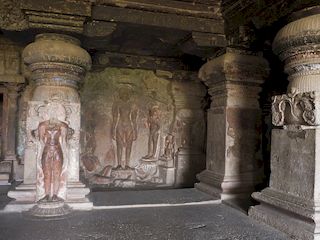
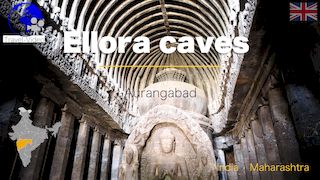
Maharashtra, India • cave nr 32 in Ellora
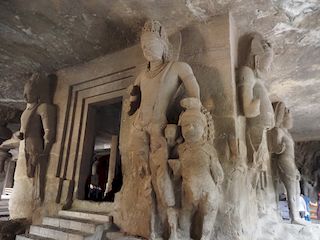
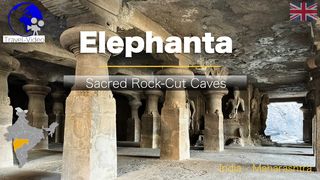
Maharashtra, India • Elephanta Hindu Cave, Mumbai
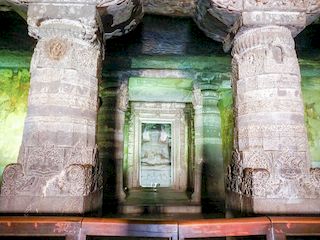
Maharashtra, India • cave nr 1 in Ajanta
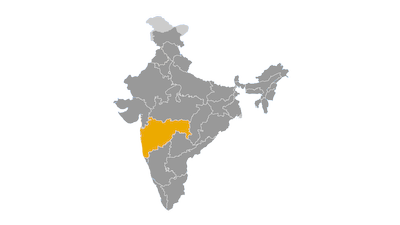
From Ancient Deccan Kingdoms to Maratha Power: The Historical Evolution of Maharashtra
A Strategic Region Between the Deccan and the Arabian Sea
Maharashtra occupies a central position in the history of western and central India. Stretching from the Arabian Sea coast to the interior of the Deccan Plateau, the region has long served as a bridge between northern India, southern India and the maritime routes of the Indian Ocean. Its ports connected the subcontinent with the Middle East, East Africa and Southeast Asia, while its inland trade routes linked the Deccan with the Gangetic plains.
Throughout history, Maharashtra witnessed the rise of powerful dynasties, the expansion of major empires and the emergence of the Marathas, whose influence transformed the political balance of the Indian subcontinent during the eighteenth century.
Prehistoric Communities and Early Settlements
Human occupation in Maharashtra dates back to prehistoric times. Stone tools and archaeological remains discovered along the valleys of the Godavari, Bhima and Krishna rivers indicate the presence of human communities during the Paleolithic period.
During the Neolithic and Chalcolithic eras, agricultural settlements gradually spread across the Deccan Plateau. Archaeological excavations have revealed evidence of farming, animal husbandry and regional trade networks.
One of the most important archaeological cultures associated with the region is the Jorwe culture, which flourished during the second millennium BCE in large parts of western Deccan India. These communities developed agricultural systems adapted to semi-arid conditions and established permanent settlements that formed the basis for later political development.
The Satavahanas and the Emergence of Regional Power
The first major historical dynasty to dominate much of present-day Maharashtra was the Satavahana dynasty, also known as the Andhras. Emerging during the final centuries BCE, the Satavahanas became the principal power of the Deccan between the first century BCE and the third century CE.
Their territory extended across large parts of western and central India and benefited from extensive commercial exchanges with the Roman world through ports located on the western coast of India.
The Satavahana period witnessed significant urban growth, the expansion of trade guilds and the flourishing of Buddhism. Numerous Buddhist monasteries and cave complexes were excavated in the hills of Maharashtra during this period.
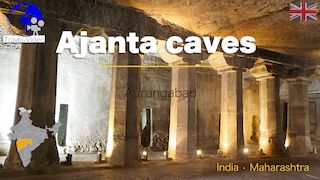
Among the most remarkable monuments associated with this tradition are the caves of Ajanta Caves and Ellora Caves, which would continue to develop under later dynasties.
The Classical Deccan and Regional Dynasties
Following the decline of the Satavahanas, Maharashtra came under the rule of several important dynasties including the Vakatakas, Chalukyas and Rashtrakutas.
The Vakatakas maintained close political and cultural relations with the Gupta Empire of northern India and encouraged artistic and religious activity throughout the Deccan. Many of the celebrated mural paintings of Ajanta date from this period.
From the eighth to the tenth centuries, the Rashtrakutas emerged as one of the most powerful empires in India. Their territories extended from the Deccan into northern India, making them one of the dominant political forces of their time.
Their most famous architectural achievement is the magnificent Kailasa Temple, carved from a single rock and considered one of the greatest examples of rock-cut architecture anywhere in the world.
Later dynasties, including the Western Chalukyas and the Yadavas of Devagiri, continued to strengthen regional political institutions and contributed to the growing prominence of the Marathi language and cultural identity.
The Delhi Sultanate and the Deccan Sultanates
The early fourteenth century marked a major turning point when military campaigns launched by the Delhi Sultanate reached the Deccan Plateau. The Yadava kingdom centred on Devagiri was defeated and incorporated into the expanding northern empire.
As the authority of Delhi weakened during the following decades, an independent Muslim state emerged in the Deccan with the establishment of the Bahmani Sultanate.
The Bahmani rulers controlled much of the Deccan for nearly two centuries and encouraged urban growth, trade and cultural exchange.
Following the fragmentation of the Bahmani state, several successor sultanates appeared, including the states of Ahmadnagar, Bijapur and Berar. These kingdoms developed distinctive forms of architecture, administration and military organisation that combined Persian, Turkish and local Deccan influences.
The period also witnessed growing commercial links with the Middle East and the wider Indian Ocean trading system.
The Rise of Shivaji and the Maratha State
The seventeenth century witnessed one of the most significant developments in Indian history with the emergence of the Maratha state under Shivaji.
Taking advantage of the weakening Deccan Sultanates and the increasing difficulties faced by the Mughal Empire in controlling the region, Shivaji gradually established an independent kingdom based in the hill forts of the Western Ghats.
Beginning in the 1640s, he captured numerous strategic fortresses and developed an efficient administrative and military system adapted to the mountainous terrain of western India.
His coronation as Chhatrapati in 1674 symbolised the formal establishment of Maratha sovereignty and marked the beginning of a new political era in the Deccan.
The administration introduced by Shivaji encouraged the use of Marathi in government affairs and contributed to the consolidation of a distinct regional identity.
Conflict with the Mughals and Imperial Expansion
The expansion of Maratha power inevitably led to conflict with the Mughal Empire under Aurangzeb.
Aurangzeb personally led military campaigns in the Deccan for more than two decades in an attempt to eliminate Maratha resistance. Despite considerable military resources, Mughal forces failed to achieve a decisive victory.
The prolonged conflict exhausted Mughal finances and contributed significantly to the decline of imperial authority across India.
Following Aurangzeb's death in 1707, the Marathas rapidly expanded beyond Maharashtra under the leadership of the Peshwas based in Pune.
By the middle of the eighteenth century, Maratha influence extended across much of the Indian subcontinent, from the Punjab to southern India. Maharashtra consequently became the political centre of one of the largest indigenous empires in early modern India.
British Expansion and Colonial Rule
The growing power of the British East India Company eventually brought it into conflict with the Marathas. A series of Anglo-Maratha wars culminated in the defeat of the Maratha Confederacy during the Third Anglo-Maratha War.
British rule transformed the political and economic landscape of Maharashtra. Much of the territory became part of the Bombay Presidency, while several princely states retained limited autonomy under British supervision.
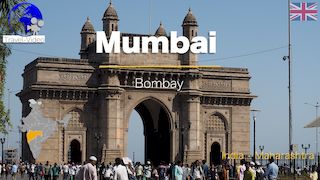
The development of the port city of Mumbai, then known as Bombay, turned it into one of the most important commercial centres of the British Empire in Asia.
Railways, industries and financial institutions expanded rapidly during the nineteenth century, laying the foundations for Maharashtra's later economic prominence.
Maharashtra and the Indian Independence Movement
Maharashtra played a central role in the Indian nationalist movement. Bombay became one of the principal centres of political debate, labour activism and anti-colonial mobilisation.
Several major nationalist leaders emerged from the region, including Bal Gangadhar Tilak, whose political campaigns helped transform the independence movement into a mass movement.
The city also served as an important base for the activities of the Indian National Congress.
One of the defining moments of the struggle for independence occurred in Bombay in 1942, when Mahatma Gandhi launched the Quit India Movement demanding an immediate end to British rule.
The Formation of Modern Maharashtra
Following Indian independence in 1947, Maharashtra initially formed part of the bilingual Bombay State, which included both Marathi-speaking and Gujarati-speaking populations.
Growing demands for a separate Marathi-speaking state led to the Samyukta Maharashtra movement, which campaigned for linguistic reorganisation.
As a result, the modern state of Maharashtra was officially established on 1 May 1960, while Gujarat became a separate state.
Mumbai was retained as the capital of Maharashtra and continued to expand as India's principal financial and industrial centre.
Historical Legacy and Contemporary Identity
The historical evolution of Maharashtra reflects the broader history of the Deccan and of India itself. The region served as a meeting place for maritime trade, imperial ambitions and regional political traditions.
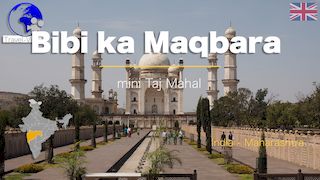
Its Buddhist cave complexes, medieval fortresses, Mughal monuments and Maratha military architecture testify to the diversity of influences that shaped the region over two millennia.
Modern Maharashtra continues to draw upon this historical legacy while remaining one of India's most influential states in political, economic and cultural life. The memory of the Maratha Empire, the heritage of the Deccan kingdoms and the cosmopolitan character of Mumbai remain central elements of the state's contemporary identity.


Maharashtra in Contemporary India: Economic Powerhouse, Cultural Diversity and Gateway to the Arabian Sea
A Leading State in Western India
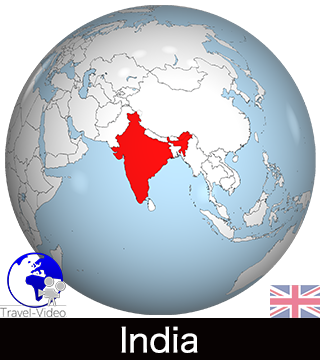
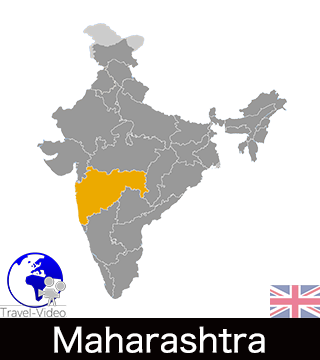
Maharashtra is one of India's most influential and dynamic states, playing a central role in the country's economy, politics and culture. Located on the western coast of the Indian subcontinent, it stretches from the Arabian Sea to the interior of the Deccan Plateau and serves as a vital link between northern and southern India.
With an area exceeding 307,000 square kilometres and a population of more than 120 million inhabitants, Maharashtra ranks among India's largest and most populous states. Its strategic position, extensive coastline and highly diversified economy have made it one of the principal engines of India's modern development.
The state shares borders with Gujarat to the northwest, Madhya Pradesh to the north, Chhattisgarh to the east, Telangana to the southeast, Karnataka to the south and Goa to the southwest.
Geography and Natural Landscapes
The geography of Maharashtra is remarkably varied. The narrow coastal plain known as the Konkan stretches along the Arabian Sea and contains some of the state's most densely populated and economically active areas.
To the east rise the Western Ghats, also known as the Sahyadri Mountains, one of India's most important mountain systems and a recognised global biodiversity hotspot. These mountains form a natural barrier between the coast and the interior plateau.
Beyond the Western Ghats lies the vast Deccan Plateau, which covers most of the state's interior. Much of this landscape consists of volcanic basalt formations created by the massive eruptions that formed the Deccan Traps approximately sixty-six million years ago.
Several major rivers flow through Maharashtra, including the Godavari, Krishna, Bhima, Tapi and Wardha rivers. These waterways play essential roles in irrigation, hydroelectric generation and agricultural production.
Climate and Environmental Conditions
Maharashtra experiences a tropical monsoon climate, although significant regional variations exist due to differences in altitude and distance from the sea.
The Konkan coast receives abundant rainfall during the southwest monsoon, while parts of the interior Deccan Plateau experience semi-arid conditions and periodic droughts. Summer temperatures frequently exceed 40 degrees Celsius in inland districts.
Environmental management has become an increasingly important issue in recent decades. The Western Ghats support rich ecosystems containing numerous endemic plant and animal species, while dry forests and grasslands dominate other parts of the state.
Protected areas such as Sanjay Gandhi National Park, Tadoba Andhari Tiger Reserve and Navegaon National Park contribute significantly to wildlife conservation.
Water scarcity, urban pollution and the environmental consequences of rapid industrialisation remain major concerns for policymakers.
Population and Social Diversity
Maharashtra is India's second most populous state after Uttar Pradesh. The population exceeded 112 million inhabitants in the 2011 census and has continued to grow significantly since then.
The state is highly urbanised compared with many other regions of India. Large metropolitan areas attract migrants from across the country, creating a socially and culturally diverse population.
The Marathas constitute the largest historical and cultural community, but Maharashtra also hosts substantial Gujarati, South Indian, North Indian and tribal populations. This diversity reflects centuries of migration and economic opportunity.
Marathi serves as the official language and is spoken by the majority of residents. Hindi is widely used in urban areas and commerce, while English occupies an important position in administration, higher education and business.
Hinduism is the dominant religion, although large Muslim communities are present throughout the state. Maharashtra also contains important Buddhist, Jain, Christian, Sikh and Parsi populations, particularly in major cities.
Major Cities and Administrative Organisation
Mumbai is the capital of Maharashtra and India's financial centre. It hosts the country's principal stock exchanges, numerous corporate headquarters and some of India's largest banking institutions.
The city also contains one of the busiest ports in South Asia and serves as the centre of India's Hindi-language film industry, commonly known as Bollywood.
Pune has developed into one of India's leading centres for higher education, information technology and manufacturing industries. It is often regarded as one of the country's most important knowledge economies.
Nagpur occupies a strategic location near the geographical centre of India and serves as a major transportation and logistics hub. It also hosts the winter session of the state legislature.
Other important cities include Nashik, an agricultural and religious centre, Aurangabad, a gateway to important historical monuments, and Kolhapur, known for its industrial and cultural significance.
Administratively, Maharashtra is divided into several divisions and thirty-six districts. Like other Indian states, it has an elected legislative assembly and a government headed by a Chief Minister, while a Governor represents the central government.
Transportation and Infrastructure
Maharashtra possesses some of India's most advanced transportation infrastructure. Its central position in western India and its economic importance have encouraged substantial investment in roads, railways and ports.
An extensive highway network connects Mumbai with Pune, Nashik, Nagpur and neighbouring states. Major expressways have significantly reduced travel times and supported industrial development.
The railway network is one of the busiest in India. Mumbai's suburban railway system alone transports millions of passengers every day and is among the world's largest urban rail networks.
Air transport infrastructure is equally important. International airports in Mumbai and Pune provide connections to destinations throughout Asia, Europe, the Middle East and North America, while regional airports improve connectivity within India.
The maritime sector remains crucial to the state's economy. The ports of Mumbai and nearby Jawaharlal Nehru Port handle a substantial share of India's international trade.
Economic Structure and Industrial Development
Maharashtra possesses the largest state economy in India and contributes a significant proportion of the country's gross domestic product.
The service sector dominates economic activity, particularly finance, insurance, information technology, telecommunications and business services. Mumbai serves as the headquarters for many of India's largest corporations and financial institutions.
Industrial production remains equally important. Maharashtra hosts major automotive, pharmaceutical, petrochemical, textile, engineering and electronics industries.
Manufacturing clusters around Pune, Nashik and Aurangabad have attracted significant domestic and foreign investment over recent decades.
Agriculture continues to support millions of livelihoods, especially in rural districts. Maharashtra is a leading producer of sugarcane, cotton, soybeans, onions, grapes and oranges.
One of the state's most famous agricultural products is the Alphonso mango from the Konkan region, internationally recognised for its quality and flavour.
Education, Research and Innovation
Maharashtra hosts some of India's most prestigious educational and research institutions. Universities in Mumbai, Pune and Nagpur play important roles in higher education and scientific research.
The state contains numerous engineering institutes, medical colleges and management schools that attract students from across India and abroad.
Pune in particular has emerged as a major centre for technological innovation, software development and startup activity.
The combination of academic institutions and industrial investment has contributed significantly to Maharashtra's transition towards a knowledge-based economy.
Contemporary Cultural Life
The cultural identity of Maharashtra reflects a combination of Maratha traditions, Deccan influences and cosmopolitan urban culture.
Festivals remain central to social life. Ganesh Chaturthi occupies a particularly important place in public celebrations, while Diwali, Gudi Padwa and Navratri are widely observed across the state.
Traditional performing arts such as Lavani dance, Tamasha theatre and devotional music continue to attract audiences and preserve regional cultural heritage.
The influence of Mumbai's film industry extends far beyond India and contributes significantly to the global visibility of Indian culture.
Handicrafts including textiles, metalwork and traditional jewellery production continue to support local economies in many districts.
Contemporary Challenges and Future Prospects
Despite its economic success, Maharashtra faces significant developmental challenges. Rapid urbanisation has increased pressure on housing, transportation systems and public services, particularly in the Mumbai metropolitan region.
Rural areas continue to experience difficulties related to agricultural productivity, water availability and income inequality. Periodic droughts affect several districts of the Deccan Plateau and create long-term concerns regarding water management.
Environmental conservation in the Western Ghats must also be balanced against industrial growth and infrastructure development.
Maharashtra therefore represents both the opportunities and the challenges of contemporary India: a highly dynamic economy, a rapidly urbanising society and a region seeking to balance economic expansion with social inclusion and environmental sustainability.