

 Français (France)
  Nederlands (nl-NL)
 • Use the markers to explore the content •

Gujarat, India • Great Rann of Kutch, schoolchildren walking on the salt desert

Gujarat, India • Rani Ki Vav, impressive step well

Gujarat, India • Dholavira, archaeological remains of the Indus Civilization
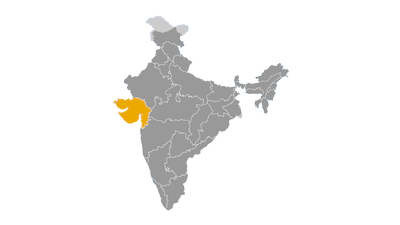
Gujarat Through the Ages: From the Indus Valley Civilization to a Modern Indian State
Located on the western coast of India, Gujarat has played a central role in the history of the Indian subcontinent for more than four millennia. Its strategic position along the Arabian Sea placed it at the crossroads of maritime trade linking India with the Middle East, East Africa, and later Europe. Throughout its history, Gujarat has been shaped by successive civilizations, powerful dynasties, Islamic sultanates, the Mughal Empire, Maratha rule, British colonial administration, and the Indian independence movement. This rich historical legacy has profoundly influenced the region's political institutions, economy, culture, and society.
Early Human Settlement and the Indus Valley Civilization
Human occupation in Gujarat dates back to prehistoric times, with archaeological evidence of Stone Age communities found throughout the region. The state's historical significance, however, became particularly evident during the third millennium BCE with the rise of the Indus Valley Civilization, also known as the Harappan Civilization.
Several of the civilization's most important urban centers were located in present-day Gujarat. Dholavira, situated on Khadir Island in the Rann of Kutch, is one of the best-preserved Harappan cities. Its sophisticated urban planning, water management systems, reservoirs, and monumental architecture demonstrate the advanced engineering skills of its inhabitants.
Another major site is Lothal, which is widely known for its impressive dockyard, often regarded as one of the earliest known maritime facilities in the world. Lothal maintained commercial links with Mesopotamia and other regions around the Persian Gulf, illustrating Gujarat's early role in international trade.
Following the gradual decline of the Indus Valley Civilization around 1900 BCE, agricultural communities continued to occupy the region, laying the foundations for later political developments.
Ancient Kingdoms and Imperial Rule
During the first millennium BCE, Gujarat became integrated into the expanding political landscape of northern India. In the third century BCE, much of the region formed part of the Maurya Empire under Emperor Ashoka. His inscriptions at Girnar, near present-day Junagadh, remain among the most important archaeological testimonies to Mauryan rule and the spread of Buddhist principles.
After the decline of the Mauryas, Gujarat came under the control of several regional powers. The Western Kshatrapas, also known as the Western Satraps, established a prosperous kingdom that dominated much of western India for several centuries. Their reign coincided with flourishing maritime commerce connecting India with the Roman Empire, Persia, and Arabia.
During the fourth and fifth centuries CE, the Gupta Empire extended its influence into parts of Gujarat. Although Gupta authority was less direct than in northern India, the region benefited from political stability, economic prosperity, and significant artistic and literary developments.
Regional Dynasties and Medieval Prosperity
Following the decline of Gupta influence, the Maitraka dynasty established its capital at Vallabhi during the sixth century. Vallabhi developed into one of the leading centers of education and Buddhist learning in western India, attracting scholars from across the subcontinent.
From the tenth century onward, the Chaulukya dynasty, commonly known as the Solankis, transformed Gujarat into one of the most powerful kingdoms in western India. Their capital at Anahilapataka, now Patan, became a major political and cultural center.
The Solanki period witnessed remarkable achievements in architecture, engineering, and urban development. Monumental temples, reservoirs, and stepwells were constructed throughout the kingdom. The Rani ki Vav stepwell at Patan, now a UNESCO World Heritage Site, represents one of the finest examples of medieval Indian hydraulic architecture.
Maritime trade expanded considerably during this period through ports such as Bharuch and Khambhat, strengthening Gujarat's commercial links with Arabia, East Africa, and Southeast Asia.
The Delhi Sultanate and the Gujarat Sultanate
The closing years of the thirteenth century brought significant political change as the armies of the Delhi Sultanate invaded Gujarat. Although initially incorporated into the Delhi Sultanate, the region eventually became an independent state with the establishment of the Gujarat Sultanate in 1407.
Under rulers such as Ahmad Shah I, the sultanate experienced substantial political and economic growth. Ahmad Shah founded the city of Ahmedabad in 1411, which rapidly developed into one of the largest and most prosperous urban centers in India.
The Gujarat Sultanate encouraged trade, crafts, and architecture. Mosques, palaces, fortifications, and public buildings combined Islamic architectural traditions with local craftsmanship, creating a distinctive regional style that remains visible today.
The state's coastal location allowed merchants to maintain active commercial relations with ports across the Arabian Sea, making Gujarat one of the wealthiest trading regions in South Asia.
Gujarat under the Mughal Empire
In 1573, Emperor Akbar conquered Gujarat and incorporated it into the Mughal Empire. The province became one of the empire's richest and most economically significant territories.
Surat emerged as one of the most important ports in the Indian Ocean. It served as the principal departure point for Muslim pilgrims travelling to Mecca and became a major center for international commerce. European trading companies, including the Portuguese, Dutch, English, and French, established commercial factories there, integrating Gujarat into expanding global trade networks.
Under Mughal administration, agriculture, textile production, banking, and overseas commerce flourished. Gujarati merchants became renowned throughout the Indian Ocean world for their commercial expertise and extensive international connections.
Maratha Expansion and British Colonial Rule
The decline of Mughal authority during the eighteenth century allowed the Marathas to expand into Gujarat. Control of the region became divided among Maratha rulers, local princely states, and independent chiefs.
During the nineteenth century, the British East India Company gradually extended its influence across Gujarat. Some territories were incorporated directly into the Bombay Presidency, while numerous princely states retained varying degrees of internal autonomy under British paramountcy.
British rule brought significant infrastructural changes, including the construction of railways, roads, ports, and irrigation systems. Ahmedabad developed into one of India's leading textile manufacturing centers, earning the nickname "Manchester of India." Industrialization accelerated economic growth while also contributing to the emergence of an educated urban middle class.
Gujarat and the Indian Independence Movement
Gujarat played a central role in India's struggle for independence. The state is the birthplace of Mohandas Karamchand Gandhi, who was born in Porbandar in 1869.
Gandhi established the Sabarmati Ashram near Ahmedabad, which became the headquarters of many campaigns of nonviolent resistance against British rule. In 1930, the famous Salt March began at Sabarmati and concluded at Dandi on Gujarat's coast. This act of civil disobedience became one of the defining events of the Indian independence movement and attracted worldwide attention.
Many political leaders, industrialists, and social reformers from Gujarat also made important contributions to India's nationalist movement and post-independence development.
The Formation of the Modern State
Following Indian independence in 1947, Gujarat became part of the bilingual Bombay State after the integration of numerous princely states into the Indian Union.
Growing linguistic movements advocating separate states for Gujarati- and Marathi-speaking populations led to the reorganization of Bombay State. On 1 May 1960, the modern state of Gujarat was officially created, while the Marathi-speaking regions formed the state of Maharashtra.
Since its formation, Gujarat has become one of India's most economically dynamic states. Rapid industrialization, extensive port development, agricultural modernization, and entrepreneurial activity have transformed the state into a major center for manufacturing, petrochemicals, pharmaceuticals, textiles, engineering, and international trade.
At the same time, Gujarat has preserved an extraordinary historical heritage. Archaeological sites such as Dholavira and Lothal, medieval monuments in Patan and Champaner, the historic city of Ahmedabad, and numerous temples, mosques, and forts illustrate the region's remarkable historical continuity. Together, these monuments reflect more than four thousand years of political, commercial, religious, and cultural development, making Gujarat one of the most historically significant regions of the Indian subcontinent.


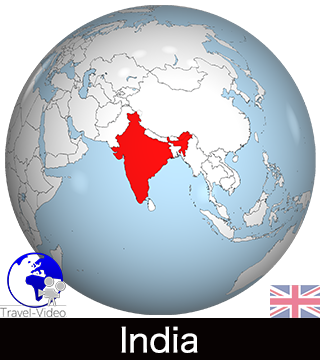
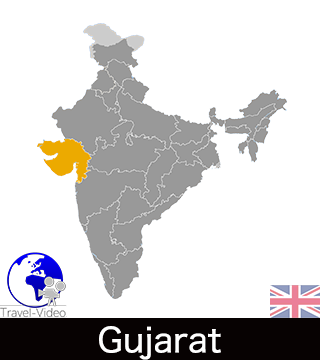

Contemporary Gujarat: A Maritime, Industrial and Cultural Powerhouse of Modern India
Located on the western coast of India, Gujarat is one of the country's most economically dynamic and strategically important states. Its long coastline along the Arabian Sea has made it a gateway for trade between the Indian subcontinent, the Middle East, Africa, and Europe for thousands of years. Today, Gujarat combines rapid industrial growth, advanced infrastructure, productive agriculture, thriving ports, and a rich cultural heritage. As one of India's leading manufacturing and commercial centers, the state plays a central role in the national economy while preserving traditions that reflect its long and diverse history.
Geography and Natural Environment
Gujarat occupies the northwestern part of peninsular India. It shares international borders with Pakistan to the northwest and state boundaries with Rajasthan to the north, Madhya Pradesh to the east, Maharashtra to the south, and the Union Territory of Dadra and Nagar Haveli and Daman and Diu. To the west and southwest, it faces the Arabian Sea along a coastline of nearly 1,600 kilometers, the longest among India's states.
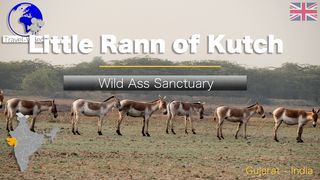
The state's landscape is remarkably diverse. The Great Rann of Kutch dominates the northwestern region with its vast seasonal salt marshes, while the Little Rann of Kutch is renowned as the last natural habitat of the Indian wild ass. Central Gujarat consists largely of fertile plains crossed by major rivers, whereas the southeastern districts gradually rise into the hills associated with the Western Ghats. Mount Girnar, near Junagadh, is one of Gujarat's most prominent peaks and an important pilgrimage destination.
The principal rivers include the Narmada, Tapi, Sabarmati, Mahi, and Banas. Large water management projects, particularly the Sardar Sarovar Dam on the Narmada River, provide irrigation, drinking water, hydroelectric power, and flood control for large parts of the state.
Climate and Biodiversity
Gujarat experiences a predominantly tropical climate with significant regional variations. Much of the state has semi-arid conditions characterized by hot summers, mild winters, and rainfall concentrated during the southwest monsoon between June and September.
Rainfall varies considerably from the arid Kutch region to the more humid southern districts. Periodic droughts and occasional flooding remain important environmental challenges.
The state contains several remarkable ecosystems. Gir National Park is internationally known as the only remaining natural habitat of the Asiatic lion. The Marine National Park in the Gulf of Kutch protects coral reefs, mangrove forests, marine mammals, and numerous species of fish and birds. During winter, the wetlands of the Rann attract thousands of migratory birds, including flamingos, pelicans, cranes, and other waterfowl.
Population and Society
Gujarat has a population exceeding 70 million people, making it one of India's most populous states. Rapid industrialization has encouraged urbanization, although a substantial proportion of the population continues to live in rural areas.
Gujarati is the official language and is spoken by the overwhelming majority of residents. Hindi is widely understood and used throughout the state, while English plays an important role in higher education, business, administration, and the technology sector.
Hinduism is the dominant religion, but Gujarat is also home to significant Muslim, Jain, Christian, Sikh, and Parsi communities. The Parsis, descendants of Zoroastrians who migrated from Persia centuries ago, have made lasting contributions to the state's commercial and industrial development.
Major Cities and Administrative Organization
Gandhinagar serves as the state capital and houses the principal government institutions. Developed after the formation of Gujarat in 1960, it is one of India's planned cities.
Ahmedabad is the state's largest city and its principal commercial, industrial, educational, and cultural center. Recognized as India's first UNESCO World Heritage City, it combines a historic urban core with a rapidly expanding modern metropolis.
Surat is one of the fastest-growing cities in India and is internationally renowned for diamond cutting and polishing. It also possesses one of the country's largest textile industries.
Vadodara is an important educational and industrial center, while Rajkot specializes in engineering, machine tools, and manufacturing. Other significant cities include Jamnagar, Bhavnagar, Bharuch, Bhuj, and Junagadh, each contributing to the state's economic and cultural landscape.
Administratively, Gujarat is divided into multiple districts governed by the state government. Local administration is carried out through municipal corporations, municipalities, and village councils, which oversee public services and local development.
Transport and Infrastructure
Gujarat possesses one of India's most advanced transportation networks. Modern highways connect all major cities and industrial zones, while an extensive railway system provides efficient links with Mumbai, Delhi, Jaipur, Chennai, and other major urban centers.
The state is served by several airports. Sardar Vallabhbhai Patel International Airport in Ahmedabad is the principal international gateway, while Surat, Vadodara, Rajkot, Bhuj, and other cities operate domestic airports with growing passenger traffic.
One of Gujarat's greatest advantages is its maritime infrastructure. The ports of Mundra, Kandla, Hazira, Pipavav, Dahej, and several others handle a substantial proportion of India's maritime trade. Mundra has become one of the largest private ports in Asia, serving as a major logistics hub for international commerce.
A Diverse and Highly Industrialized Economy
Gujarat is one of India's leading industrial states and contributes significantly to the country's manufacturing output and exports.
Agriculture remains important despite increasing industrialization. Farmers cultivate cotton, groundnuts, wheat, rice, millet, sugarcane, cumin, sesame, coriander, tobacco, fruits, and vegetables. The state is also India's leading producer of groundnuts and one of the country's largest producers of cotton.
The dairy sector represents another major economic strength. The cooperative movement initiated by Amul transformed Gujarat into one of India's foremost milk-producing regions and became a model for dairy development across the country.
Industrial activity forms the backbone of the state's economy. Gujarat hosts major petrochemical complexes, oil refineries, pharmaceutical manufacturers, chemical industries, automobile plants, engineering companies, textile mills, and renewable energy projects. Jamnagar contains one of the world's largest oil refining complexes, while Surat dominates the global diamond cutting and polishing industry.
The services sector continues to expand rapidly, particularly in finance, logistics, information technology, education, healthcare, and business services.
Culture, Festivals and Traditional Crafts
Gujarati culture combines centuries-old traditions with modern urban development. The state is particularly famous for Navratri, during which millions of people participate in Garba and Dandiya Raas dances. These celebrations are among the largest cultural festivals in India.
Traditional craftsmanship remains vibrant, especially in the Kutch region, where artisans produce embroidered textiles, handwoven fabrics, leather goods, metalwork, pottery, lacquerware, and wood carving. Patola silk weaving from Patan is internationally recognized for its exceptional craftsmanship.
Gujarati cuisine is predominantly vegetarian and is distinguished by its balanced combination of sweet, sour, salty, and spicy flavors. Popular dishes include dhokla, thepla, undhiyu, khandvi, fafda, and various lentil-based preparations.
Education, Research and Contemporary Challenges
Gujarat hosts several institutions of national and international importance. Among the best known are the Indian Institute of Management Ahmedabad, the Indian Institute of Technology Gandhinagar, the Gujarat National Law University, and the Physical Research Laboratory, which has played a significant role in India's space science and astrophysical research.
Despite its remarkable economic achievements, Gujarat faces several important challenges. Water management remains a priority because of uneven rainfall and recurring droughts in some regions. Rapid industrialization has increased pressure on natural resources and raised concerns about air and water pollution, particularly around industrial zones and coastal areas.
Climate change presents additional challenges through rising sea levels, coastal erosion, stronger cyclones, and changing monsoon patterns. At the same time, urban growth requires continued investment in housing, transportation, healthcare, and public services.
Through sustained industrial expansion, efficient infrastructure, entrepreneurial traditions, and a strong maritime economy, Gujarat has established itself as one of India's leading engines of economic development. Its ability to combine historical heritage with technological innovation and global trade continues to shape its role as one of the country's most influential and prosperous states.