

 Français (France)
  Nederlands (nl-NL)
 Of Buddhist tradition, (with additional Hindu and Jain influence), the Mahameghavahana dynasty ruled for approximately 200 years, ± between -150 and 50 over all or part of Central India, East India, North India and South India, during the Ancient Period.
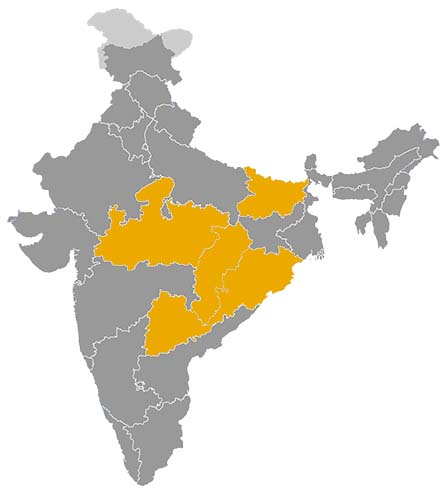
This map illustrates the maximum territory that the Mahameghavahana Dynasty had reached at its height, covering the current regions of __, Bihar, Madhya Pradesh, Odisha, Rajasthan and Telangana in India. Its main purpose is to provide a visual aid to understand the geographical extent of this dynasty. However, it's important to note that the contemporary borders of these regions may not necessarily coincide with the historical territories.
The Mahameghavahanas and the Reassertion of Kalinga in Ancient Indian History
A regional dynasty rooted in the political identity of Kalinga
The Mahameghavahana dynasty occupies an important place in the history of ancient India because it is closely connected with the political revival of Kalinga after the decline of Mauryan authority. Kalinga, broadly corresponding to present day Odisha and neighbouring areas of the eastern coast, had already become famous in Indian history through its conquest by Ashoka. The rise of the Mahameghavahanas shows that this region did not remain a passive frontier of imperial power, but re-emerged as an active political centre in the post-Mauryan period.
The chronology of the dynasty is uncertain, and only a limited number of rulers can be identified with confidence. The best known among them is Kharavela, whose reign is mainly documented by the Hathigumpha inscription near Bhubaneswar. This inscription presents him as a ruler of military ambition, administrative energy and religious patronage. Although its royal tone must be interpreted with caution, it remains the main source for understanding the political and cultural role of the Mahameghavahanas.
A political power that restored the prestige of Kalinga
The political importance of the Mahameghavahanas lies above all in their restoration of Kalinga as a significant regional kingdom. After the Mauryan conquest, Kalinga had been incorporated into a larger imperial structure. With the weakening of Mauryan authority, regional powers across the subcontinent began to reassert themselves. The Mahameghavahanas belonged to this wider movement of post-Mauryan political fragmentation and renewal.
Kharavela is described as a ruler who led campaigns in several directions. These campaigns suggest that the dynasty sought not only to defend Kalinga, but also to project its power into neighbouring regions. The precise extent of these expeditions remains debated, yet their political meaning is clear: the Mahameghavahanas presented Kalinga as a restored and assertive kingdom.
Their rule therefore illustrates a key phase in Indian history, when large imperial systems gave way to a mosaic of regional states. These states competed for territory, prestige, trade routes and religious legitimacy. The Mahameghavahanas were not an empire on the scale of the Mauryas, but they were a visible and influential force in eastern India.
Administrative activity and the consolidation of royal authority
The reign of Kharavela is associated not only with warfare, but also with public works and administrative measures. The Hathigumpha inscription mentions repairs, constructions and civic improvements, suggesting that royal authority was expressed through material development as well as military action. Such statements must be read as part of royal self-presentation, but they also reflect the expected duties of a successful ruler in ancient India.
For a regional dynasty such as the Mahameghavahanas, infrastructure was politically important. Roads, water systems, urban spaces and religious sites helped integrate the kingdom and demonstrate royal effectiveness. By maintaining and improving such structures, the ruler could present himself as a protector of prosperity and social order.
This administrative role also strengthened the legitimacy of the dynasty. In a period of regional competition, a king needed to show that his rule produced stability, wealth and prestige. The Mahameghavahanas used both military success and public benefaction to establish their authority over Kalinga.
Jain patronage and the cultural identity of the dynasty
The cultural impact of the Mahameghavahanas is especially associated with Jainism. Kharavela is often described as a patron of the Jain tradition, and the caves of Udayagiri and Khandagiri near Bhubaneswar are among the most visible monuments connected with this religious environment. These rock cut spaces were used by ascetics and became important evidence for the religious life of ancient Kalinga.
This association does not mean that the dynasty existed in a religiously exclusive world. Ancient Indian rulers often supported multiple traditions or operated within plural religious settings. Nevertheless, the connection between Kharavela, Jain communities and the cave inscriptions gives the Mahameghavahanas a distinctive cultural profile.
Their patronage helped place Kalinga within the wider religious map of the subcontinent. The dynasty supported institutions and sacred spaces that linked royal authority with ascetic traditions, moral prestige and local religious identity. In this way, the Mahameghavahanas contributed to the cultural development of eastern India, even though they are not known for an imperial artistic programme comparable to that of later great dynasties.
Economic strength from agriculture, routes and coastal access
The economic role of the Mahameghavahanas was shaped by the geography of Kalinga. The region combined fertile plains, forested and hilly interiors, mineral and natural resources, and access to the Bay of Bengal. This made it a valuable base for a regional kingdom. Agriculture provided food and revenue, while inland routes connected Kalinga with central India, the Deccan and the Gangetic world.
Coastal access was another major advantage. Although the details of maritime trade under the Mahameghavahanas are not fully known, Kalinga’s position on the eastern seaboard made it well placed for exchange along the Bay of Bengal. Trade, movement of goods and contacts with other coastal regions likely strengthened the economic foundations of the kingdom.
The resources of Kalinga helped finance warfare, construction, religious patronage and administration. The economic base of the dynasty was therefore not incidental; it was central to its political visibility. The Mahameghavahanas show how a regional coastal kingdom could use its geography to regain prominence after imperial decline.
A dynasty that embodied post-Mauryan regional renewal
The Mahameghavahanas were important not because they created a long lasting empire, but because they represent the resilience and revival of Kalinga in ancient Indian history. Their rule shows how regional identities survived imperial conquest and could later reassert themselves with political and cultural force.
Their legacy is concentrated around Kharavela, the Hathigumpha inscription, the Jain associations of Udayagiri and Khandagiri, and the renewed visibility of Kalinga in the eastern subcontinent. Politically, they belong to the world of post-Mauryan regional kingdoms. Culturally, they are linked to Jain patronage and sacred landscapes. Economically, they demonstrate the importance of coastal and inland networks in sustaining regional power.
The Mahameghavahanas therefore occupy a distinctive place in Indian history. They were not universal rulers, but they were central to the re-emergence of Kalinga as an autonomous and influential kingdom. Their role helps explain how ancient India developed through the interaction of imperial memories, regional ambitions, religious patronage and economic geography.
The Geographic Reach of the Mahameghavahanas and the Regional Power of Kalinga
A kingdom centred on Kalinga in eastern India
The Mahameghavahana dynasty was primarily associated with Kalinga, a historical region on the eastern coast of India. Its core territory corresponded mainly to present day Odisha, with possible influence extending at times into neighbouring areas of northern Andhra Pradesh and the inland zones adjoining the eastern Deccan. The dynasty should not be understood as ruling a vast empire with fixed administrative borders. Its power was regional, flexible and closely tied to the political geography of Kalinga after the decline of Mauryan authority.
Kalinga had already played a major role in Indian history before the rise of the Mahameghavahanas. Its conquest by Ashoka had marked one of the most famous episodes of Mauryan expansion. After the weakening of Mauryan control, the re emergence of Kalinga under the Mahameghavahanas represented a significant regional revival. Their authority was anchored in the eastern coastal zone, but their influence could extend inland and southward through military campaigns, political contacts and control of strategic routes.
The Odisha heartland as the centre of royal authority
The heartland of Mahameghavahana power lay in the region of present day Odisha. The area around Udayagiri and Khandagiri, near modern Bhubaneswar, is especially important because of its association with Kharavela and the Hathigumpha inscription. This landscape suggests that the dynasty’s political and religious centre was located in the central part of ancient Kalinga.
This core zone combined several geographic advantages. It included fertile plains suitable for agriculture, hill areas with natural resources, and access to the Bay of Bengal. These conditions allowed the dynasty to draw revenue from farming, control routes between the coast and the interior, and maintain contacts with maritime networks. The kingdom’s strength was therefore based not only on military action, but also on the effective use of a varied regional environment.
The Mahameghavahanas seem to have controlled a compact but valuable territory. Their base was strong enough to support public works, religious patronage and military expeditions, but there is little evidence for a permanent imperial administration over distant provinces. Their geographic power was concentrated, yet strategically well placed.
Kharavela’s campaigns and the widening of political influence
The reign of Kharavela gives the clearest indication of the dynasty’s wider geographic ambitions. The Hathigumpha inscription presents him as a ruler who conducted campaigns in several directions. Although the exact interpretation of these campaigns remains debated, they show that the Mahameghavahanas sought to project power beyond the immediate heartland of Kalinga.
Toward the west and north west, Kharavela’s activity appears to have involved regions linked to the interior routes of central India. Such campaigns may have aimed at asserting prestige, collecting tribute, protecting trade corridors or challenging rival powers that had emerged after the decline of the Mauryas. These actions did not necessarily create permanent annexations, but they expanded the political visibility of Kalinga.
Toward the south, the dynasty’s sphere interacted with the eastern coast and the northern Deccan. Later or related rulers of the Sada line are sometimes associated with regions connected to Kalinga’s southern or coastal continuation. This suggests that Mahameghavahana influence, or influence derived from related political traditions, may have extended beyond the Odisha heartland into neighbouring coastal areas. The exact boundaries remain uncertain, but the direction of expansion is historically plausible.
Relations with the Deccan and central Indian powers
The geographic position of Kalinga placed the Mahameghavahanas in contact with the political world of the Deccan. During the post Mauryan period, this region was shaped by the rise of several powers, including the Satavahanas and other local dynasties. Kalinga’s western and south western approaches connected it with routes leading into central India and the Deccan plateau.
These connections influenced diplomacy and conflict. A ruler of Kalinga had to secure inland access while also protecting the coastal heartland. Control of routes mattered because armies, merchants, religious communities and political envoys all moved through these corridors. The Mahameghavahanas therefore operated in a frontier zone between eastern India, central India and the Deccan.
Their relations with neighbouring powers were probably not constant warfare. They likely included shifting balances of rivalry, negotiation and indirect influence. The geographic reach of the dynasty depended on its ability to maintain control over Kalinga while intervening in surrounding regions when political conditions allowed.
The northern horizon and the memory of Mauryan domination
To the north, the Mahameghavahanas faced the broader political landscape that had emerged after the Mauryan Empire. The memory of Mauryan conquest gave Kalinga a strong historical identity. Under Kharavela, the assertion of power beyond the core territory can be understood partly as a statement that Kalinga had recovered from earlier imperial subordination.
Northern contacts also had symbolic importance. Claims of military success or political reach toward northern India enhanced the royal image of the dynasty. They presented the Mahameghavahana ruler not merely as a local king, but as a sovereign capable of participating in the wider politics of the subcontinent.
This wider horizon shaped relations with other dynasties. The Mahameghavahanas were part of the competitive world of post Mauryan India, where regional kingdoms sought prestige, security and access to strategic routes. Their geography made them both a coastal power and an inland participant in larger political struggles.
Coastal access and the importance of maritime connections
Kalinga’s eastern coastline gave the Mahameghavahanas an economic and strategic advantage. The Bay of Bengal linked the region to coastal trade routes running north and south, and potentially to wider maritime exchange. Although the exact details of Mahameghavahana maritime activity remain uncertain, the location of Kalinga made sea oriented commerce a natural part of its regional importance.
Coastal access strengthened the dynasty’s economy and widened its contacts. Goods, religious ideas and political influences could move through ports and coastal routes. This maritime dimension distinguished Kalinga from many inland kingdoms and helped explain its resilience as a regional power.
A regional expansion with durable historical meaning
The Mahameghavahanas did not create a long lasting empire over the whole of India. Their geographic extension was mainly regional, centred on Kalinga and enlarged by campaigns, alliances and influence in neighbouring zones. Yet their location gave them importance beyond the size of their territory.
By controlling the Odisha heartland, reaching toward the interior, interacting with the Deccan and benefiting from coastal access, the Mahameghavahanas restored Kalinga as a visible power in ancient India. Their territorial history reflects the broader post Mauryan transformation, in which regional kingdoms used geography, trade, warfare and cultural patronage to shape the political map of the subcontinent.
The chronology of the Mahameghavahanas of Kalinga is highly uncertain. Kharavela is the best attested ruler, mainly through the Hathigumpha inscription. The other names are known chiefly from short inscriptions and coins; their order, exact dates and dynastic affiliation may vary according to historical reconstructions.
- Mahameghavahana (c. 2nd century BCE) • Probable eponymous ruler or dynastic ancestor of the Kalinga line. His actual reign remains poorly documented.
- Unnamed early rulers of Kalinga (c. 2nd to 1st century BCE) • Rajas or chiefs before Kharavela, known only indirectly. Their existence is inferred from the fact that Kharavela is presented as belonging to an already established lineage.
- Kharavela (c. 1st century BCE) • Maharaja and lord of Kalinga, he is the most famous Mahameghavahana ruler. His reign is associated with military campaigns, public works and Jain patronage.
- Kudepasiri (c. 1st century BCE) • Maharaja of Kalinga attested by an inscription in the Manchapuri cave. He is generally regarded as a close successor of Kharavela.
- Vadukha (c. 1st century BCE) • Prince known from a short inscription at Udayagiri. His status as an effective ruler is uncertain, but he probably belonged to the ruling family.
- Siri Sada (c. 1st century BCE to 1st century CE) • Ruler probably connected with the southern or regional continuation of the Mahameghavahanas. He is associated with epigraphic and numismatic evidence for the Sada line.
- Maha Sada (c. 1st century CE) • King of the Sada line, often interpreted as a branch or succession connected with the Mahameghavahanas. His authority appears to have concerned Kalinga or neighbouring regions.
- Asaka Sada (c. 1st century CE) • Ruler attested by coins or inscriptions attributed to the Sada series. His precise connection with the Mahameghavahanas remains debated.