Français (France)
  Nederlands (nl-NL)
 00:00 • intro | 00:22 • Udayagiri Caves | 05:33 • Ganesh Gumpha | 06:39 • Khandagiri caves
Personal creation from visual material collected during my trip India • Amazing East India: Assam, Odisha, West Bengal (2023)
Map of places or practices in Bhubaneswar on this site
• Use the markers to explore the content •
Bhubaneswar and the Jain Caves of Udayagiri and Khandagiri
A major rock-cut heritage site of ancient India
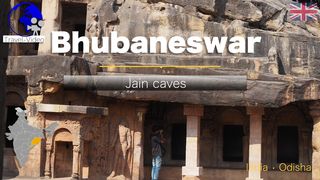
Near Bhubaneswar, the present capital of Odisha, the twin hills of Udayagiri and Khandagiri preserve one of the most important rock-cut archaeological ensembles in eastern India. These excavated caves are associated with early Jainism and reflect a period when religion, royal patronage and artistic expression were closely connected. The site combines carved monuments, natural slopes, panoramic views and a landscape shaped by both geology and human intervention.
This video offers an introduction to the main components of the complex: sculpted cave façades, ascetic chambers, carved reliefs and the broader arrangement of monuments across two neighboring hills. It also shows how architecture and terrain interact, which is essential for understanding this type of sacred site.
The principal spaces and monuments visible
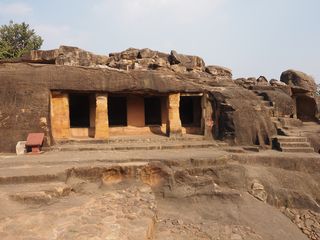
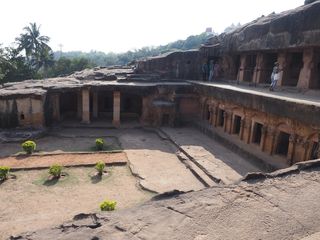
The caves of Udayagiri are among the most celebrated parts of the complex. They include chambers of varying sizes, some arranged on more than one level, with porches, pillars and sheltered interiors. Many were designed as retreats for Jain monks, while some façades were enriched with decorative carving.
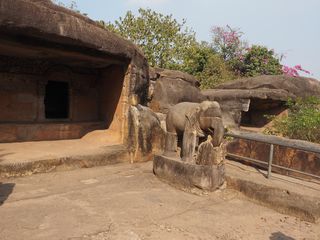
Ganesh Gumpha is one of the most recognizable caves. Its modern name refers to a later association with the deity Ganesh, but the monument belongs to the earlier Jain context of the site. The entrance composition, sculpted panels and balanced façade make it especially significant. It demonstrates how a practical rock shelter could be transformed into an architectural statement with symbolic and artistic value.
The caves of Khandagiri complement the visit by revealing a wider range of excavated spaces. Some are simpler and more austere, while others show decorative ambition. Together, the two hills create the impression of a large monastic and ceremonial landscape rather than a single isolated monument.
Historical, religious and architectural context
The caves are generally dated to the 1st century BCE and are linked to King Kharavela, ruler of ancient Kalinga, the historic region corresponding largely to modern Odisha. Inscriptions connected with the site make it an important source for the political and cultural history of eastern India.
Jainism, one of India’s oldest religious traditions, emphasizes non-violence, self-discipline and spiritual renunciation. Rocky hillsides offered suitable settings for meditation and withdrawal from urban life. Many of the chambers are modest in scale, reminding visitors that their original purpose was practical and religious rather than purely monumental.
Architecturally, Udayagiri and Khandagiri belong to the broader Indian tradition of rock-cut construction. Instead of assembling masonry blocks, builders carved usable spaces directly into stone. This required careful planning, since pillars, entrances, benches and ceilings had to be shaped from the existing rock mass. Decorative sculpture then added prestige and meaning to these functional spaces.
The site also illustrates an early stage in the long history of Indian rock-cut architecture, which later produced more extensive Buddhist, Hindu and Jain cave complexes elsewhere on the subcontinent.
What the videos on this site make especially clear
Videos built from carefully selected and animated photographs are particularly effective for rock-cut monuments. They allow the viewer to observe details that can be missed during a quick visit: worn carvings, surface textures, pillar proportions, stair alignments and the relationship between façades and open terraces.
Transitions between images also help explain spatial organization. The viewer can gradually understand how caves are distributed across the slopes, how some overlook the surrounding plain, and how the two hills function as parts of one coherent sacred landscape.
This format is equally useful for contrasting exteriors and interiors. Sculpted entrances often create a formal public image, while the chambers behind them are more restrained and intimate. Such differences become easier to read through progressive visual sequencing.
A valuable witness to ancient eastern India
The caves of Udayagiri and Khandagiri offer a rare insight into the religious life, political history and artistic skills of ancient Kalinga. They unite Jain spirituality, royal patronage and technical mastery within a distinctive natural setting. This video provides a clear and accessible introduction to the site, while the related detailed pages allow visitors to explore its history, symbolism and architecture in greater depth.







Audio Commentary Transcript
Located on the outskirts of Bhubaneswar, the capital of Odisha, the Udayagiri and Khandagiri caves form a major rock-cut complex associated with Jain tradition. The site was likely in use as early as thethird century before Christ, but most of the caves visible today were excavated under the rule of King Kharavela in the first century before Christ.
Carved into two adjacent hills, the caves reflect intense monastic activity, rituals characteristic of early Jainism, and the emergence of early Indian rock-cut architecture. Some caves include decorative reliefs, inscriptions, or simple architectural elements serving residential or commemorative purposes.
The Udayagiri and Khandagiri caves are carved into two neighbouring hills near Bhubaneswar.
Originally developed as separate monastic sites for Jain ascetics, each group has its own layout and sculptural features.
Although officially distinguished as two separate sites, they form a continuous complex, and this video does not draw a strict division between them.
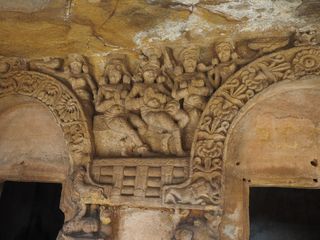
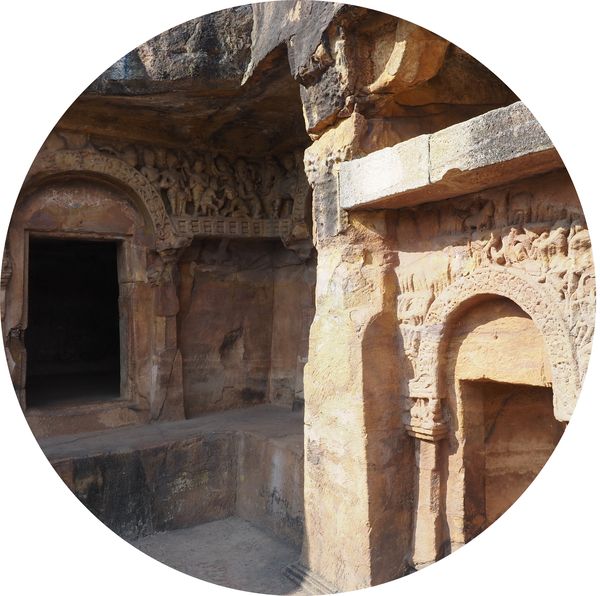
Around the entrances of many caves at Udayagiri, we see sculpted scenes that are unusual in Jain art: dynamic figures, armed men, dancers, and animals.
These reliefs do not depict tirthankaras, but likely illustrate secular or legendary stories.
They may honour patrons, represent moral qualities, or simply reflect the cultural world of their time.
Their presence reminds us that these caves were part of a living environment, shaped by its political and social context.
Ganesh Gumpha is one of the best-known caves at the Udayagiri site.
It is named after a relief of the Hindu god Ganesha, added long after the cave’s original Jain context. This depiction, barely visible from outside, reflects a symbolic reappropriation of the site, likely made several centuries after its excavation.
The façade features a row of relatively simple columns, and two sculpted elephants in the round appear to guard the entrance. These statues do not depict Ganesha, but they enhance the majestic feel of the site.
Inside, the cave consists of a simple monastic cell. Despite its modest layout, the cave has become one of the most photographed on the site due to its guardian elephants and later association with the popular figure of Ganesha.
Music:
- - YouTube video library - Aalaap in Raag Jhinjhoti - Sandeep Das, Adhiraj Chaudhuri
- - YouTube video library - Raag Pilu - Sandeep Das, Adhiraj Chaudhuri, Bivakar Chaudhuri
Disclaimer: Despite its appropriateness, copyright issues prevent the use of indian traditional music in "Bhubaneswar • Udayagiri et Khandagiri Jain caves ", hence the use of royalty-free music. Despite our careful selection, some might regret this decision, which is necessary to avoid potential lawsuits. Although difficult, this decision is the only viable solution.