

 Français (France)
  Nederlands (nl-NL)
 Of Hindu tradition, (with additional Buddhist influence), the Sailodbhava dynasty ruled for approximately 200 years, ± between 550 and 750 over all or part of East India, during the Medieval Period.
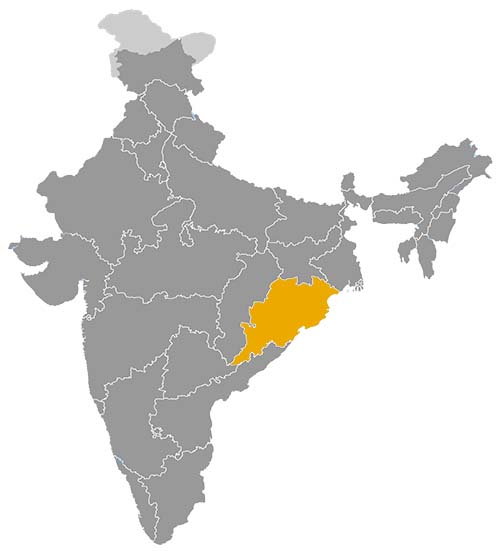
This map illustrates the maximum territory that the Sailodbhava Dynasty had reached at its height, covering the current regions of Odisha in India. Its main purpose is to provide a visual aid to understand the geographical extent of this dynasty. However, it's important to note that the contemporary borders of these regions may not necessarily coincide with the historical territories.
The Sailodbhava Dynasty and Its Role in the History of Eastern India
A Regional Power in Early Medieval Odisha
The Sailodbhava dynasty ruled mainly over Kongoda, a region associated with southern Odisha and parts of the eastern Indian coast, from approximately the sixth to the eighth century. Their political importance lay not in the creation of a vast empire, but in the consolidation of a regional kingdom during a period when imperial authority in northern and central India was fragmented. In this environment, several local dynasties strengthened their positions by controlling agricultural zones, trade routes, religious institutions, and strategic coastal areas.
Kongoda occupied a significant position between the coastal plains of the Bay of Bengal and the inland routes leading toward Kalinga, Utkala, and the Deccan. This location allowed the Sailodbhavas to act as an intermediary power between larger political formations. Their kingdom helped shape the early medieval history of Odisha by providing continuity between earlier regional polities and the later dynasties that would dominate the area more extensively, such as the Bhauma-Karas, Somavamshis, and Eastern Gangas.
Political Authority and Dynastic Legitimacy
The Sailodbhavas developed their authority through a combination of territorial control, royal titles, and religious legitimacy. Their inscriptions suggest that some early rulers may have governed as feudatories or regional chiefs before later members of the dynasty asserted a more independent status. Titles such as maharaja and mahasamanta appear in connection with their rule, while later claims point to a broader aspiration to dominate parts of Kalinga.
The dynasty’s name, often interpreted as meaning “born from the rock” or “mountain-born,” reflects a symbolic construction of origin. Such dynastic narratives were common in early medieval India, where ruling families used mythic or semi-mythic genealogies to strengthen political identity. For the Sailodbhavas, this form of self-representation helped distinguish their lineage from neighbouring houses and reinforced their authority in a region where power was frequently contested.
Politically, the Sailodbhavas had to operate between stronger or competing dynasties. Their history shows phases of dependency, autonomy, and assertion. They were situated near regions influenced by powers from Bengal, Kalinga, Andhra, and the Deccan, which required diplomacy, military strength, and flexible alliances. Their ability to maintain authority across several generations indicates that they were effective regional rulers, even when their influence remained geographically limited.
Cultural and Religious Patronage
The Sailodbhavas are particularly associated with the consolidation of Shaivism in early medieval Odisha. Several rulers appear to have supported religious institutions linked to Shiva, a pattern that would become increasingly important in the religious landscape of the region. Royal patronage of temples, Brahmins, and sacred establishments strengthened the dynasty’s legitimacy while integrating local communities into wider Sanskritic and Brahmanical networks.
This religious policy was also a cultural strategy. By supporting Brahmanical learning and ritual, the Sailodbhavas participated in the spread of Sanskrit political culture in eastern India. Inscriptions, royal titles, land grants, and ritual references show how regional kingship became connected with models of authority shared across much of the subcontinent. The dynasty did not merely govern territory; it helped embed Kongoda within a broader cultural system of royal donation, temple patronage, and ritual prestige.
Although the surviving architectural record from the Sailodbhava period is limited compared with later Odisha dynasties, their patronage contributed to the conditions that allowed temple culture to expand in the region. Later artistic and religious developments in Odisha did not arise in isolation; they were prepared by earlier regional powers that linked kingship, sacred geography, and social organization.
Economic Foundations of Their Rule
The economic base of the Sailodbhava kingdom rested primarily on agriculture, land control, and regional exchange. The coastal and near-coastal zones of southern Odisha provided access to cultivable land, riverine routes, and connections with inland markets. Control over such areas allowed the dynasty to draw revenue from agrarian production while benefiting from movement between the coast and interior.
Land grants were central to the economic and political order of the period. By donating land to Brahmins or religious institutions, Sailodbhava rulers secured alliances with learned and ritual elites while extending their influence into rural society. These grants helped structure local authority, encouraged settlement or cultivation in selected areas, and connected royal power with religious prestige. They also show that the dynasty’s economy was not based only on direct taxation, but on networks of patronage and delegated control.
This system strengthened the relationship between state formation and agrarian expansion. The Sailodbhavas governed through local intermediaries, religious beneficiaries, and regional elites rather than through a highly centralized bureaucracy. Their economic role was therefore characteristic of early medieval Indian polities, where land, ritual status, and political authority were closely linked.
Historical Legacy in Eastern India
The Sailodbhavas occupy a transitional place in the history of Odisha and eastern India. They helped define Kongoda as a politically meaningful region and contributed to the formation of local kingship in the centuries before the rise of larger medieval Odishan dynasties. Their rule demonstrates how regional powers shaped Indian history not by imperial conquest, but by organizing territory, legitimizing authority, and supporting religious institutions.
Their political legacy lies in the stabilization of a strategic coastal and inland zone. Their cultural legacy is connected with the growth of Shaivism, Sanskritic political expression, and Brahmanical patronage. Their economic significance rests on the integration of land grants, agrarian resources, and regional networks into a durable system of rule. Through these combined roles, the Sailodbhavas contributed to the long-term development of Odisha as a distinct political and cultural region within the history of India.
The Geographic Reach of the Sailodbhava Dynasty in Eastern India
A Kingdom Centred on Kongoda in Southern Odisha
The Sailodbhava dynasty ruled primarily over Kongoda, a historical region generally associated with southern Odisha and parts of the eastern coast of India. Their territorial base lay between the coastal plains facing the Bay of Bengal and the inland routes that connected Odisha with Kalinga, Andhra, and the Deccan. This location gave the dynasty access to agricultural land, riverine corridors, and regional exchange networks. The Sailodbhavas did not control a vast empire, but their kingdom occupied a strategic zone within eastern India.
Kongoda was the core of Sailodbhava authority. It probably included areas corresponding to parts of present-day Ganjam and neighbouring districts of Odisha. The region allowed the dynasty to maintain contact with both coastal and inland communities. The coast offered opportunities for exchange and communication, while the hinterland provided access to agricultural resources and routes leading toward the interior. The strength of the Sailodbhavas depended on the ability to manage these linked environments rather than on extensive conquest.
Kongoda within the Wider Space of Kalinga
The Sailodbhava kingdom belonged to the broader historical sphere of Kalinga, a region whose limits changed over time but which occupied a major place along the eastern seaboard of India. Some Sailodbhava rulers used titles suggesting authority over Kalinga or parts of it. These titles indicate political ambition and may reflect periods of expanded influence, but they should not always be read as evidence of continuous control over the entire Kalinga region.
Their effective power was probably strongest in Kongoda and its surrounding zones. From this base, they could influence nearby territories through military pressure, alliances, land grants, and religious patronage. The use of elevated royal titles by later rulers suggests that the dynasty moved from a more limited regional status toward a stronger claim to sovereignty. This development reflects the changing balance of power in eastern India during the early medieval period.
The position of Kongoda made it both valuable and vulnerable. It stood near the meeting point of several political zones: Utkala to the north, Kalinga along the coast, Andhra to the south, and the Deccan to the west. This geography gave the Sailodbhavas room to manoeuvre, but it also exposed them to pressure from neighbouring powers. Their political history can therefore be understood as an attempt to preserve regional autonomy in a landscape of competing dynasties.
Territorial Control through Land Grants and Regional Authority
The geographic reach of the Sailodbhavas is known mainly through inscriptions and genealogical references. These records suggest that their control was not based solely on direct administration from a single capital. Like many early medieval Indian dynasties, they reinforced their territorial authority through land grants to Brahmins and religious institutions. Such grants helped bind rural areas to the ruling house and gave the king a recognized presence in local society.
Land donations also reveal how power operated across the landscape. By assigning villages, fields, or revenue rights to religious beneficiaries, the Sailodbhavas integrated peripheral areas into their political order. These grants created relationships between the court, local elites, religious specialists, and agrarian communities. Through them, the dynasty could extend influence into regions where permanent administrative control may have been limited.
This form of territorial organization was especially suited to a medium-sized regional kingdom. The Sailodbhavas did not need to maintain direct military occupation over every locality. Instead, their authority depended on a network of recognized rights, ritual legitimacy, and local cooperation. Their geographic expansion was therefore dense rather than imperial: it strengthened control over a strategic core and connected surrounding territories through political and religious ties.
Relations with Neighbouring Dynasties
The Sailodbhavas had to manage relations with several neighbouring powers. In the north, other Odishan lineages competed for control over Utkala and the lower Mahanadi region. To the south, dynasties active in Andhra and the southern Kalinga zone could challenge their authority. To the west and southwest, powers from the Deccan influenced the political balance of eastern India. The Sailodbhavas were therefore placed between multiple centres of power rather than isolated within a fixed regional frontier.
Their early rulers may have acted as feudatories or subordinate chiefs under stronger authorities. Later rulers asserted greater independence and used titles that expressed sovereign ambition. This shift suggests that the dynasty’s relations with neighbours changed over time, depending on military strength, succession politics, and the weakness or expansion of surrounding kingdoms. Their territorial claims were thus closely linked to regional diplomacy and conflict.
The strategic value of Kongoda made the Sailodbhavas important even when their kingdom remained limited in size. Control of this region meant influence over coastal movement, inland routes, and agricultural resources. Neighbouring dynasties had reason to seek alliance, submission, or dominance over Kongoda. Conversely, the Sailodbhavas could use their location to negotiate between larger powers and to maintain a degree of political independence.
A Regional Territory within the Formation of Medieval Odisha
The decline of the Sailodbhavas in the eighth century did not erase the regional importance of Kongoda. Their territory became part of the broader political transformations that shaped medieval Odisha. Later dynasties such as the Bhauma-Karas, Somavamshis, and Eastern Gangas inherited an eastern Indian landscape already structured by earlier regional powers. The Sailodbhavas contributed to this process by consolidating authority in southern Odisha and linking the area to wider religious and political networks.
Their geographic legacy lies in the organization of a coastal and inland zone that connected Kalinga, Utkala, Andhra, and the Deccan. They did not create a pan-Indian empire, but they gave political coherence to a region of strategic value. Through their control of Kongoda, their claims over parts of Kalinga, and their interactions with neighbouring dynasties, the Sailodbhavas played a significant role in the territorial history of early medieval eastern India.
The chronology of the Sailodbhavas is based mainly on inscriptions and remains approximate. The early rulers were often regional chiefs or feudatories using titles such as maharaja or mahasamanta, while later kings asserted a more explicit sovereign status. The actual accession of some late members of the dynasty remains uncertain.
- Ranabhita, or Dharmaraja I (c. 553–575 CE) • The first identifiable historical ruler of the line, he governed Kongoda as a regional authority probably dependent on the Vigrahas.
- Madhavaraja I Sainyabhita I (c. 575–600 CE) • He ruled as maharaja and mahasamanta during a phase when the Sailodbhavas still acknowledged external suzerainty.
- Ayashobhita I, or Charamparaja (c. 600–615 CE) • He strengthened Kongoda’s autonomy amid rivalries between neighbouring powers in early Odisha.
- Madhavaraja II Sainyabhita II (c. 620–670 CE) • Initially a feudatory, he later asserted sovereign authority and used the title Sakala-Kalingadhipati, “lord of all Kalinga”.
- Madhyamaraja I Ayashobhita II (c. 670–700 CE) • His reign appears to have been relatively stable; inscriptions associate him with donations and Vedic sacrifices.
- Madhavavarman III, or Madhava (c. 700–705 CE ?, contested reign) • His accession was connected with a succession conflict against Dharmaraja II; his effective power was probably brief and disputed.
- Dharmaraja II Manabhita (c. 705–725/727 CE) • He defeated his brother Madhava and consolidated royal power; his inscriptions give him high sovereign titles such as Maharajadhiraja and Parameshvara.
- Madhyamaraja II Ayashobhita III (c. 725–730 CE ?) • A late successor of the dynasty, he ruled during the weakening of the Kongoda kingdom.
- Allaparaja (first half of the 8th century CE ?, accession uncertain) • A late dynastic member, he is mentioned in the genealogical tradition, but his effective reign is not secure.
- Tailapanibha (first half of the 8th century CE ?, crown prince) • He is known as yuvaraja, or crown prince; his accession to the throne remains uncertain.
- Madhyamaraja III (c. 730–736 CE ?) • The last known representative of the dynasty, he appears in epigraphic traditions before the Sailodbhavas faded before rising regional powers.