

 Français (France)
  Nederlands (nl-NL)
 The Udayagiri and Khandagiri caves are two groups of rock-cut chambers located on adjacent hills in Bhubaneswar, in the Indian state of Odisha. Together, they comprise over thirty caves of archaeological significance, reflecting ancient spiritual practices. Due to their close proximity and historical association, the two sites are frequently presented and visited as a single entity. Their layout dates back to the pre-classical period and illustrates the cultural and religious importance of the region.
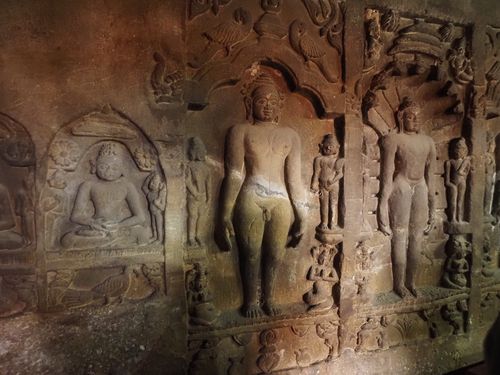
Bhubaneswar • Udayagiri and Khandagiri caves
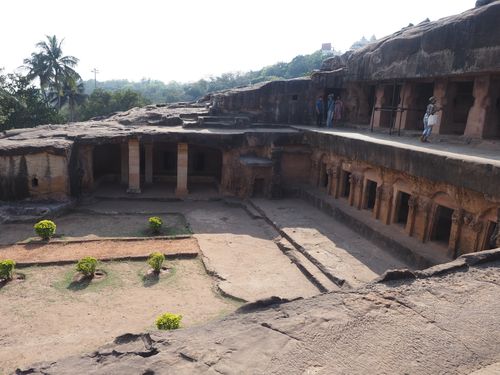
Bhubaneswar • Udayagiri and Khandagiri caves
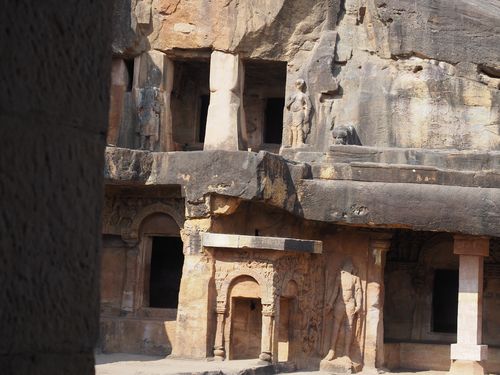
Bhubaneswar • Udayagiri and Khandagiri caves
Monument profile
Udayagiri and Khandagiri caves
Monument category: Rock Sanctuary
Monument family: Rock Sanctuary and Monumental Bas-reliefs
Monument genre: Religious
Cultural heritage: Jain
Geographic location: Bhubaneswar • Odisha • India
Construction period: 1st century BC
• Links to •
• Dynasties that contributed to the construction of the monument •

• This monument illustrates the following theme •
Architecture • Rock-cut monuments : Rock-cut temples and caves in India
• List of videos about Bhubaneswar on this site •
Bhubaneswar • the city of the temples • Odisha
Bhubaneswar • Udayagiri and Khandagiri Jain caves
The Historical Significance of the Udayagiri and Khandagiri Caves: Politics, Religion, and Legacy in Ancient Kalinga
The Udayagiri and Khandagiri Caves, located on two adjoining hills near Bhubaneswar in Odisha, India, are a remarkable example of early Jain monastic architecture. Excavated during the late 2nd to early 1st century BCE, these caves reflect a unique intersection of spiritual devotion, political assertion, and artistic expression. The site bears witness to the ancient kingdom of Kalinga’s resilience and its strategic use of religion and monumentality to assert regional identity.
Political and Social Context of Construction
The creation of the caves is attributed primarily to King Kharavela of the Mahameghavahana dynasty, one of the most notable post-Mauryan rulers of eastern India. Following the devastating conquest of Kalinga by Emperor Ashoka in the 3rd century BCE, the region underwent a period of social and political restructuring. Kharavela’s reign (c. 2nd century BCE) marked a resurgence of indigenous rule and a reassertion of Kalinga’s cultural and political autonomy.
The construction of the caves had multiple motivations:
• Religious patronage: It demonstrated the king’s devotion to Jainism, which had deep roots in eastern India.
• Political legitimacy: Carving monumental structures into the hills symbolized stability, control over the landscape, and cultural sophistication.
• Public welfare and cultural identity: By housing ascetics and encouraging spiritual life, Kharavela projected his rule as dharmic and benevolent.
A key document supporting this interpretation is the Hathigumpha inscription, engraved in Brahmi script in one of the caves. This text is a royal proclamation detailing Kharavela’s military campaigns, civic works, and religious endowments. It emphasizes both his military prowess and his commitment to the Jain community, including the recovery of sacred images looted from Kalinga in earlier centuries.
Major Historical Events Shaping the Site
After Kharavela’s reign, the political landscape of Kalinga experienced various shifts. The site did not witness significant destruction but gradually declined in importance due to changes in dynastic patronage and the regional shift toward Hindu temples in subsequent centuries.
During the medieval period, particularly under the Somavamshi and Eastern Ganga dynasties, Bhubaneswar became a center of Shaivite worship. As a result, Jain institutions were marginalized, and the caves fell into partial neglect. Some caves may have been sporadically reused for ascetic practices, but the organized monastic life they once supported faded.
The rediscovery of the caves by British colonial antiquarians in the 19th century, particularly by James Prinsep and later by Alexander Cunningham, marked a new phase. They deciphered the inscriptions and recognized the architectural and epigraphical value of the site. However, many of the inscriptions had already suffered damage due to erosion and human interference.
Global Historical Context at the Time of Construction
The period in which Udayagiri and Khandagiri were excavated coincides with a broader global phenomenon: the monumentalization of religious and political ideologies. In India, similar efforts can be observed in the Barabar caves in Bihar, created under the Mauryas for the Ajivika sect, and in early Buddhist cave complexes such as those at Bhaja and Karla.
Globally, the late Hellenistic period saw the carving of impressive rock-cut structures such as the facades of Petra in Nabataea and the tombs of Lycian rulers in Anatolia. These reflect a shared desire among ruling elites to use architecture as a means of projecting authority, sacralizing territory, and preserving legacy.
The Udayagiri and Khandagiri Caves stand out within this context as some of the earliest examples of Jain architecture in India, integrating monastic and royal functions into a unified monumental language.
Transformations Over Time
Over the centuries, the site underwent several transformations:
• Functional changes: With the decline of Jain influence in the region, the caves ceased to be active monasteries but retained symbolic significance.
• Structural erosion: Several caves suffered from natural weathering, particularly during the monsoon cycles, which damaged intricate carvings and inscriptions.
• Urban encroachment: The integration of Bhubaneswar into a modern urban center brought roadways and construction near the site, altering its landscape.
Some caves, such as Rani Gumpha, remain relatively well-preserved and continue to be visited, not only for their historical value but also for their scenic positioning and artistic richness. Others are more obscure and in need of conservation.
Role and Cultural Importance Today
In contemporary times, Udayagiri and Khandagiri are recognized as heritage sites of regional and religious importance. They are frequented by local pilgrims, Jain devotees from other parts of India, school groups, and tourists.
The site contributes significantly to the identity of Bhubaneswar, often referred to as the “Temple City,” by offering a glimpse into its pre-Hindu religious landscape. Cultural festivals occasionally include references to Kharavela and the caves, and regional literature continues to cite their legacy.
Their educational value is also important, providing accessible insight into ancient Indian scripts, early stone architecture, and religious pluralism. They represent a cultural bridge between India’s Vedic, Jain, and later Hindu traditions.
Conservation Challenges and Current Status
The caves are under the protection of the Archaeological Survey of India (ASI). Although they benefit from basic preservation efforts, such as fencing, signage, and guided access, several challenges remain:
• Environmental degradation: The sandstone is highly susceptible to weathering, especially due to acid rain and biological growth.
• Urban pressure: Expanding infrastructure in Bhubaneswar has brought noise, pollution, and informal settlements closer to the site.
• Tourism impact: While the site is not overcrowded, unsupervised visitation has led to minor vandalism and graffiti in some areas.
Though not yet recognized as a UNESCO World Heritage Site, the caves have been included on India’s tentative list. This acknowledgment may lead to international funding and greater oversight, provided that management plans address the dual challenge of conservation and public engagement.
The Udayagiri and Khandagiri Caves are more than a religious monument. They are a testament to a civilization’s use of architecture to assert political sovereignty, religious identity, and cultural memory. As one of the earliest surviving examples of Jain monumentalism, the site plays a crucial role in understanding the religious dynamics and artistic expressions of ancient India, while its continued relevance reflects the enduring legacy of the Mahameghavahana dynasty.
Architectural Analysis of the Udayagiri and Khandagiri Caves: Monumental Rock-Cut Expressions in Ancient Odisha
The Udayagiri and Khandagiri Caves, carved into two facing hills near Bhubaneswar in the state of Odisha, India, are among the oldest surviving rock-cut structures in the Indian subcontinent. Dated to the late 2nd to early 1st century BCE, these caves represent one of the earliest and most distinctive forms of Jain religious architecture. Their construction reflects not only a religious imperative but also a complex understanding of structural engineering, material adaptation, spatial organization, and aesthetic synthesis.
Technological and Architectural Innovations
The creation of the caves was achieved through subtractive techniques — carving into the natural sandstone hills from the exterior inward. This required precise planning and sophisticated knowledge of stone stability and sequencing. Excavation was done using chisels, iron picks, and hammers, carefully progressing from the façade to the interior to avoid collapses and preserve alignment. The caves, particularly those of Udayagiri, exhibit tiered platforms, multi-level layouts, and façade articulation that anticipate later developments in rock-cut architecture in western India.
Notably, the caves integrate natural ventilation and lighting through small apertures and perforated stonework, allowing diffused daylight to illuminate the interiors while minimizing thermal load. These design elements are not only functional but also demonstrate an early environmental responsiveness. The spatial sequencing — from open courtyards to enclosed cells — shows an understanding of monastic needs, with areas for meditation, teaching, and communal rituals.
The layout of the two hills differs: Udayagiri features a more formal and monumental layout with symmetrical alignment, while Khandagiri is more irregular, reflecting either a different phase of construction or simpler functional needs. The ability to adapt rock faces into usable, durable structures with complex forms marks a technological innovation in the period’s architectural practices.
Materials and Methods of Construction
The caves were carved into local coarse-grained sandstone, chosen for its relative softness during quarrying and its durability when exposed to air. This stone allowed intricate detailing without the brittleness of harder materials and has withstood centuries of exposure, albeit with some erosion.
No additional binding or construction material was used; everything — columns, beams, walls, ceilings — was sculpted from a continuous mass of rock. This not only ensured stability but allowed integrated artistic embellishment. The construction was a unified process of architecture and sculpture, unlike built temples where the structural and decorative elements are distinct.
Structural stability was achieved by leaving stone ribs and load-bearing pillars within the rock mass. Flat ceilings were avoided in favor of slightly curved or sloped roofs to distribute weight, and in some cases, grooved channels were carved to direct rainwater away from entrances.
The vertical and horizontal alignment of rooms, especially in Rani Gumpha and Hathi Gumpha, required precise surveying — suggesting the use of basic geometric tools and string lines, possibly wooden templates, to achieve proportion and alignment.
Architectural and Artistic Influences
While the caves are unmistakably rooted in Jain religious tradition, their architectural language draws from broader Indian artistic currents. Elements such as pillared verandas, multi-tiered façades, and decorative friezes show parallels with Mauryan and early Shunga architecture.
The presence of arched doorways, semi-circular niches, and lotus medallions in some cave carvings reflects stylistic motifs seen in earlier Buddhist caves at Barabar, though executed with greater elaboration. The decorative vocabulary includes motifs such as lions, elephants, dancers, musicians, and geometric borders — merging symbolism, narrative, and aesthetics.
In Rani Gumpha, processional panels depicting courtly and religious scenes suggest a strong narrative element. These carvings reflect a shift from purely symbolic forms to figurative and dynamic representations, rare in Jain religious spaces at the time. Such integration of secular imagery into a religious context implies a sophisticated patronage and a regional taste for expressive visual culture.
The use of horizontal registers, stylized floral bands, and framed panels may also show indirect influences from Hellenistic design conventions, brought to India via Gandhara and trade connections, although adapted to a local idiom.
Organization and Structural Features
Across the two hills, a total of 33 caves have been identified — 18 in Udayagiri and 15 in Khandagiri — though not all are equally preserved. The caves vary in complexity:
• Simple monastic cells with a single chamber and entrance.
• Elaborate multi-roomed layouts with sculpted porticos, internal courtyards, and staircases.
• Elevated caves with stone terraces or platforms for ritual or public gatherings.
Rani Gumpha, the largest and most architecturally sophisticated cave, has two stories. Its upper level features a colonnaded veranda with detailed friezes, while the lower level includes multiple cells and open spaces for communal activity. Its name, meaning “Queen’s Cave,” may derive from the richness of its decoration, although there is no historical evidence of royal residency.
Hathi Gumpha is significant primarily for its epigraphic content rather than architectural complexity, though its semi-circular vaulted ceiling and massive scale make it structurally unique.
Other notable features include carved balustrades, ornamental door frames, and pillars with square or octagonal sections, all shaped directly from the living rock. In several caves, remnants of stone benches and recessed niches suggest functional uses for reading, prayer, or storage.
Dimensions and Notable Facts
• Rani Gumpha spans approximately 30 meters in length and contains over ten chambers across its two levels.
• Hathi Gumpha measures around 6.5 meters deep, and its inscription consists of 17 lines in early Brahmi script.
• The caves’ heights vary, with some chambers reaching over 3 meters in interior elevation.
A curious fact about the site is the misinterpretation of Kharavela’s inscriptions by early British scholars due to weathering. It took over a century for a scholarly consensus to emerge on the king’s achievements and the accurate reading of the Hathigumpha inscription.
There are also local legends associating certain caves with Jain monks performing miracles, and some contemporary visitors believe the caves hold spiritual energies, contributing to their continued ritual visitation.
Recognition and Conservation Challenges
The Udayagiri and Khandagiri Caves are protected by the Archaeological Survey of India (ASI). While they are not currently UNESCO World Heritage Sites, they are on India’s tentative list. The site’s architectural uniqueness and antiquity have made it a subject of national heritage campaigns.
Conservation issues include:
• Erosion of sandstone surfaces due to monsoons and air pollution.
• Encroachment by urban infrastructure, including roads and buildings that disrupt the historic ambiance.
• Inadequate signage and visitor control, leading to wear from foot traffic and occasional vandalism.
Restoration efforts have involved rock surface consolidation, fencing of fragile zones, and digital documentation. However, given the scale and importance of the site, greater resources are necessary to ensure long-term protection.
The Udayagiri and Khandagiri Caves offer an invaluable architectural record of India’s early rock-cut traditions. Their integration of sculptural finesse, functional monastic design, and environmental sensitivity anticipates later developments in Indian temple architecture. As artifacts of spiritual devotion, royal patronage, and artistic experimentation, they stand among the most important early architectural achievements in South Asia.